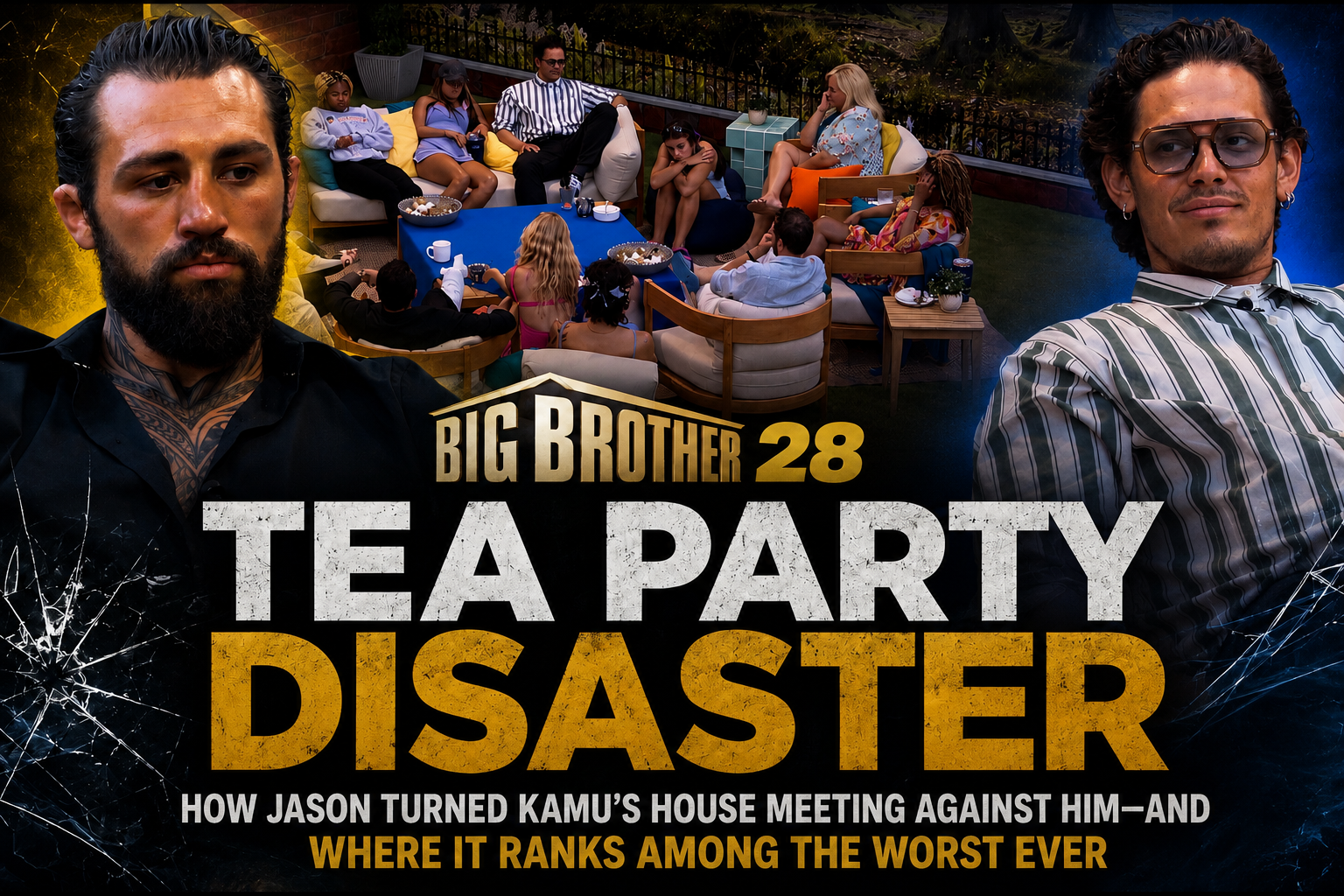

Big Brother 28 Episode 11 gave Kamu the replacement nomination he wanted while showing exactly why his first Head of Household reign may have done more damage to his own game than Jason’s.
Lyric won the Power of Veto, removed herself from the block and opened the seat Kamu needed to nominate Jason beside LaTrice and Mallory. The mechanical part of Kamu’s plan worked. Jason lost the Veto, Lyric saved herself and Kamu completed the replacement nomination he had been planning since the beginning of the week.
Everything surrounding that plan became an unnecessary disaster.
Kamu did not simply nominate Jason and allow the house to vote. He rehearsed a speech, hijacked Mallory’s tea party and attempted to publicly expose Jason for making contradictory promises about the Veto. Kamu wanted Jason embarrassed, isolated and unable to answer the accusations in front of the entire house.
Jason was ready.
He admitted that he was scrambling to save himself, challenged Kamu’s claim that the confrontation was about honesty and identified the majority structure controlling the house. Jason named himself, Mallory, Melody, Taylor, Yash and LaTrice as the people left outside that protection. He also called out Drew and Barrett as the middlemen benefiting from both sides.
Kamu wanted to prove Jason was playing a messy game.
Jason never needed to deny that.
He argued that he was playing Big Brother because he knew Kamu was attempting to backdoor him. More importantly, he exposed that Kamu’s speech was not the reason for Jason’s nomination. Kamu had already decided to target Jason before the conflicting Veto promises became public.
Jason’s gameplay remained reckless. He made too many promises, shared too much information and approached people who immediately compared notes. He gave Kamu legitimate ammunition.
That still did not make Kamu’s tea-party performance a good move.
Jason clearly won the argument. Kamu left the confrontation looking rehearsed, self-important and completely unprepared for Jason to respond. The rest of the house spent most of the confrontation sitting in uncomfortable silence. LaTrice repeatedly challenged Kamu’s reasoning, Taylor eventually left because she only wanted to drink tea and eat a damn sandwich, and Mallory watched her dream event become another public spectacle.
Kamu still placed Jason on the block.
Jason still has the BB Lackluster.
If Jason wins Thursday, Kamu will have publicly declared war on someone he failed to evict.
That is not control.
That is turning a straightforward nomination into a problem that could survive longer than the Head of Household reign that created it.
Big Brother 28 Episode 11 Quick Rundown
- The episode continued after Kamu nominated LaTrice, Lyric and Mallory.
- Lyric remained upset because Kamu had given her reason to believe she would be safe.
- Mallory confronted Kamu about returning to the block.
- Kamu confirmed that Jason was the primary target and Mallory was the backup.
- Lyric and Mallory shared an emotional conversation and focused on winning the Veto.
- The episode continued exploring the possibility of a Barrett and Dee connection.
- Rick attempted to keep his Diamond Power of Veto secret.
- Dee continued protecting Rick’s secret while Angela remained uninformed.
- Drew became suspicious that Jason might possess the hidden Time Capsule power.
- Jason correctly recognized that Kamu was attempting to repeat the plan previously used against Rome Seymour.
- Jason approached the nominees and offered to use the Veto on whoever selected him.
- LaTrice used Houseguest’s Choice to select Jason.
- Haley was also selected to compete.
- Kamu, LaTrice, Lyric, Mallory, Jason and Haley competed in a pickle-themed variation of Bowlerina.
- Mallory defeated LaTrice.
- Kamu eliminated Jason.
- Lyric defeated Haley.
- Mallory eliminated Kamu.
- Lyric defeated Mallory in the final round and won the Power of Veto.
- Jason attempted to turn Dee against Kamu, Chuk and Haley.
- Jason then warned Chuk about Dee, Rick and Angela.
- Dee and Chuk compared notes and recognized that Jason was throwing information in multiple directions.
- Kamu learned that Jason had made overlapping Veto promises.
- Kamu rehearsed a public speech before Mallory’s tea party.
- Mallory prepared food, decorations and Have-Not-friendly snacks for the house.
- Drew and Barrett wore dresses to the tea party.
- Kamu interrupted the event to confront Jason.
- Jason defended his actions as necessary self-preservation.
- Jason identified the house’s majority structure and named the outsiders being excluded.
- Jason called Drew and Barrett the middlemen between both sides.
- LaTrice repeatedly challenged Kamu’s reasoning.
- Angela attempted to support Kamu’s argument.
- Taylor became exhausted by the confrontation and left because she only wanted tea and a sandwich.
- Jason asked Rick directly whether he possessed the hidden Time Capsule power.
- Rick denied having it.
- Jason continued his campaign by banging a tea kettle with a wooden spoon.
- Jason interrupted conversations and followed Kamu around with the kettle.
- Kamu insisted the psychological warfare was not bothering him.
- Kamu referred to Jason as his “Zesty Bestie,” one of the episode’s most ridiculous lines.
- Lyric used the Power of Veto on herself.
- Kamu nominated Jason as the replacement nominee.
- Jason, LaTrice and Mallory became the final three nominees heading into Thursday’s BB Lackluster and eviction.
Kamu’s Nomination Fallout Confirmed Lyric Had Every Reason to Feel Betrayed
Episode 11 began with Lyric still processing her nomination.
Kamu had given her reason to believe she would be safe after Rome’s eviction. Lyric voted with the house, lost her closest ally and entered the new week expecting the cooperation to earn her at least temporary protection.
Kamu nominated her anyway.
He then attempted to calm Lyric by explaining that Jason was the actual target and that he never wanted to blindside her.
That explanation did not make sense.
Lyric was blindsided.
Kamu did not need to lie to her before nominations. He could have said he was considering every available option. He could have warned her that she might become a pawn. He could have explained that he needed three nominees to create the replacement-nomination plan.
Instead, he gave Lyric an expectation of safety and violated it almost immediately.
There is nothing wrong with lying in Big Brother. The entire game depends on deception, incomplete information and promises that may eventually need to be broken.
The problem is lying without gaining anything meaningful from it.
Jason already suspected he was the target. Lyric knowing she might be nominated would not have prevented Kamu from making the nominations. The majority already supported the plan.
Kamu damaged his credibility for no real strategic return.
Lyric may continue working with him because she has limited options. That should not be confused with trust.
A person can vote with an alliance without feeling protected by it.
Kamu showed Lyric that his reassurance only lasts until he decides it is inconvenient.
Grade: D+
What Worked
- Kamu maintained control of the initial nominations.
- Lyric remained less likely to leave than Jason.
- The nomination created a possible opening for the replacement plan.
- Kamu’s majority supported Jason becoming the target.
- Lyric remained motivated to win the Veto.
What Did Not Work
- Kamu contradicted the impression he had given Lyric.
- The lie provided no meaningful strategic benefit.
- Lyric gained a legitimate reason to distrust him.
- Kamu made an emotional situation more difficult than necessary.
- Other Houseguests now have evidence that his promises may be disposable.
- Jason recognized the backdoor plan without Lyric needing to expose it.
Mallory Learned Again That Being Called a Pawn Does Not Make Someone Safe
Mallory was equally frustrated about returning to the block.
She had already been nominated during Dee’s first Head of Household reign and needed the Power of Veto to guarantee her safety. Less than two weeks later, Kamu used her as another disposable nomination.
Kamu assured Mallory that Jason was the real target.
What he did not openly emphasize was that Mallory remained his backup.
If Jason avoided the block, won the BB Lackluster or survived the vote, Mallory could leave despite entering the week as a supposed pawn.
That is the problem with Kamu’s reassurance.
A pawn can still be evicted.
A pawn can lose the Veto.
A pawn can lose the BB Lackluster.
A pawn can become the target when the original plan fails.
Mallory correctly understood that the word itself offered no protection.
Her larger problem is that she remains socially connected without being structurally protected. She has relationships with Lyric, Melody, Drew and Barrett, but none of those connections prevented Kamu from nominating her.
Being liked is not the same as being defended.
Mallory’s frustration was not entitlement.
She was recognizing that the dominant alliance considers her one of the easiest people to risk whenever it needs a placeholder.
Grade: B- for recognizing her position
What Worked
- Mallory understood that she remained in real danger.
- She confronted Kamu instead of blindly accepting the pawn explanation.
- Her relationship with Lyric continued becoming stronger.
- She correctly recognized that the same outsiders keep touching the block.
- Kamu gave her confirmation that Jason was the primary target.
What Did Not Work
- Mallory still lacked enough protection to avoid another nomination.
- Her relationships did not become votes or veto commitments before the ceremony.
- She remained Kamu’s backup target.
- Her game again depended on winning a competition or surviving beside a larger target.
- She had no reliable alliance capable of punishing Kamu for nominating her.
Lyric and Mallory’s Emotional Conversation Had More Value Than Another Rome Flashback
Lyric and Mallory shared one of the episode’s most sincere scenes.
Lyric was still dealing with losing Rome Seymour, but the emotion was not only about the showmance. She had lost the person most visibly committed to protecting her and immediately found herself endangered by someone who had implied she was safe.
Mallory was also vulnerable.
Both women had been placed on the block by a majority that considered them replaceable. Their conversation showed a real relationship forming between two people who recognized that they could lose each other before the week ended.
The scene worked because it was not simply another extension of Lyric’s showmance storyline.
Lyric and Mallory needed to focus on themselves.
Rome’s game was over.
Lyric’s game was not.
The episode still spent too much time using Rome’s memory-wall picture and Lyric’s sadness to keep the showmance alive after his eviction. Rome continued receiving more attention than several Houseguests who were still actively playing.
Chuk, Yash and Haley barely existed outside the scenes where the episode required them.
The emotional material mattered, but the edit needed a better balance.
Lyric missing Rome was part of the story.
Lyric recognizing that the majority still considered her expendable was the more important part.
Grade: B
What Worked
- Lyric and Mallory’s relationship received meaningful development.
- The scene gave both nominees emotional depth.
- Lyric began moving beyond being only one half of a showmance.
- Mallory showed genuine concern for Lyric.
- Their conversation gave Lyric’s eventual Veto victory stronger payoff.
What Did Not Work
- The episode continued leaning too heavily on Rome after his eviction.
- The conversation did not become a concrete strategic plan.
- Lyric still appeared too willing to accept verbal reassurance.
- Mallory and Lyric remained isolated from dependable numbers.
- Several current Houseguests continued receiving almost no storyline.
The Barrett and Dee Segment Felt More Like the Show Searching for Another Showmance
With Rome gone, the episode briefly attempted to create romantic speculation around Barrett and Dee.
There may be personal chemistry between them.
That does not automatically make it a showmance.
The segment felt like production looking for a replacement storyline rather than documenting a developed relationship. Barrett and Dee are comfortable around each other, and their connection could eventually become strategically important, but the episode did not show enough to make the romantic framing feel necessary.
The more useful takeaway involved Barrett’s position.
He is close to Drew.
He is connected to the Toolshed.
He has a relationship with Dee.
He remains largely protected while attracting little direct attention.
That is far more strategically important than whether the show can attach another romance label to the season.
Grade: C+
What Worked
- The scene gave Barrett additional personality.
- Barrett and Dee’s comfort level may become strategically relevant.
- It provided a lighter moment before the competition.
- Their relationship could create another layer inside the majority.
What Did Not Work
- The romantic framing felt premature.
- The episode appeared eager to replace the evicted showmance.
- Barrett’s actual strategic position deserved more attention.
- Dee’s relationships are important without needing to become romantic.
- The segment added little to the central storyline.
Rick’s Diamond Power of Veto Was Not New, but the Suspicion Around It Mattered
Rick’s Diamond Power of Veto had already been revealed during Sunday’s episode.
Episode 11 focused on the aftermath.
Rick knew that the power could become dangerous if the house identified him as the winner. He had already won Head of Household and the Power of Veto during the previous week. Another major advantage would make him look even more protected and capable.
His attempt to hide the secret was logical.
His performance was not convincing.
Rick argued that America would have no reason to give him another advantage after he had already won two competitions. That explanation was reasonable, but his visible discomfort whenever the subject appeared made him look like someone actively trying not to look suspicious.
Dee continued helping him protect the secret.
Angela remained outside the information.
Angela attempted to rationalize the situation by believing Rick might be keeping the secret from her to avoid burdening her. That interpretation protected Rick in the immediate term, but it ignored the real information hierarchy.
Rick trusted Dee.
Dee knew the power.
Angela did not.
The Plants may present themselves as a three-person unit, but the information is not moving equally.
Rick has the advantage.
Dee has the knowledge.
Angela has reassurance.
That difference could eventually fracture the group.
Rick’s Grade: A- for gaining the power, C for hiding it
What Worked
- Rick retained one of the strongest hidden advantages in the game.
- Dee continued protecting the secret.
- Suspicion began moving toward Jason.
- Rick remained outside Kamu’s nominations.
- The power gives him protection if the majority turns on him.
- Angela did not confront him directly.
What Did Not Work
- Rick appeared visibly uncomfortable discussing the power.
- His repeated denials risked drawing additional attention.
- Angela could feel betrayed when she learns Dee knew.
- The power further increases Rick’s threat level.
- Telling Dee gives her leverage over him.
Drew Suspecting Jason Had the Power Only Made Jason Look More Dangerous
Drew began considering whether Jason possessed the secret Time Capsule power.
That suspicion fit the majority’s existing perception of Jason.
Jason was already viewed as unpredictable, messy and dangerous. Believing America had given him another hidden advantage made it easier for the house to justify targeting him.
Drew warned Kamu that attempting the backdoor could be risky if Jason had a power.
Kamu rejected the fear and argued that nominating Jason could at least force the advantage into the open.
Kamu was correct about that part.
As Head of Household, Kamu could not become the replacement nominee. If Jason possessed a nomination-altering power, forcing him to use it while Kamu was immune would have been one of the safest available options.
Drew’s warning therefore protected him regardless of the result.
If Kamu nominated Jason and the move worked, Drew had supported the original backdoor plan.
If Jason revealed a power, Drew could say he warned Kamu.
If Kamu changed direction, Drew could claim he prevented a disaster.
Drew continues positioning himself close enough to influence every decision without becoming completely responsible for any of them.
That remains one of the strongest games in the house.
It is also becoming easier to notice.
Jason Correctly Recognized That Kamu Was Repeating the Rome Plan
Jason understood what was happening almost immediately.
He compared Kamu’s nominations to the strategy Rick used against Rome.
The Head of Household nominated people around the real target.
The target was supposed to remain outside the Veto competition.
The Veto would create an open seat.
The target would become the replacement nominee.
The BB Lackluster would decide whether the plan actually worked.
Jason was correct.
The target changed from Rome to Jason.
The structure remained almost identical.
Jason’s ability to identify danger is one of the strongest parts of his game. He notices unusual behavior, recognizes inconsistencies and understands when the official explanation does not match the available evidence.
His problem begins after the realization.
Jason cannot hold information.
He does not quietly prepare three controlled options.
He tells people what he has discovered, names the players he suspects and attempts to force movement before confirming who can be trusted.
Jason understood the backdoor.
He then reminded the house why it considered him dangerous.
Jason’s Read: A
Jason’s Execution: C-
What Worked
- Jason identified the plan before the Veto draw.
- He recognized that the majority was repeating the previous week.
- He understood that entering the Veto was his best chance of safety.
- He began working before Kamu could complete the replacement nomination.
- His analysis of the house structure was largely correct.
What Did Not Work
- Jason discussed the plan with too many people.
- He exposed his own target list.
- He approached players connected to the majority.
- His urgency became additional evidence of his threat level.
- He continued confusing accurate reads with protected information.
Jason’s Original Veto Pitch Was Logical
Jason approached the nominees and offered a straightforward deal.
If one of them selected him through Houseguest’s Choice and he won, he would use the Veto on that person.
That was a reasonable offer.
Jason needed to play.
The nominees needed someone willing to use the Veto.
Both sides had something to gain.
LaTrice accepted the proposal and selected him.
At that point, Jason’s obligation should have been clear. If he won, he should use the Veto on LaTrice because she gave him the opportunity to compete.
The problem was that Jason had already made another agreement with Kamu.
Before the nominations, Kamu had asked Jason whether he would allow Kamu to decide how the Veto was used if Kamu kept him off the initial block and Jason was later selected to play.
Jason agreed.
That deal was terrible for Jason.
Kamu’s entire plan depended on keeping Jason away from the Veto and nominating him afterward. Following Kamu’s instructions would have required Jason to cooperate with a strategy designed to evict him.
Jason had no strategic reason to honor it once he realized he was the target.
However, he should not have agreed to it in the first place.
Jason then complicated everything further by giving multiple nominees the impression that he would save them.
The original Houseguest’s Choice pitch made sense.
The overlapping commitments did not.
Grade: C+
What Worked
- Jason created a legitimate reason for a nominee to select him.
- LaTrice benefited from choosing someone willing to save her.
- Jason increased his odds of entering the competition.
- The pitch directly threatened Kamu’s backdoor plan.
- Jason correctly prioritized his survival over Kamu’s instructions.
What Did Not Work
- Jason had already shaken hands on a contradictory agreement with Kamu.
- He made more promises than he could satisfy.
- He gave the majority evidence that he was playing every direction.
- His commitments became easy to expose publicly.
- He failed to control who knew about each deal.
LaTrice Selecting Jason Was the Right Decision
LaTrice made the strongest available choice.
Jason had offered to save the nominee who selected him. Choosing someone aligned with Kamu would have increased the likelihood that the Veto remained unused or followed the Head of Household’s preferred plan.
Jason had a direct reason to disrupt Kamu’s week.
If Jason won and used the Veto on LaTrice, Kamu could not nominate him because the Veto holder would be safe. Kamu would need to select another replacement nominee.
LaTrice chose the person whose interests aligned most closely with hers.
The decision did not work because Jason lost.
That does not make the choice wrong.
Good decisions can produce bad results.
Grade: A-
What Worked
- Jason had promised to protect the person who selected him.
- His victory would have disrupted Kamu’s plan.
- LaTrice prioritized her game over the Head of Household’s wishes.
- She created the best chance for the Veto to be used on her.
- The selection gave an outsider meaningful competition power.
What Did Not Work
- Jason failed to win.
- His overlapping promises created additional distrust.
- LaTrice remained dependent on someone outside her closest relationships.
- The decision reinforced her association with Kamu’s target.
- She remained on the block after the ceremony.
The Veto Competition Delivered a Clear Story Without Needing So Much Airtime
The Power of Veto competition was a pickle-themed variation of the familiar dizzy ballerina format.
The players competed head-to-head. They spun until dizzy, attempted to roll balls into scoring positions and needed the higher total to advance.
Mallory defeated LaTrice in the opening round.
Mallory selected Jason as the next player.
Jason chose Kamu as his opponent.
Kamu eliminated Jason, restoring the backdoor plan.
Lyric defeated Haley.
Mallory then eliminated Kamu.
That created a final round between Lyric and Mallory, with Lyric winning the Power of Veto.
The competition worked because every matchup carried strategic consequences.
Jason against Kamu was the most important round. Jason needed the Veto to guarantee his safety and potentially destroy the replacement-nomination plan. Kamu needed Jason eliminated so Lyric or another nominee could create the open seat.
Kamu won that battle.
Lyric won the competition.
The pickle theme was ridiculous without making the rules impossible to follow. Kamu discussing a serious backdoor plan while dressed for a dizzy ballerina competition captured the absurdity of the week perfectly.
The segment still lasted too long.
Episode 11 had a major public confrontation, Jason’s post-tea-party campaign and a Veto ceremony to cover. The repeated competition explanations and attempts consumed time that could have been used on more of the tea party or the strategic fallout.
Competition Grade: B
What Worked
- The head-to-head structure created immediate stakes.
- Jason and Kamu faced each other directly.
- Mallory performed strongly.
- Lyric earned the win rather than receiving it through chance.
- The competition balanced coordination, balance and accuracy.
- The pickle presentation was memorable.
- Kamu eliminating Jason temporarily restored his plan.
What Did Not Work
- The segment ran longer than necessary.
- The rules were explained repeatedly.
- Several attempts added little after the result became obvious.
- The extra competition time compressed the tea-party fallout.
- The theme threatened to overpower the strategy.
Lyric Winning the Veto Was the Cleanest Success of the Episode
Lyric entered the competition needing to protect herself.
Kamu called her a pawn, but that label did not guarantee anything. Lyric would still face the BB Lackluster and possible eviction if she remained nominated.
She removed all uncertainty by winning.
The victory mattered beyond the immediate week.
Lyric had been presented primarily through her relationship with Rome. Her emotional scenes, strategic position and visibility often revolved around the showmance.
This win belonged entirely to her.
Rome did not save her.
Kamu did not protect her.
The majority did not decide to spare her.
Lyric won the competition and removed herself.
That made her the episode’s most successful player.
The next question is whether she understands what the nomination revealed.
Lyric should not leave this week believing Kamu’s plan protected her. Kamu placed her in danger. She survived because she performed under pressure.
She now needs to convert that victory into leverage.
Winning a Veto saves someone for one week.
Using the win to rebuild relationships can change the rest of the game.
Grade: A-
What Worked
- Lyric won while facing real danger.
- She guaranteed her safety.
- She earned her first individual competition victory.
- She began separating her game from Rome.
- She prevented Kamu from controlling her immediate fate.
- She remained eligible to compete for the next Head of Household.
What Did Not Work
- She was forced to win because Kamu had nominated her.
- Mallory and LaTrice remained vulnerable.
- Her alliance position did not automatically improve.
- She may still place too much value on Kamu’s reassurance.
- She needs to turn the victory into something larger than survival.
Lyric’s Win Was Also the Best Possible Outcome for Kamu
Kamu did not win the Veto.
He still received the result he needed.
Lyric was always going to save herself.
Jason winning would have destroyed the plan.
A LaTrice victory would have forced Kamu to nominate Jason while leaving Lyric and Mallory exposed.
A Mallory victory would have created a similar decision.
A Haley victory would have required Kamu to convince an ally to use the Veto.
Lyric removed every complication.
She would save herself.
The seat would open.
Kamu could nominate Jason.
That was good fortune for Kamu, not proof that he controlled the competition.
Kamu spent the remainder of the episode treating the result like confirmation that his entire plan was working.
The Veto result worked.
His social execution did not.
Jason’s Attempts to Split the Majority Were Correct in Theory and Terrible in Practice
After losing the Veto, Jason knew the replacement nomination was coming.
He attempted to create conflict inside the majority before the ceremony.
Jason approached Dee and warned her about Kamu, Chuk and Haley.
He then approached Chuk and warned him about Dee, Rick and Angela.
The underlying idea made sense.
Jason needed the majority to fracture.
He needed people inside the structure to become afraid of one another.
He needed a reason for the vote to change if he lost the BB Lackluster.
The execution was far too obvious.
Dee and Chuk compared notes.
They immediately understood that Jason was giving each side a different version of the same warning.
Jason did not create distrust between them.
He created shared distrust toward himself.
This was another example of Jason seeing the correct strategic destination and taking the most visible route possible.
The majority contains cracks.
The Plants are withholding information from Angela.
Drew is positioned between multiple groups.
Kamu is increasingly disposable.
Chuk and Haley do not benefit equally from the alliance.
Jason could have exploited those problems.
He needed patience and precision.
Instead, he delivered competing warnings to people who were always likely to speak with one another.
Grade: D+
What Worked
- Jason correctly recognized that the majority needed to fracture.
- He identified real divisions inside the structure.
- He continued playing after losing the Veto.
- His warnings were not entirely inaccurate.
- He attempted to give people reasons to reconsider Kamu’s plan.
What Did Not Work
- Dee and Chuk immediately compared notes.
- Jason’s different pitches exposed his desperation.
- He strengthened their trust in each other.
- The conversations gave Kamu additional material.
- Jason made the majority feel justified in targeting him.
- His approach lacked subtlety or follow-through.
Kamu Learning About the Veto Promises Gave Him Ammunition, Not a New Target
Kamu learned that Jason had made multiple promises about how he would use the Power of Veto.
That information was valuable.
It allowed Kamu to prove that Jason was offering different outcomes to different people.
It did not cause Kamu to target Jason.
Jason was already the target.
Kamu had already designed the nominations around a Jason backdoor.
Jason had already identified the plan.
The difference matters.
Kamu later presented the Veto promises as though they forced him to reconsider Jason’s trustworthiness. In reality, they gave him a cleaner public explanation for a decision he had already made.
The actual chronology was straightforward:
Kamu planned to backdoor Jason.
Kamu offered Jason a one-sided Veto agreement.
Jason recognized the backdoor.
Jason offered protection to the nominees so someone would select him.
LaTrice selected Jason.
Jason made overlapping commitments.
Jason lost the Veto.
Kamu learned about the promises.
Kamu used them to justify a plan already in motion.
Jason’s promises were sloppy.
Kamu’s public framing was dishonest.
Both can be true.
Kamu Rehearsing His Speech Made the Tea Party Look Even Worse
Kamu did not lose control during the tea party because he became emotional in the moment.
He planned the confrontation.
He rehearsed his speech.
He practiced his delivery in the Head of Household room.
He wore black and prepared to turn Mallory’s event into a public exposure ceremony.
The episode’s editing was excellent during this sequence.
Mallory excitedly prepared decorations, snacks and tea while Kamu paced upstairs practicing his takedown. The contrast told the entire story before the confrontation began.
Mallory believed she was creating a fun memory.
Kamu believed he was preparing the season’s defining game move.
One of them was right about creating memorable television.
It was not Kamu for the reason he expected.
The rehearsal showed that Kamu wanted more than information shared.
He wanted a performance.
He wanted an audience.
He wanted Jason stunned.
He wanted the rest of the house to watch him control the room.
Jason was not required to follow Kamu’s script.
Once Jason responded, Kamu had no second act.
Grade for Planning the Ambush: F
What Worked
- Kamu gathered the information he wanted to expose.
- He prepared the opening of the confrontation.
- The house learned about Jason’s overlapping promises.
- His existing allies received another reason to support the nomination.
- The scene produced excellent television.
What Did Not Work
- The entire confrontation was unnecessary.
- Kamu hijacked Mallory’s event.
- He gave Jason a public platform.
- He exposed the majority structure.
- He made the move appear personal.
- He had no effective response when Jason challenged him.
- He created no new votes.
- He turned himself into a larger target.
- Jason remained capable of surviving through the BB Lackluster.
Mallory’s Tea Party Was a Dream Come True Until Kamu Made It About Himself
Mallory wanted to host a real tea party inside the Big Brother house.
She prepared the table.
The Houseguests dressed up.
Drew and Barrett wore dresses.
The group made snacks, including food the Have-Nots could eat.
Mallory looked genuinely happy.
She called the moment a dream come true.
Kamu let her believe the event would remain hers before using it as the setting for his planned confrontation.
That was one of the worst parts of the decision.
Mallory was already nominated.
She had lost the Veto.
She remained Kamu’s backup target.
The one event she created for the house became another extension of his obsession with Jason.
Kamu could have confronted Jason privately.
He could have addressed the issue at the Veto ceremony.
He could have gathered the people involved in the promises.
He could have done nothing and nominated Jason exactly as planned.
He chose Mallory’s tea party because it guaranteed the largest possible audience.
That made the decision less about protecting his game and more about controlling the show.
Kamu’s Deal With Jason Was Never Fair
Kamu explained the agreement he had made with Jason before nominations.
Kamu would leave Jason off the initial block.
If Jason was selected for the Veto and won, Jason would allow Kamu to decide how the Veto was used.
Jason agreed and shook his hand.
Kamu presented the agreement as proof that Jason had betrayed him.
The agreement was one-sided from the beginning.
Kamu was leaving Jason off the initial block because he wanted to prevent Jason from competing. His plan was to place Jason on the block after the Veto.
Jason received no meaningful protection.
He received a temporary delay before Kamu attempted to remove him.
Following Kamu’s instructions would have required Jason to assist his own backdoor.
That was never realistic.
Jason should not have agreed to the deal. Making an agreement he had no intention of honoring damaged his credibility and gave Kamu something legitimate to expose.
However, Kamu also had no reason to expect Jason to sacrifice his game once the backdoor became obvious.
Kamu wanted obedience disguised as trust.
That is not a balanced agreement.
Jason Did Not Deny Being Messy Because He Did Not Need To
Jason’s best decision during the confrontation was refusing to argue that he had played a clean game.
He had not.
Jason made multiple promises.
He gave contradictory warnings to Dee and Chuk.
He talked too openly.
He attempted to create chaos.
Denying that would have allowed Kamu to control the argument.
Instead, Jason explained why he was scrambling.
He knew he was the target.
He knew the majority wanted him out.
He knew Kamu was attempting to keep him away from the Veto.
Jason argued that he was playing Big Brother to save himself.
That was the correct defense.
Kamu was trying to turn gameplay into a character indictment while pretending his own lies were strategically different.
Jason refused to accept that double standard.
“Baby, I’m the Kettle” Was the Perfect Response
Kamu wanted to spill tea.
Jason understood that he was prepared to become the entire kettle.
The Diary Room line captured why the confrontation failed.
Kamu believed he was surprising Jason.
Jason had already recognized the plan, heard enough information to understand that Kamu wanted a public confrontation and knew his game was in immediate danger.
Jason was not caught flat-footed.
He was waiting for the opportunity to answer.
Kamu prepared a speech.
Jason prepared for a fight.
That difference became obvious within minutes.
Jason Won the Tea-Party Argument
Jason clearly won the argument.
That does not mean he suddenly became a better-positioned player.
It means his case was stronger, his response was faster and Kamu could not defend the contradictions in his own presentation.
Jason admitted that he was trying to save himself.
Kamu attempted to behave as though Jason’s self-preservation was shocking.
Jason pointed out that the same protected people continued controlling the house.
Kamu struggled to explain why that was inaccurate.
Jason reminded everyone that Kamu had already targeted him.
Kamu continued speaking as though Jason’s Veto promises caused the decision.
Jason challenged the majority directly.
Most of the majority remained silent.
Kamu wanted Jason exposed as a liar.
Instead, the confrontation exposed Kamu as someone who needed public validation for a move he had already decided to make.
Jason won the argument because he accepted the messy parts of his game and redirected attention toward the larger truth.
He was on the outside.
The people confronting him were protected.
The Head of Household was publicly criticizing him for attempting to survive a backdoor plan.
Kamu never produced an answer strong enough to overcome that.
Jason’s Tea-Party Grade: A-
What Worked
- Jason remained calm enough to answer the accusations.
- He admitted he was playing aggressively to survive.
- He challenged Kamu’s hypocrisy.
- He exposed the majority structure.
- He identified the outsiders being treated as expendable.
- He called out Drew and Barrett’s middle position.
- He forced the room into uncomfortable silence.
- He turned Kamu’s planned ambush against him.
What Did Not Work
- Winning the argument did not remove Jason from danger.
- The majority still controlled the votes.
- Jason publicly confirmed that he understood the alliance structure.
- He made himself an even more obvious threat if he survived.
- His earlier promises remained strategically sloppy.
- Kamu still controlled the replacement nomination.
Jason Identified the Majority Alliance Without Knowing Its Name
Jason’s strongest moment came when he stopped discussing individual promises and described the house structure.
He identified himself, Mallory, Melody, Taylor, Yash and LaTrice as the people outside the protected majority.
He did not know the Toolshed’s name.
He did not need to know it.
Jason understood its function.
The same group had influenced the first three weeks.
The Plants remained protected.
Kamu, Chuk and Haley occupied another part of the majority.
Drew and Barrett moved between groups as middlemen.
The outsiders continued touching the block.
Jason named the exact pattern that the television episodes had not fully explained.
This was not an imaginary alliance created by a desperate nominee.
The majority existed.
Jason challenged Kamu because Kamu was presenting the confrontation as though the house consisted of independent players making personal decisions. Jason forced everyone to confront the fact that several of them were protected by an organized structure while the same outsiders remained vulnerable.
The silence mattered.
People did not rush to prove Jason wrong.
They sat there because he had identified something they did not want discussed publicly.
Calling Drew and Barrett the Middlemen Was Another Correct Read
Jason also asked Drew and Barrett whether they wanted to speak.
They did not.
Calling them the middlemen was accurate.
Drew is connected to nearly every important part of the house. He has Kamu, Barrett, Melody, the Toolshed and relationships with people outside the majority.
Barrett is protected through Drew while maintaining connections with Dee and others.
Both benefit from information traveling between groups.
Neither wanted to publicly commit during the tea party.
Speaking would have forced them to expose where they stood.
Silence allowed them to continue pretending they were not central to the structure Jason had identified.
Jason’s callout did not destroy their games.
It did place their positions into the open.
LaTrice Refused to Let Kamu Control the Conversation
LaTrice repeatedly interrupted Kamu’s presentation and demanded an explanation.
Her involvement mattered because Kamu had included her in the story.
Jason promised to use the Veto on LaTrice after she selected him. Kamu attempted to use that promise as evidence against Jason without acknowledging why LaTrice had accepted the deal.
LaTrice was on the block.
Jason offered safety.
Why would she reject it?
LaTrice challenged why she and Jason were being presented as major threats while the people controlling nominations and votes remained protected.
Her “tell me why, Papa” delivery made the moment funny, but the question was legitimate.
Why were the outsiders being treated like the dangerous group?
Why did Jason campaigning require a public trial?
Why was LaTrice’s effort to protect herself being used as evidence against someone else?
Kamu did not provide a satisfying answer.
LaTrice helped prevent the confrontation from remaining a controlled exchange between two men. She widened the argument and forced Kamu to explain the parts of his logic that did not hold together.
Grade: B+
What Worked
- LaTrice challenged Kamu instead of remaining silent.
- She defended her decision to select Jason.
- She exposed weaknesses in Kamu’s argument.
- She prevented him from controlling the pace.
- She gave the outsiders another voice during the confrontation.
- Her questions created some of the segment’s best moments.
What Did Not Work
- She remained nominated.
- Her involvement reinforced her connection to Jason.
- The argument did not create clear new votes.
- She still needed the BB Lackluster or a successful campaign.
- Some of her points were lost inside the chaos.
Angela Supporting Kamu Reinforced the Majority’s Double Standard
Angela attempted to support Kamu by arguing that Jason had once again been exposed.
Jason had been exposed as someone making deals.
So had nearly everyone else.
Kamu had misled Lyric.
Rick was hiding the Diamond Power of Veto.
Dee was protecting Rick’s secret from Angela.
Drew was maintaining relationships across the house.
The majority was sharing information and coordinating targets.
The difference was not that Jason played while everyone else remained honest.
The difference was that Jason’s game had become public.
Angela already had reasons to distrust Jason after their previous confrontation. Supporting Kamu was therefore understandable personally.
Strategically, her participation reinforced Jason’s argument.
The protected people could lie and call it strategy.
The outsider lied and was publicly condemned for playing the same game.
Taylor Only Wanted Tea and a Damn Sandwich
Taylor delivered the most relatable reaction of the entire episode.
She came to Mallory’s tea party expecting food and a break from the game.
She ended up trapped inside another public confrontation.
Kamu made his accusation.
Jason responded.
LaTrice challenged Kamu.
Angela joined the discussion.
The room fell into repeated stretches of silence.
Taylor had enough.
She left because she only wanted to drink tea and eat a damn sandwich.
The line was funny because it captured exactly how unnecessary the confrontation had become.
Nothing productive was happening.
Kamu was still going to nominate Jason.
Jason was still going to fight.
The majority still controlled the vote.
Mallory’s event had already been ruined.
Taylor leaving was the most logical move anyone made during the final stretch of the tea party.
The Silence Around the Table Was the Real Verdict Against Kamu
Kamu expected the house to watch him expose Jason.
Most of the house remained silent.
Some already knew the confrontation was coming.
Some were part of Kamu’s alliance.
Some wanted Jason evicted.
They still did not enthusiastically join the attack.
That silence did not mean everyone suddenly trusted Jason.
It meant Kamu had turned a simple game move into an uncomfortable personal performance.
His allies did not need the scene.
They already had the numbers.
They already knew Jason was messy.
They already supported the replacement nomination.
Kamu created a public spectacle that made the majority easier to see and harder to defend.
Jason’s argument landed because the room could not immediately disprove it.
Jason Asking Rick About the Secret Power Was Another Smart Public Pressure Move
Jason used the tea party to ask Rick directly whether he possessed the Time Capsule power.
Rick denied it.
Jason did not prove Rick was lying.
He did force the question into the open.
Before that moment, suspicion existed in smaller conversations. Jason made it part of a public discussion in front of the house.
That increased the pressure on Rick.
It also reinforced Jason’s broader argument that the most protected players might possess additional advantages.
Rick handled the denial without revealing the truth, but the question will not disappear.
Jason may not survive long enough to benefit.
Someone else could.
Kamu Looked Terrible Coming Out of the Tea Party
Kamu entered the confrontation believing he would isolate Jason.
He left more exposed himself.
The event showed that Kamu had rehearsed a public humiliation instead of simply making a nomination.
It showed that he needed the house to validate his decision.
It showed that his allies were uncomfortable defending the performance.
It showed that the majority could be named publicly.
It showed that Jason could respond more effectively than Kamu anticipated.
Kamu’s Head of Household reign was already protecting stronger players. The tea party made him the visible face of their control.
Dee and Rick did not need to attack Jason publicly.
Angela provided limited support.
Drew and Barrett remained silent.
Kamu absorbed the consequences.
Even if Jason leaves, the people remaining will remember who ruined Mallory’s tea party, publicly named an outsider as his enemy and exposed the majority’s structure.
Kamu’s Tea-Party Grade: F
What Worked
- He revealed Jason’s overlapping promises.
- He made his replacement-nomination reasoning public.
- His allies received another argument for evicting Jason.
- The confrontation created memorable television.
- Jason could no longer pretend Kamu trusted him.
What Did Not Work
- The information did not change the intended nomination.
- Kamu gained no obvious new votes.
- He hijacked Mallory’s event.
- He looked rehearsed and self-important.
- Jason won the argument.
- LaTrice challenged him successfully.
- The majority became easier to identify.
- His allies remained largely silent.
- He created a direct enemy who could survive.
- He made himself a more attractive future target.
The “Zesty Bestie” Comment Was Ridiculous, and I Loved It
Kamu referring to Jason as his “Zesty Bestie” was one of the episode’s wildest lines.
It was ridiculous.
It was unnecessary.
It fit the increasingly absurd tone of their rivalry.
Kamu had spent the week presenting Jason as his greatest strategic enemy, rehearsing a public speech and insisting that the confrontation was about integrity. Reducing the rivalry to “Zesty Bestie” was so unserious that it almost felt like the show briefly acknowledged how theatrical the entire week had become.
The comment did nothing for Kamu strategically.
It was still funny television.
Episode 11 needed moments that allowed the conflict to breathe without repeating the same argument, and “Zesty Bestie” delivered exactly that.
Jason’s Tea-Kettle Campaign Extended the Confrontation Beyond the Party
Jason did not allow the argument to end when the tea party was adjourned.
He found a tea kettle and a wooden spoon.
He began banging them together around the house.
He carried the kettle into conversations.
He followed Kamu.
He interrupted game talk.
He went to bed with the kettle nearby and resumed the performance the next morning.
It was childish.
It was loud.
It was intentionally irritating.
It was also excellent Big Brother television.
Jason understood that Kamu had tried to make him feel isolated and powerless. The tea kettle allowed him to reclaim the symbol of the confrontation and turn it into psychological warfare.
Kamu insisted it did not bother him.
It clearly bothered him enough to keep responding.
The more Kamu attempted to present himself as unaffected, the more Jason understood that the tactic was working.
Jason’s kettle campaign did not improve his relationships with everyone. Some Houseguests were exhausted by the noise. It reinforced the perception that he is chaotic and difficult to control.
That may not matter.
Jason was already the target.
Playing quietly was not going to remove him from the block.
At minimum, he transformed Kamu’s planned humiliation into his own recurring bit.
Grade: B+ for television, C for strategy
What Worked
- Jason reclaimed the tea-party imagery.
- He kept pressure on Kamu.
- The campaign showed he was not emotionally defeated.
- It produced memorable television.
- Kamu’s reactions suggested the tactic affected him.
- Jason remained the episode’s central character.
What Did Not Work
- The noise irritated people beyond Kamu.
- Jason reinforced his chaotic reputation.
- The tactic did not directly create votes.
- It gave the majority another reason to describe him as disruptive.
- Psychological warfare can become exhausting when overused.
Kamu’s “Not Around the Women” Reaction Made Him Look Even More Self-Important
Kamu’s attempt to scold Jason over his language around the women added another unnecessary layer to the conflict.
The women in the house did not need Kamu to appoint himself as their protector.
The comment made him sound less like a strategic player and more like someone trying to claim moral authority over the room.
Kamu had already turned a tea party into a public confrontation.
He had already rehearsed the speech.
He had already attempted to embarrass Jason.
Acting offended by Jason’s response afterward felt selective.
The argument was no longer about the Veto.
It was becoming a contest over who had the right to speak and how.
Kamu continued losing that contest.
The Veto Ceremony Was Predictable but Entertaining
Lyric used the Power of Veto on herself.
There was never a serious possibility that she would leave herself nominated.
Kamu named Jason as the replacement nominee.
Again, there was no suspense.
Jason knew.
The house knew.
The audience knew.
The tea party had already made the plan completely public.
Jason’s performance at the ceremony still made the segment entertaining. He sipped tea and exaggerated his reaction as Kamu announced the nomination, refusing to give Kamu the shocked response he had wanted from the beginning.
Kamu received the image he wanted.
Jason was sitting on the block.
He did not receive emotional control over the target.
Jason remained defiant.
Kamu Completed a Replacement Nomination, Not a Traditional Backdoor
Calling the move a completed backdoor remains misleading.
Jason played in the Power of Veto competition.
Jason will play in the BB Lackluster.
He received two separate opportunities to save himself.
A traditional backdoor prevents the target from competing for the Veto and leaves no competition-based escape after the replacement nomination.
Kamu accomplished neither part.
Jason lost the Veto.
That reopened the plan.
The BB Lackluster could still destroy it.
Kamu successfully nominated Jason after the Veto.
He has not successfully evicted him.
Jason, LaTrice and Mallory Enter Thursday With Three Different Paths
If Jason Wins the BB Lackluster
This would be the worst possible outcome for Kamu.
Jason would save himself for a second consecutive week.
Kamu would have publicly declared him the target, rehearsed an ambush, exposed the majority and failed to remove him.
The vote would shift to LaTrice and Mallory.
Jason would remain in the house with every reason to target Kamu.
If Mallory Wins the BB Lackluster
Jason and LaTrice would become the final nominees.
Jason remains the intended target.
LaTrice would still have a chance if voters decided Jason was useful as a shield, but the majority has spent the week preparing to remove him.
If LaTrice Wins the BB Lackluster
Jason and Mallory would face the vote.
Jason would again be the expected target.
Mallory remains Kamu’s backup and would need to make sure her relationships do not suddenly make her appear more dangerous than Jason.
Lyric Was the Episode’s Best Player
Lyric guaranteed her own safety.
She did not need the majority to change its mind.
She did not need Kamu to honor his reassurance.
She did not need to win an argument.
She won the competition and removed herself.
That was the cleanest result achieved by anyone in Episode 11.
Best Player Grade: A-
Jason Was the Episode’s Best Character
Jason remained strategically frustrating and impossible to ignore.
He recognized the backdoor.
He made too many promises.
He attempted to fracture the majority too openly.
He lost the Veto.
He won the tea-party argument.
He identified the majority.
He questioned Rick.
He turned a tea kettle into a weapon of psychological warfare.
Jason is not playing the best game.
He is providing the season’s most important resistance to a developing steamroll.
Kamu Was the Episode’s Biggest Loser Despite Getting His Nomination
Kamu controlled the replacement nomination.
He lost control of almost everything around it.
He damaged trust with Lyric.
He nominated Mallory and LaTrice.
He exposed Jason as an enemy.
He ruined Mallory’s event.
He exposed the majority.
He made himself more visible than the people benefiting from his Head of Household reign.
He created a direct enemy who still has a competition path to safety.
The nomination worked.
The week has not ended.
Dee and Rick Continued Receiving the Benefits Without the Consequences
Dee and Rick remained safe and protected.
Rick held the Diamond Power of Veto.
Dee knew his secret.
Neither needed to become the public face of Jason’s eviction.
Kamu accepted that role.
If Jason leaves, The Plants lose someone willing to name and target them.
If Jason stays, Kamu is likely to absorb most of his anger.
That is an excellent arrangement for Dee and Rick.
They receive the strategic benefit.
Kamu receives the damage.
Mallory Was the Episode’s Most Unfairly Treated Player
Mallory began the episode nominated.
She lost the Veto final.
She remained the backup target.
Her tea party was hijacked.
She watched the event she had been excited to host become a public argument.
She ended the episode still on the block.
Mallory needs to turn her frustration into strategy, but she had every reason to be upset.
The Episode Finally Made the Majority Visible
The same broad power structure has controlled the first three weeks.
Dee won the first Head of Household.
Rick won the second.
Kamu won the third.
The person holding the key changed.
The protected group largely did not.
Episode 11 finally allowed someone to say that publicly.
Jason did not know every alliance name.
He understood the arrangement.
The Plants remained central.
The Toolshed controlled votes and nominations.
Drew and Barrett benefited from the middle.
The same outsiders remained available for the block.
Jason exposed the structure.
The next question is whether the outsiders will do anything with that information.
Recognizing a majority is useless if they continue reporting on one another to the people controlling it.
Someone outside the structure must win Head of Household.
Until that happens, the majority can survive being exposed because it still possesses the numbers.
Best Player of the Night: Lyric
Lyric won the Power of Veto and guaranteed her own safety after Kamu blindsided her with a nomination.
Best Television Moment: Jason Destroys Kamu’s Tea-Party Ambush
Kamu rehearsed a public exposure speech. Jason admitted he was playing to survive, challenged the majority and left Kamu without an effective response.
Best Strategic Read: Jason Identifies the Majority
Jason correctly named the outsiders and described the protected structure controlling the house without knowing the alliance’s official name.
Best Decision: LaTrice Selects Jason for the Veto
LaTrice chose the person most likely to use the Veto in her interest and disrupt Kamu’s plan.
Worst Decision: Kamu Hijacks Mallory’s Tea Party
The confrontation created no obvious new votes, exposed the majority, damaged Kamu and gave Jason a platform to fight back.
Funniest Comment: “Zesty Bestie”
The comment was completely ridiculous and one of the episode’s funniest moments.
Most Relatable Moment: Taylor Wants Tea and a Damn Sandwich
Taylor expressed exactly what everyone watching the endless confrontation was beginning to feel.
Best Diary Room Line: “Baby, I’m the Kettle”
Jason understood Kamu’s plan to spill tea and made it clear that he was ready to return everything being directed at him.
Best Prop: Jason’s Tea Kettle
The kettle became the perfect extension of Jason’s refusal to let Kamu control the aftermath.
Most Frustrating Player: Jason
Jason correctly identified the plan and majority but continued sharing sensitive information with people connected to that structure.
Biggest Strategic Beneficiaries: Dee and Rick
Kamu took the shot and absorbed the attention while Dee and Rick remained protected.
Most Underserved by the Edit: Chuk and Yash
Both remain relevant to the structure and vote but continue receiving almost no meaningful television development.
What Worked
- Lyric’s Veto victory.
- Jason correctly identifying the backdoor plan.
- LaTrice selecting Jason through Houseguest’s Choice.
- The head-to-head structure of the Veto competition.
- Mallory reaching the final round.
- The editing between Mallory’s tea-party preparation and Kamu rehearsing.
- Kamu’s speech receiving enough context to understand the conflict.
- Jason being allowed to give a complete response.
- Jason identifying the majority alliance.
- Jason naming the outsiders.
- Jason calling Drew and Barrett the middlemen.
- LaTrice challenging Kamu.
- Taylor’s sandwich comment.
- Jason questioning Rick about the secret power.
- The “Zesty Bestie” line.
- Jason’s tea-kettle campaign.
- Jason’s fake shock and tea sipping at the Veto ceremony.
- The episode clearly establishing Thursday’s stakes.
What Did Not Work
- The Veto competition ran too long.
- Rome continued receiving more attention than active Houseguests.
- Chuk, Yash and Haley remained underdeveloped.
- The Barrett and Dee showmance framing felt premature.
- Jason’s pitches to Dee and Chuk lacked subtlety.
- Jason made too many Veto promises.
- Kamu’s deal with Jason was presented as more balanced than it actually was.
- Kamu attempted to use Jason’s promises as the cause of a backdoor already in progress.
- Mallory’s event was hijacked for no strategic reason.
- The majority’s complete structure still was not properly mapped by the broadcast.
- The tea-party fallout was compressed.
- The episode treated the replacement nomination like the completion of a backdoor despite the BB Lackluster.
Final Thoughts
Big Brother 28 Episode 11 delivered the strongest episode of Kamu’s Head of Household reign because it finally moved beyond another predictable majority-controlled nomination.
Lyric won the Power of Veto and earned her safety.
Jason recognized the backdoor but continued playing with no control over his own information.
Kamu received the competition result he needed and then made the week far more complicated than it needed to become.
The tea party exposed everyone.
Jason’s overlapping promises were real.
His gameplay was messy.
His attempts to split Dee, Chuk and the majority were transparent.
None of that made Kamu’s confrontation intelligent.
Kamu already planned to nominate Jason.
The house already knew Jason was the target.
The majority already possessed the votes.
The public ambush accomplished nothing Kamu could not have achieved through the Veto ceremony.
Instead, it gave Jason an audience.
Jason named the outsiders.
He identified the majority.
He challenged Kamu’s hypocrisy.
He called out the middlemen.
He questioned Rick’s hidden power.
He won the argument.
Kamu still nominated him.
That difference is important.
Jason won the confrontation but did not win the week. His game remains in danger, and he may need another BB Lackluster victory to survive.
Kamu completed the nomination but did not complete the eviction. If Jason wins Thursday, Kamu will have transformed a failed backdoor into a direct rivalry that continues after his immunity expires.
The episode also clarified who continues benefiting from the majority’s control.
Dee and Rick remained protected.
Angela remained useful but outside important information.
Drew and Barrett remained in the middle.
Kamu became the public face of the structure.
The outsiders gained confirmation that the majority exists.
Now they need power.
Episode 11 was messy, funny, uncomfortable and occasionally ridiculous. It gave us Lyric’s first Veto win, Mallory’s destroyed dream party, Taylor’s sandwich frustration, the “Zesty Bestie” comment and Jason banging a tea kettle around the house as though pots-and-pans warfare had returned.
More importantly, it showed the danger of an Head of Household becoming obsessed with winning the room instead of winning the week.
Kamu placed Jason on the block.
Jason exposed everything around him.
Thursday will determine which result actually matters.
Overall Grade: A-
The first half dragged in places, and the Veto competition received more time than it needed. Several Houseguests continued disappearing from the television edit, and the episode did not fully explain every layer of the majority.
The tea party delivered.
Jason won the argument.
Kamu looked terrible coming out of it.
Lyric earned her safety.
LaTrice challenged the Head of Household.
Taylor only wanted a sandwich.
The “Zesty Bestie” comment was ridiculous.
The kettle campaign turned the aftermath into genuine old-school Big Brother chaos.
Episode 11 finally gave the season a clear conflict between the protected majority and the players beginning to understand they are outside it.
The majority still has control.
For the first time, everyone can see it.
Make sure to subscribe to our Late Night Crew Youtube Channel. Follow @yorkjavon, @kspowerwheels, @MS_MISCHA & @LateNightCrewYT on X.