Every season of Big Brother eventually reaches the same stage.
A reasonably charming houseguest develops relationships on both sides of the house, avoids the nomination block for a couple of weeks and becomes the latest player compared to Dr. Will Kirby. Sometimes the comparison comes from fans. Sometimes it comes from former players. This time, it came from inside the Big Brother 28 house.
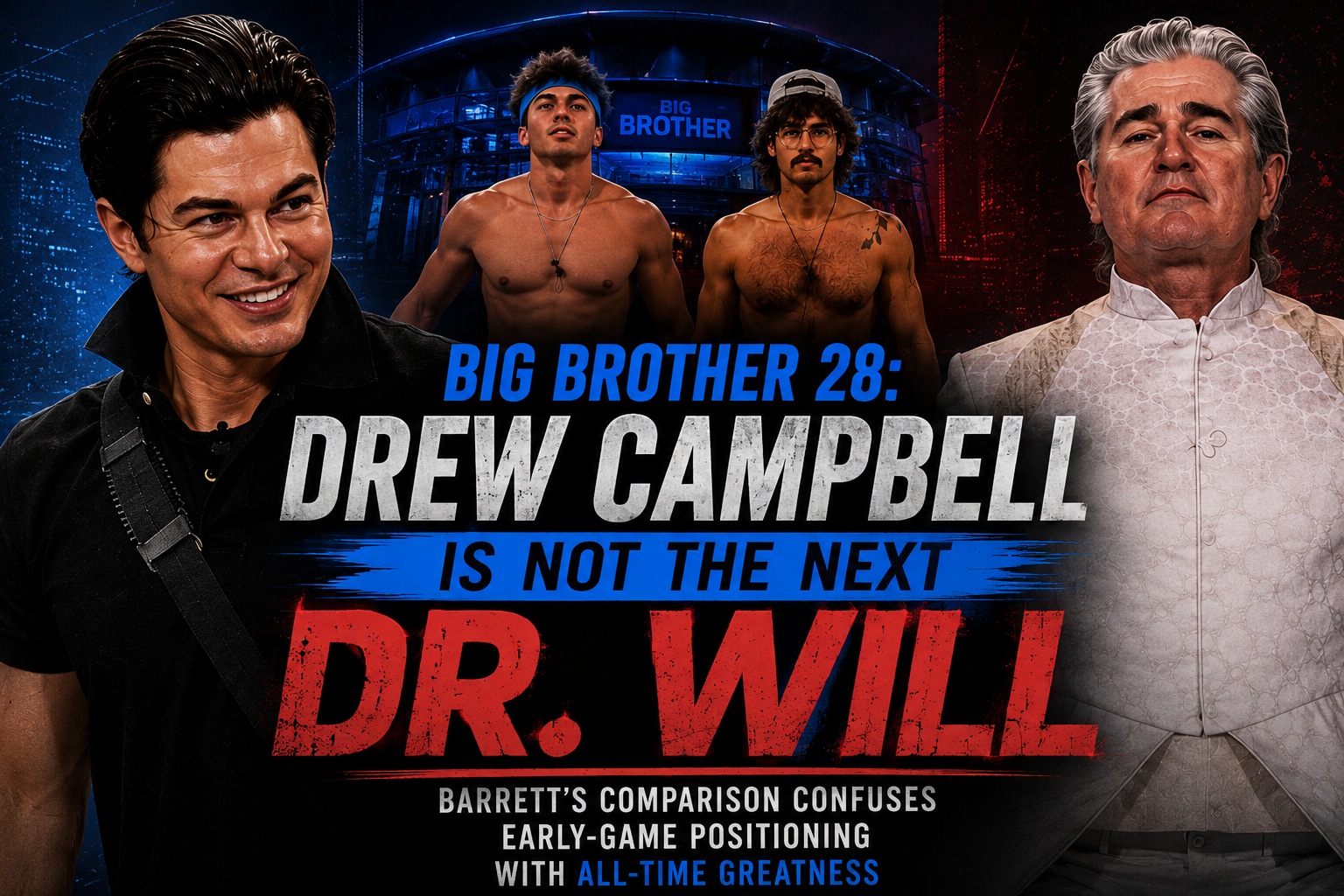
During a conversation with Angela Murray, Barrett Pfeiffer described Big Brother 28 Drew Campbell as “a little Dr. Will.”
It is an understandable compliment from Drew’s closest strategic partner. It is also an enormous exaggeration.
Drew has played a promising early game. He has formed important relationships, positioned himself between competing groups and influenced conversations without winning formal power. Those are legitimate strengths. None of them currently place him anywhere near Dr. Will’s level.
The comparison confuses early-game positioning with all-time greatness.
Dr. Will did not become one of the greatest players in Big Brother history simply because he was charming, deceptive, flirtatious or connected to multiple sides. He earned that reputation by surviving the destruction of his alliance in Big Brother 2, reaching the end without winning a single competition and defeating Nicole Nilson Schaffrich before a jury that knew he had lied to them.
He returned for Big Brother 7: All-Stars as the only former winner in the cast, entered with one of the largest targets imaginable and still reached the final four without winning a competition. Along the way, he and Mike “Boogie” Malin penetrated nearly every important power structure, dismantled the Season 6 alliance, manipulated multiple HOHs and turned Janelle Pierzina’s historic competition dominance into a weapon for Chilltown.
Drew, through less than three completed weeks of Big Brother 28, has formed several overlapping alliances and helped pitch a Jason De Puy backdoor.
Those accomplishments do not belong in the same category.
The Comparison Begins With a Surface-Level Resemblance
There are reasons Barrett sees something familiar in Drew.
Drew is socially comfortable. He speaks confidently about the game, has relationships across the house and appears more interested in influencing power than publicly collecting it. He is close to Barrett through their final-two agreement, the Jugglers, while also maintaining relationships with Melody Morris, Dee Valladares, Angela, Rick Devens, Kamu Kirk and several players outside his primary alliance structure.
Drew has also avoided winning HOH during a period when winning it would have forced him to expose his divided loyalties. Dee controlled Week 1, Devens controlled Week 2 and Kamu controls Week 3. Drew has remained protected while other people accepted the responsibility that comes with nominations.
That resembles one component of Will’s strategy.
Will understood that formal power creates evidence. An HOH must expose targets. A veto winner may have to reveal loyalties. The person holding power becomes publicly responsible for an outcome, while the person influencing that decision can benefit without absorbing the same damage.
Drew has experienced a smaller version of that advantage. He reportedly helped introduce the idea of backdooring Jason to Kamu, but Kamu remains the HOH who must nominate the replacement and defend the move. Drew can potentially receive the strategic benefit while Kamu accepts the public responsibility.
That is good gameplay.
It is not proof that Drew is operating with Will’s precision.
Dr. Will did not merely avoid competitions while standing inside a dominant alliance. He repeatedly survived without formal power when the people winning those competitions had strong reasons to remove him. He convinced players to keep him while openly acknowledging that he was deceptive and dangerous.
Drew has mostly avoided danger because his allies have held power.
There is an enormous difference between surviving power and benefiting from it.
Dr. Will’s Big Brother 2 Game Was Built From the Ruins of His Original Position
The mythology surrounding Will sometimes erases how badly his game began.
The original Chilltown alliance was loud, arrogant and painfully visible. Will, Boogie, Shannon Dragoo and Krista Stegall behaved like the center of the house without possessing the votes or social discipline necessary to maintain control.
Will helped create the backlash that destroyed his own alliance.
Shannon was evicted. Boogie followed. Chilltown collapsed, and Will became one of the most obvious remaining targets in the house.
That is where his winning game truly began.
Will did not continue pretending that he controlled a majority. He did not panic and expose every relationship he possessed. He accepted that he was isolated and redesigned his value around that isolation.
He turned himself into a movable piece.
Hardy Ames-Hill and Nicole did not need to trust Will completely. They only needed to believe that keeping him benefited them more than evicting him. Will presented himself as a vote, a temporary ally, an obvious future target and an apparently weak finalist who could always be removed later.
Every part of that description helped him survive.
Because he was isolated, the house believed he lacked numbers. Because he refused to win competitions, the house believed it controlled his fate. Because he admitted he was a liar, people believed they understood his game. Because he was disliked, Nicole believed he would be easier to defeat before the jury.
Will turned his worst qualities into reasons to keep him.
Drew has not been forced to accomplish anything comparable.
His original structure has not collapsed. Barrett remains in the house. The Crossovers and the larger Toolshed structure have helped protect him. Players connected to his side have won all three HOH competitions.
Drew has not crawled out of a destroyed alliance. He is standing comfortably inside the alliance currently controlling the game.
That does not make his positioning meaningless. It makes the Will comparison premature.
Dr. Will Controlled How the House Interpreted His Dishonesty
Will’s most important strategic weapon was not simply lying. Plenty of terrible players lie.
Will controlled the meaning of his lies.
In Big Brother 2, he did not ask the house to believe that he was honest. He openly cultivated the image of a manipulator. That removed the shock from his deception and created an unusual form of predictability.
Players understood that Will would act in his own interest. They believed they could use him temporarily, account for his dishonesty and eliminate him when necessary.
Will’s reputation became camouflage because everyone thought they had already diagnosed him.
Drew is playing a more conventional game. He is building trust by allowing different people to believe that their relationship with him is legitimate and important.
Barrett believes in the Jugglers.
Melody has received Drew’s personal and strategic protection.
The veterans have treated Drew as a younger member of their power structure.
Kamu trusts him enough to receive strategic input.
The remnants of the other side have viewed Drew as more approachable than the central veterans.
That is not Will’s game. It is a familiar middle-position game built on overlapping loyalties.
The immediate advantage is obvious: Drew can receive real information because people believe he may genuinely choose them.
The danger is equally obvious: those promises become contradictions once people compare notes.
Will survived exposure by making deception part of his established identity. Drew’s game depends on avoiding exposure because his relationships are built on each person feeling comparatively important.
Will could tell someone, in effect, “You knew I was a liar.”
Drew cannot eventually tell Barrett, Melody, Dee, Angela and Kamu that they should all have understood they were temporary without creating bitterness and distrust.
The resemblance therefore breaks down at the foundation.
Will Turned Other Players Into His Competition Résumé
Drew and Will have both benefited from other people winning power, but Will’s version was far more advanced.
In Big Brother 7, Will developed a relationship with Janelle that became the engine of Chilltown’s game. Janelle possessed elite competition ability. Will possessed elite social and psychological influence.
He did not merely remain safe during her HOHs. He repeatedly helped shape how she used them.
Janelle became the visible person nominating and evicting players who threatened Chilltown. Will received the benefits while avoiding the formal responsibility. He effectively outsourced competition wins without surrendering strategic influence.
At the same time, Boogie maintained a separate relationship with Erika Landin. Chilltown sat between Janelle and Erika, offering each woman a different path while keeping the women divided.
That structure carried Will and Boogie to the final four.
Drew has shown early signs that he understands the value of influencing an HOH. His involvement in the Jason backdoor discussion is the clearest example. However, one suggestion during Kamu’s HOH is not the equivalent of directing an entire season through other people’s competition victories.
It is not even clear that removing Jason is uniquely beneficial to Drew.
Jason is a target for much of the dominant group. His eviction would preserve the veterans, keep the Toolshed intact and eliminate an obvious outsider. Drew would remain protected, but he would also lose someone capable of taking a shot at the people who may eventually target him.
That is the problem with describing every piece of influence as brilliant.
A player can successfully push a plan that strengthens the alliance above them more than it strengthens their own long-term position.
Will’s best moves weakened people capable of threatening Chilltown.
Drew’s Jason plan may simply help the current power structure continue controlling the game.
Drew’s Current Position Is Strong, but It Is Not Invisible
The strongest argument for Drew is that he has built one of the widest information networks among the new houseguests.
He receives information through Barrett.
He is connected to the veterans through the Crossovers and Toolshed structures.
He has a meaningful relationship with Melody.
He maintained access to Rome Seymour and Lyric Medeiros through the Four Seasons grouping.
He has enough trust with Kamu to participate in target planning.
Drew is rarely excluded from the important conversations.
That is valuable, especially during the early game. The more information a player possesses, the better they can tailor individual conversations and avoid being blindsided by a changing target.
However, Drew’s reach is no longer hidden.
Dee and Angela have already discussed the possibility of targeting Drew and Barrett. Devens previously considered whether targeting Melody could weaken Drew’s influence. Drew’s efforts to protect Melody during Week 2 made that relationship easier to identify. His closeness with Barrett is apparent enough that the pair can be discussed together as a potential future problem.
This is not how a Will-level middle game looks.
Will certainly attracted suspicion, but he repeatedly redirected that suspicion toward more immediate threats. Drew has not yet demonstrated that he can survive once the power structure above him decides that his relationships are no longer useful.
He is well positioned because his alliance keeps winning.
The real test begins when it does not.
The Melody Relationship Exposes One of Drew’s Largest Weaknesses
Drew’s relationship with Melody has given him a loyal number outside the veterans’ core. It has also created the clearest evidence that he is not completely committed to the people protecting him.
Drew fought to preserve Melody during Devens’s HOH. Wanting her to stay made strategic sense. Melody provides information, loyalty and a potential route away from the veterans.
The problem was not the preference. It was the visibility.
An effective middle player protects outside numbers without teaching the majority alliance exactly which outsiders belong to them.
Drew’s investment became obvious enough that weakening Drew became part of the logic for considering Melody as a target.
That is not Dr. Will-level concealment.
Will often made people feel that keeping him served their own interests. Drew risks making his alliance feel that keeping Melody serves Drew’s interests.
Those are opposite outcomes.
When Will protected someone, he could frame the decision around the power holder’s needs. Drew’s advocacy has occasionally revealed his own priorities too clearly.
If Melody becomes expendable, Drew will eventually have to decide whether to abandon her, damage his position to save her or expose that their relationship was never as meaningful as she believed.
There is no evidence yet that he can navigate that decision cleanly.
Drew Is Surrounded by Shields, While Will Became His Own Shield
Drew currently benefits from one of the most protective structures available in an early Big Brother game.
Dee, Devens and Angela entered with prior reality-television experience and immediate reputations. They are natural targets. Kamu has now won HOH and become more publicly involved in the season’s direction. Barrett is socially connected. Melody provides Drew with another visible relationship that can attract attention.
Drew can hide behind several people.
Will entered Big Brother 7 as a former winner whose strategy was already famous. He was the shield.
There was no larger strategic reputation protecting him. There was no veteran trio ahead of him. There was no mystery surrounding whether he could manipulate a house.
Everyone knew.
His accomplishment was convincing an All-Star cast that they could postpone eliminating him even though they understood what he had done before.
Drew’s accomplishment has been avoiding the block while aligned with every HOH winner of the season.
Those are not remotely comparable degrees of difficulty.
This is why results cannot be evaluated without context. Reaching Week 3 untouched is not automatically impressive. The route matters.
Drew has played well enough to remain protected. Will repeatedly remained protected when keeping him should have appeared irrational.
Will’s Relationships Produced Action; Drew’s Relationships Currently Produce Options
Will’s strongest relationships changed the direction of the game.
Nicole took him to the final two in Big Brother 2 because she believed he was easier to defeat than Monica Bailey.
Janelle repeatedly made decisions in Big Brother 7 that protected Chilltown and eliminated its obstacles.
Boogie controlled Erika’s trust while Will controlled Janelle’s.
James Rhine entered the Legion of Doom, helping Chilltown exploit the fractures within the Season 6 alliance.
Will did not merely collect social connections. He converted them into outcomes.
Drew has collected options.
Barrett could become his true final-two partner.
Melody could remain a loyal outside number.
The veterans could continue shielding him.
Kamu could continue accepting his strategic ideas.
Those possibilities have value, but they have not yet been tested against one another. Drew has not had to select one relationship at the direct expense of another while preserving the rest of his structure.
The moment that happens will reveal whether he possesses genuine strategic control or merely broad early-game access.
Almost every promising player looks flexible before the house forces them to choose.
Barrett’s Compliment Says More About Big Brother’s Dr. Will Obsession Than Drew’s Game
Barrett calling Drew “a little Dr. Will” is understandable within the personal context of the house.
Barrett is close to Drew. He sees Drew’s social maneuvering, game knowledge and confidence. He may be describing a style or personality rather than claiming that Drew has already matched Will’s résumé.
The larger problem is how casually the Big Brother community uses Will’s name.
Every year, a male houseguest who is charming, sarcastic, flirtatious or intentionally losing competitions is branded the next Dr. Will.
Most of them are not.
Throwing competitions does not make someone Dr. Will. It can also mean that a player is afraid to expose their position.
Having alliances on both sides does not make someone Dr. Will. It can also mean that a player is overextended and waiting to be exposed.
Being charismatic does not make someone Dr. Will. Charisma becomes strategically meaningful only when it changes decisions.
Lying does not make someone Dr. Will. Bad players lie constantly and receive nothing in return.
Avoiding the nomination block does not make someone Dr. Will. Many passive players remain safe because the majority alliance has no reason to target them yet.
The comparison has become a shortcut that replaces actual analysis.
Rather than evaluating what a houseguest has done, people recognize two or three familiar characteristics and attach the name of a legendary player. It is the reality-television equivalent of comparing every young basketball player with confidence and a jump shot to Michael Jordan.
The standard becomes meaningless when nearly everyone receives the label.
Drew Has Not Controlled a Vote, Survived Adversity or Proven His Jury Ability
Through the Week 3 veto competition, Drew has not faced the nomination block.
He has not survived an eviction vote as the target.
He has not lost his primary alliance.
He has not recovered from a major strategic betrayal.
He has not controlled an HOH against that HOH’s original interests.
He has not been forced to explain contradictory alliances.
He has not turned an enemy into the person responsible for saving him.
He has not demonstrated jury management.
He has not evicted the central power player above him.
He has not reached the stage of the game where social maneuvering must become strategic execution.
That is not an insult. It is the reality of evaluating a player during Week 3.
Drew cannot have a Will-level résumé because the season has not provided enough time to build one. What makes the comparison laughable is pretending the evidence already exists.
Drew should be judged as Drew.
At present, he is an active, knowledgeable and socially connected young player with a strong early position and several emerging problems. That is interesting enough without forcing him into the identity of a two-time legend.
The Differences Between Their Competition Strategies Are More Important Than the Similarity
Both players have avoided winning early power, but the strategic meaning is different.
Will’s competition losses were incorporated into his entire identity. He sold himself as someone who could not—or would not—win, making other players believe they controlled when he would leave. His refusal to win also prevented him from exposing formal loyalties.
Drew has avoided power while his allies repeatedly won it.
There is no evidence yet that Drew can maintain the same position if Jason, Lyric, Mallory Aurichio, LaTrice Verrett or another outsider becomes HOH. It is possible his connections would protect him. It is also possible that his name would emerge as the safest way to weaken the dominant alliance without immediately targeting one of the veterans.
Drew’s lack of competition wins has not yet become a strategic weapon. It has simply avoided becoming a problem.
That distinction matters.
Will weaponized losing.
Drew has benefited from not needing to win.
The Differences Between Their Duos Are Equally Significant
Will and Boogie entered Big Brother 7 as an established pair, but their loyalty was absolute. Every temporary alliance existed beneath Chilltown in Will’s hierarchy.
Will did not need to wonder whether Boogie would choose Erika over him. Boogie did not need to wonder whether Will would choose Janelle over him. Their outside relationships were tools serving the pair.
Drew’s hierarchy is less clear.
Barrett may be his most trusted strategic partner, but Drew has also made commitments to Melody and worked closely with the veteran structure. His game depends on multiple people believing they have a meaningful claim to his loyalty.
That gives Drew more routes but less certainty.
If Barrett is the real final two, Drew’s protection of Melody must eventually serve that partnership.
If Melody is his most important outside number, Barrett may be overestimating his place.
If the Crossovers remain Drew’s true power structure, the Jugglers could be disposable.
A player can maintain ambiguity early, but eventually a successful game requires a clear internal hierarchy even when the rest of the house cannot see it.
Will always knew Boogie came first.
It is not yet clear who comes first for Drew.
The Differences in Self-Awareness May Become Decisive
Will possessed extraordinary awareness of how the house perceived him.
He knew people viewed him as arrogant, dishonest and dangerous. Rather than fighting those perceptions, he adjusted his game around them. He understood the reason each player believed they could keep him, and he reinforced that reason.
Drew appears highly confident in his understanding of the game, but confidence is not the same as accurate self-perception.
His closeness with Melody has become visible.
His pair with Barrett has been identified.
Dee and Angela have questioned the younger duo’s long-term value.
His influence on the Jason plan could eventually become public.
The strongest version of Drew’s game exists only if he recognizes that his cover is already cracking.
If he still believes he is moving invisibly between groups, he is behind the house’s perception of him.
Will’s advantage was that he often understood his reputation better than the people attempting to use it against him.
Drew has not yet proven the same level of awareness.
Lyric’s Veto Win Creates Another Test Drew Does Not Control
Kamu nominated Lyric, Mallory and LaTrice, intending to use the veto cycle to create an opportunity to nominate Jason.
Lyric then won the Power of Veto and is expected to remove herself, opening the replacement-nominee position Kamu wanted.
That result may allow the Jason plan to proceed exactly as Drew and others discussed.
Even so, Drew is not the central operator of the week.
Kamu won HOH.
Kamu selected the nominees.
Lyric won the veto.
Kamu will determine the replacement.
The house will decide whether Jason leaves.
Drew may have influenced the framework, but influence should not be inflated into ownership. If Jason is nominated and evicted, the move primarily belongs to Kamu’s HOH unless clear evidence shows Drew dictated the decision against Kamu’s instincts.
Too often, fans grant their preferred player credit for every favorable outcome while assigning responsibility for every mistake to someone else.
A fair evaluation cannot work that way.
Drew deserves credit for contributing to the plan. He does not deserve credit for controlling a week he did not control.
Where Drew Is Genuinely Better Than Many Early-Game Players
Rejecting the Will comparison does not require pretending Drew is playing badly.
Drew is more strategically engaged than several people in the house.
He recognizes the importance of maintaining connections outside the dominant structure.
He understands that the veterans can serve as shields.
He has helped position Barrett and himself between groups.
He is actively thinking about future targets rather than merely voting with the majority.
He has earned personal trust from Melody and strategic trust from Kamu.
He has avoided becoming one of the first three primary targets despite being an obvious superfan who entered confidently discussing his knowledge of the game.
Those are meaningful accomplishments.
The honest assessment is not that Drew is terrible. It is that “promising” and “Dr. Will” are separated by an ocean.
Drew has built an intriguing opening.
Will built two historically significant games.
What Drew Would Need to Do Before the Comparison Becomes Serious
Drew would first need to survive the eventual collapse of the current power structure.
The Toolshed cannot remain perfectly united forever. Dee, Angela and Devens have their own interests. Drew and Barrett have their own pair. Kamu and Haley possess their relationship. Melody gives Drew an outside route. Once those interests collide, Drew must preserve himself without appearing responsible for the fracture.
He would need to turn the veterans against one another before they successfully target him and Barrett.
He would need to retain Melody without making her an obvious extension of his game—or cut her at the correct time without losing her respect.
He would need to influence HOHs from opposing groups, not merely allies already inclined to target his enemies.
He would need to survive direct danger without relying on his side winning every competition.
He would need to conceal the Jugglers long enough for Barrett to remain useful.
He would need to explain his overlapping commitments in a way that jurors respect rather than resent.
He would need to reach the end with visible strategic ownership of the season.
Even then, matching Will would remain an enormous standard.
Will won his first season after his alliance was demolished and nearly won an All-Star season despite entering as the most obvious strategic threat.
Drew is currently safe in Week 3.
The comparison needs considerably more evidence.
Drew Campbell Is Not Big Brother 28’s Dr. Will—and He Does Not Need to Be
Barrett’s comparison works as affectionate shorthand between allies. Drew is clever, social, confident and comfortable operating without formal power. Those traits can remind someone of Will.
Beyond that, the resemblance becomes increasingly artificial.
Will’s games were defined by survival under extreme pressure, precise management of his own reputation, the ability to make enemies preserve him and a rare talent for converting other people’s power into his outcomes.
Drew’s game is currently defined by access, overlapping relationships and protection from a majority alliance that has won every HOH.
Will transformed vulnerability into control.
Drew has not been vulnerable.
Will made people who distrusted him act against their own long-term interests.
Drew has mostly worked with people whose interests already align with his immediate safety.
Will managed his threat after proving he was dangerous.
Drew is still trying to avoid proving it.
The annual search for “the next Dr. Will” does a disservice to both players. It diminishes how difficult Will’s accomplishments actually were, and it forces Drew into a standard he has done nothing to earn and does not need in order to become a good player.
Drew may develop into one of the strongest players of Big Brother 28. His social reach could carry him deep. His relationships with Barrett and Melody could provide routes beyond the veterans. His ability to influence Kamu may be an early sign of greater strategic potential.
It could also fall apart the moment the wrong person wins HOH and the house compares information.
That uncertainty is what makes Drew worth watching.
He is not Dr. Will.
He is a promising Week 3 player whose game has already become more visible than he appears to realize. Until he survives adversity, converts his relationships into sustained control and proves that his overlapping loyalties can withstand exposure, calling him anything more is not analysis.
It is another season repeating the same tired fantasy.
Make sure to subscribe to our Late Night Crew Youtube Channel. Follow @yorkjavon, @kspowerwheels, @MS_MISCHA & @LateNightCrewYT on X.