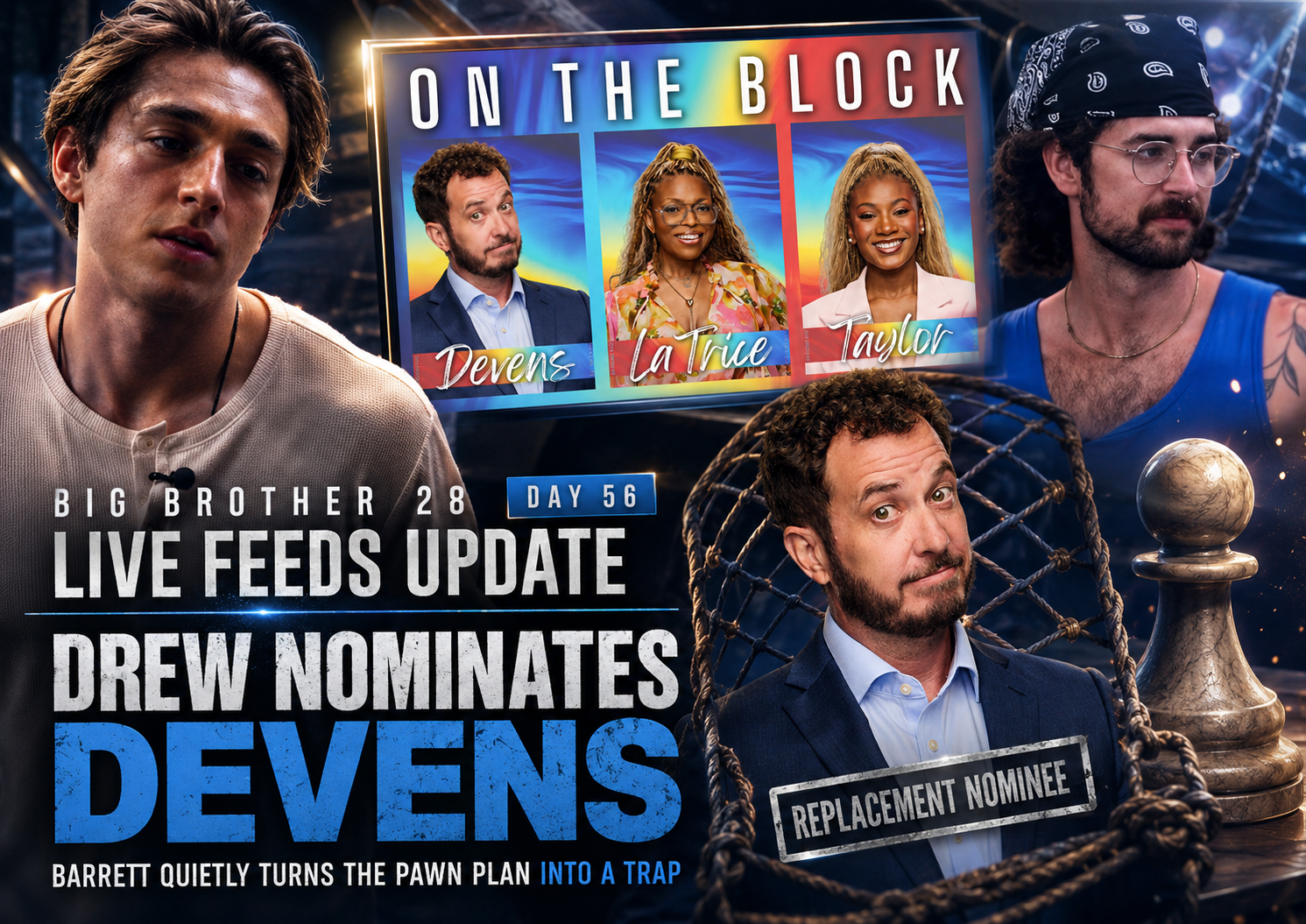

Big Brother 28 Episode 27 should have been Yash’s showcase. He survived the final medieval contest, personally eliminated Haley, maneuvered around an HOH competition he had no strategic reason to win, confronted Drew about his cowardly nominations, won the Power of Veto and forced an Icon onto the block.
Yash went wire to wire. The episode still dragged like it was being paid by the minute.
CBS had two hours and somehow made the night feel both overstuffed and underdeveloped. The show had to finish the medieval twist, send Haley home, bring in Zingbot, crown a new Head of Household, show an entire nomination cycle, play the veto competition and reach the veto meeting.
That is enough story for a strong episode. It is also enough story to expose every bad editing decision when the production keeps stopping to repeat rules, recycle Diary Room explanations and manufacture suspense that has already expired.
The episode should have been ninety focused minutes. Cut the filler, trust the audience to remember what a balance beam does and give the actual strategy room to breathe.
Instead, viewers watched Melody and Barrett transform into Diary Room gangstas while remaining cautious in front of Drew. They watched Drew win power and confirm what should have been obvious since Day 1: he has been attached to the Icons for most of this game, no matter how often the house pretends he is floating somewhere else.
They watched Devens acknowledge that volunteering for the block is one of the dumbest things a Big Brother player can do and then convince himself it would become a résumé move because he was the one doing it.
By the time Yash had one gold nugget left in the veto competition, fewer than thirty minutes remained and the veto meeting was still ahead. Big Brother went to commercial anyway. They might as well have pulled a WWE, put “Veto Competition Continues” in the bottom-right corner and promised to finish the match after the break.
The night contained a great individual performance. It was trapped inside a bad television episode.
Big Brother 28 Episode 27 Tried to Be Three Episodes at Once
The structural problem started before anybody touched a crown, watched a Zingbot documentary or carried a gold nugget.
This broadcast had to complete three different stories. The first was the ending of the medieval twist from Day 53, including the final elimination contest. The second was the Week 8 HOH competition and Drew’s nominations. The third was the veto draw, veto competition, campaign conversations and replacement nomination.
That amount of material demanded discipline. Production responded with bloat.
Every competition received the usual layers of rules, repeated rules, contestant narration and reaction shots. The Zingbot visit became a full museum package and then an extended memory competition built around another video package. Conversations with genuine strategic value were placed beside scenes that repeated information viewers had already received in the Diary Room.
The problem was not that the episode had too much game. The problem was that it did not trust the game.
Yash’s path alone supplied a natural beginning, middle and end. He entered the night in danger, won the right to eliminate somebody, managed the restrictions created by Dee’s $5,000 bribe, pressured Drew and then won the veto that changed the nominations. That story did not need artificial help. It needed a cleaner edit.
Barrett Finally Made a Decision for Barrett
The medieval twist resumed with Barrett holding the power to select the two houseguests who would compete against Haley in the final contest.
Dee wanted LaLa and Taylor. Haley remained an important number for the Icons, and putting her against that pairing gave her a field they considered more manageable. Barrett understood what they wanted. He simply decided their preferred outcome was no longer automatically his responsibility.
He selected LaLa and Yash.
That was the most important decision Barrett made in the episode because it was one of the first times he openly chose his own relationships over the Icons’ instructions. He protected Melody, gave Yash the chance he wanted and knowingly increased the odds that Haley would leave.
Barrett even asked Dee whether he had made the wrong decision. Her reassurance did not change the truth. She hated the move because Yash was the strongest person Barrett could have sent against Haley.
The choice also carried the residue of Mallory’s eviction. Barrett had watched the Icons prioritize themselves while he lost an ally. When Haley’s safety became their concern, he was no longer interested in sacrificing his game to solve it. His Diary Room response was cold and completely understandable: he had to lose Mallory, so Dee and Angela could experience losing their friend.
That is not petty side drama. That is alliance damage becoming a decision.
Yash Eliminated Haley and Ended the Medieval Twist Himself
Yash, LaLa and Haley had to build crowns using pieces divided among three bags. Once every piece was placed, the first player to grab a scepter would win safety and receive the sole power to eliminate one of the other two competitors.
Haley started well. Yash struggled with falling pieces and had to rethink his base. LaLa knew Haley would likely eliminate her, while Yash understood that Haley could view him as the greater competitive threat. Nobody could pretend second place offered protection.
Yash recovered, completed his crown and won.
There was no committee, no house vote and no convenient majority behind which he could hide. The twist gave him the decision, and he eliminated Haley.
Haley’s exit was abrupt because the format denied her the normal goodbye. She had volunteered to enter the medieval danger early because she did not believe she would become the final sacrifice. That assumption aged about as well as these volunteer plans usually do. She later admitted that she had failed to win several chances to save herself and was left with the what-ifs.
It was a rough way for her game to end, but Yash did exactly what the moment required. He eliminated a number attached to the Icons and guaranteed his own place in the jury phase.
The House’s 5–4 Math Was Built Around a Drew-Sized Truth
After Haley left, Taylor described the house as five against four: Taylor, LaLa, Yash, Melody and Barrett on one side, with Dee, Angela, Devens and Drew on the other.
That was a more honest count than the version the Icons wanted to believe.
Dee and Devens still discussed Drew and Barrett as solid Crossovers numbers who had to be managed carefully. Barrett privately described the game as five against three because he had mentally left the Icons behind. The missing person in that formulation was Drew, and that omission captured the entire problem. Drew kept being treated as a movable middle even while his actions repeatedly protected the same trio.
Why does this house keep acting surprised that Drew is close to the Icons?
He has been their homie since the beginning. His own preferred final six was the Crossovers plus Melody. When he received power, he immediately protected the Crossovers. When he had the chance to nominate an Icon directly, he chose Yash, LaLa and Taylor. When the veto forced a replacement nominee, he searched for the option that would create the least resistance.
Taylor saw it. Melody saw it. Barrett saw enough of it to call Drew the Icons’ puppy dog in the Diary Room. Yash saw it and challenged Drew to his face.
The mystery was never Drew’s behavior. The mystery was why people kept waiting for a different version of him to appear.
Melody and Barrett Became Diary Room Gangstas
Melody learned that Drew had spent weeks lying to her. Drew admitted that she mattered to him but was not inside the Crossovers. His ideal ending included her only after his established alliance had already received its seats.
Melody responded correctly in one respect: she stopped trusting him. She said her walls were up and planned to smile, flirt and make him believe they remained completely solid.
Barrett delivered his own declaration. He said his fanboy era with the Icons had worked until their moves stopped benefiting him. He wanted $750,000, not a certificate for riding behind three people who had enjoyed comfort and safety. If he won HOH, he said, the Icons should be nervous.
Those were good Diary Rooms. They were also Diary Rooms.
In front of Drew, Melody kept playing the fun, flirty ally. Barrett admitted that he could not tell Drew to nominate the Icons because Drew might immediately carry the information back to them. Both had strategic reasons to maintain cover, but the episode kept presenting private toughness as though the move had already happened.
Melody talked especially hard for somebody who had not won anything in fifty-eight days. She warned Drew that he would not like what happened if she won the veto, promised to use it and spoke as if the medal were already around her neck. The confidence was entertaining. It was not leverage.
Zingbot would soon point directly at her empty competition résumé. The joke landed because the scoreboard was doing most of the writing.
Zingbot Did His Job, but the Episode Did Not Know When to Move On
Zingbot arrived after the medieval twist and delivered a mostly solid round of insults.
Barrett’s chest became a dirty hairball with two pepperoni slices. Devens became a wrinkled, leathery old heavy bag in need of sunscreen. Melody’s competition ability and comedy were placed in the same tragedy. Dee was called a major downgrade from Rachel Reilly. Taylor was sent to the Book of Boring.
Angela’s “MILF” label became “moron I’d like to forget.” Drew’s crush on Melody became a song about the friend zone and dying alone. LaLa was accused of desperately clinging to her youth. Yash’s haircut received the punishment Zingbot thought Big Brother had forgotten to give him.
Some hit harder than others. Barrett’s pepperoni reaction, Drew’s friend-zone song and Angela’s acronym were the easiest laughs. LaLa rejected hers in real time, which was more entertaining than the insult. Devens tried to turn his zing into a speech before remembering that crying might create more wrinkles.
This segment was not the episode’s problem by itself. Zingbot is a seasonal tradition, and the cast gave production usable reactions.
The issue was scale. Zingbot roasted nine people, introduced the HOH setup, disappeared through the time machine and then remained the subject of a two-part documentary memory competition. A fun visit became an entire programming block while the strategic week waited behind it.
The episode needed punctuation. Production gave it a paragraph that refused to end.
Yash Was Smart Enough Not to Win an HOH He Could Not Use
The Head of Household competition asked the players true-or-false questions about two Zingbot history videos. After seven questions, Melody, Yash and Drew reached a numerical tiebreaker.
Yash’s approach mattered more than the trivia.
Because he had accepted Dee’s bribe, his next HOH could not be used to nominate Dee, Angela or Devens. Winning this particular competition would force him to take power while protecting the three people he most wanted to see on the block. That is not power. That is a week of doing their work and accepting the backlash.
Yash therefore tried to create a better outcome. On the final true-or-false question, he intentionally answered incorrectly so Melody could catch him and reach the tiebreaker. Melody was the ideal winner because she could nominate all three Icons without his restriction.
Drew also answered correctly, creating a three-way tie. The final question asked how many minutes had passed between the opening trumpet of the medieval twist and LaLa and Yash’s return. The answer was 378 minutes. Drew won.
Yash did not fail by avoiding that HOH. He recognized that a title is only useful when the rules allow the winner to pursue the correct target. His plan to hand power to Melody failed because Drew survived the same tiebreaker, not because Yash misunderstood his position.
Drew Won Power and Immediately Confirmed Everyone’s Read
Drew celebrated the HOH as the week he had dreamed about since childhood. He had survived Dee nominating him, won the BB Block Buster, lived through the medieval twist and now controlled the next nominations.
Then he used that power to take the easiest available route.
His plan was to protect the Crossovers and Melody. That left exactly three initial options: Yash, LaLa and Taylor. He nominated all three and identified Yash as the target because Yash was the largest competition threat.
Targeting Yash had a defensible logic. He had just won the medieval contest, had already accumulated multiple competition victories and openly wanted the Icons vulnerable. Drew did not invent that threat.
The weakness was everything around the target. Drew’s nominations asked none of the people closest to the center of power to experience risk. He selected three players outside the structure he had protected, then described Yash as guilty by association. That was not an independent HOH. It was a comfortable one.
Melody called the nominations embarrassing and spineless. LaLa and Taylor called Drew a coward. Barrett wanted to shake him but knew that challenging the Icons too openly could make Drew expose him.
Their criticism was right. Their surprise was not.
Devens Volunteered as a Pawn and Mistook Exposure for a Résumé
Devens looked Drew in the face and offered to go on the block as a pawn.
He knew the history. He said himself that every Big Brother fan understands how stupid volunteering can be and how often pawns leave. Then he built a personal exception around the exact same danger.
His explanation was that volunteering would protect Angela, Dee and Barrett, keep Drew happy and account for Drew’s unwillingness to nominate Melody. He called it a big play that could help his résumé.
That logic was backwards.
A résumé move increases a player’s control over the game. This offer surrendered control. Devens could not guarantee the veto result, the replacement nomination, the BB Block Buster or the eviction votes. He was relying on Drew and Barrett not to turn while handing both of them the cleanest opportunity they had received to remove an Icon.
Dee understood immediately. She called the idea stupid and warned that Barrett or Drew could flip because neither had much on his résumé. Her analysis was sharper than Devens’s because she separated loyalty from incentive. An ally can like you and still recognize that removing you is the biggest move available.
Devens did not create an impressive risk. He created unnecessary exposure and hoped the audience would reward him for announcing it first.
Yash Told Drew What Everyone Else Saved for the Diary Room
After the nominations, Yash went to the HOH room and told Drew that the choices were disappointing.
He reminded Drew that Dee had nominated him and argued that larger moves were available. Drew answered with the familiar promise that somebody would probably win the veto and create another opportunity. He also made clear that Barrett and Melody were not going up.
Yash did not need the conversation to change Drew’s mind. He needed the veto.
He told Drew that winning it would finally force him to get blood on his hands. That was the most honest description of the week. Drew had built an initial nomination set designed to avoid choosing among the people he actually valued. Remove Yash, and the hiding place disappeared.
This is where Yash separated himself from the episode’s Diary Room gangstas. He said the relevant part to the HOH’s face and then entered the competition capable of making it real.
Melody Talked Like a Veto Holder Before Winning a Veto
The random draw added Dee and Melody to the veto field alongside Drew and the three nominees.
Dee wanted nominations to remain the same. Melody told Drew that, if she won, he would not like what happened because she planned to remove somebody. She considered saving Taylor or LaLa while leaving Yash exposed to the BB Block Buster.
Her willingness to use the veto was strategically useful. Forcing Drew to reveal another priority would have been better for her than protecting the HOH’s comfortable week.
The comedy was how hard she spoke before securing the power. Melody treated a hypothetical win like a scheduled appointment even though she had gone the entire season without one. Drew compared their position to Romeo and Juliet. Melody talked about ruining his future if he nominated her. The episode wanted all of that to feel dangerous.
Without a win, it was flirtation wrapped around a threat.
The Gold, the Bad and the Ugly Was Buried Under Awful Pacing
The veto competition sent the players to 1849 for “The Gold, the Bad and the Ugly.” Each competitor had to transport twenty-five gold nuggets, one at a time, across a teetering balance apparatus and place them in a prospecting pan. If a nugget fell or touched the ground, the player had to reset.
It was a legitimate pressure competition. Balance, pace and placement mattered. Moving too quickly risked destroying an entire run; moving too slowly gave another player time to finish.
Yash built the best performance. Dee and Drew remained close enough to supply pressure, while LaLa and Taylor suffered resets. Devens watched from the sideline after volunteering for the block and visibly shook as the people most likely to keep nominations intact fell behind.
That image told the whole story. Devens wanted credit for being fearless until somebody else’s victory could make the danger real.
Then Yash reached his final nugget.
There were fewer than thirty minutes left in the broadcast. Production still needed to show the result, reactions, replacement-nominee campaigns and the veto meeting. Big Brother cut to commercial.
For what?
The edit had already established that Yash was one clean crossing away. The commercial did not create a new strategic question. It interrupted the answer. This is where the episode’s pacing stopped being merely slow and became self-parody.
Yash Won the Veto and Forced the Only Decision That Mattered
Yash placed the final nugget, hit the button and won the Power of Veto. It was his fourth competition win across his previous six appearances.
More importantly, it did what he promised.
Yash could remove himself. Drew would then have to choose between Melody and somebody inside the Crossovers. Barrett was Drew’s closest ally and never appeared to be a serious option. That left Melody, Dee or Devens.
For the first time in the week, Drew could not maintain every relationship at once.
Barrett loved the opening because Devens had volunteered. Dee feared the same opening because she understood that Drew and Barrett could use it to remove an Icon. Devens hoped he would receive résumé credit for volunteering without ever having to touch the block.
That last part captured the absurdity perfectly. He wanted ownership of the risk and insulation from the consequences.
The Campaign Talk Added Motion Without Movement
Melody went to work on Drew with wine, flirting and jokes about his missing redemption arc. She said that working her magic on men might as well become her competition if she could not win the actual ones.
The segment had personality. Strategically, it went in a circle.
Drew already wanted to protect Melody. Melody already knew that keeping herself safe required maintaining their relationship. Neither revealed a new alliance, offered a vote Drew did not have or changed the replacement options.
Drew’s cam talk briefly became more interesting. He questioned why Dee had barely spoken to him after nominating him the previous week and wondered why he should protect somebody who had been selfish toward him. He considered matching her move by putting her on the block.
That thought was the episode’s best chance to show Drew making a decision with actual consequences.
It remained a thought.
The Icons Ran Down on Drew Because They Finally Saw the Trap
Dee told Devens to push harder for Melody as the replacement nominee. Devens refused to overplay because he was the one at risk, but Dee’s fear was accurate: if Devens touched the block, Drew and Barrett would have the opportunity to cut an Icon.
The conversation became the Icons running down on Drew while pretending the demand was simple alliance logic.
They told him they were his team. They argued that, if he applied the same logic Dee had used the previous week, no Crossovers member should go up. They promised that Melody would be safe while simultaneously insisting that she was the only acceptable nominee.
Drew saw the contradiction. Putting Melody up could allow the Icons to evict her on his HOH. Putting Dee up invited retaliation from someone who had already nominated him. Putting Devens up was dangerous, but Devens had volunteered and would create less immediate conflict.
That is why the conversation mattered. The Icons were not calmly controlling the week. They were nervous because Yash had removed Drew’s easy target and forced them to ask for protection directly.
Devens’s response was still ridiculous. He remained willing to go up, but he openly hoped Drew would nominate Melody so he could receive credit for being a team player without taking the risk.
That is not how credit works.
Drew Chose the Least Blood and Put Devens on the Block
At the veto meeting, Yash used the Power of Veto on himself. Drew named Devens as the replacement nominee.
Drew explained that Devens had volunteered and therefore gave him the easiest path with the least blood. He considered Dee more selfish and acknowledged that she had put him up, but he feared her response. Devens was loyal, agreeable and already offering cover.
So much for the giant résumé move.
The replacement nomination was not Drew suddenly standing up to the Icons. It was Drew accepting the safest option an Icon had handed him. He still expected Devens to remain. He still avoided targeting Dee. He still protected Melody and Barrett.
The strategic consequence was real anyway.
Yash noted that he might be restricted from nominating an Icon, but nothing stopped him from voting one out. Barrett celebrated that Devens was vulnerable. LaLa predicted that, if she or Taylor won the BB Block Buster, Devens would be choosing a room in the jury house.
Devens finished the episode trusting the Crossovers to keep him and promising to win the BB Block Buster if necessary. He described the gamble as “no risk, no reward.” That slogan sounds much better before the votes are counted.
Yash Put Belt to Ass From Beginning to End
Yash was the only houseguest whose decisions consistently altered the episode.
Barrett selected him for the medieval contest, and Yash won. The victory gave him sole authority, and he eliminated Haley. Dee’s bribe made the next HOH strategically useless to him, so he tried to steer the win toward Melody. Drew took power instead, nominated him and called him the target. Yash confronted Drew, entered the veto, led the field and saved himself.
Every time the episode placed a real obstacle in front of him, he responded with either a win or a deliberate strategic choice.
That is what going wire to wire looks like. It does not mean he won every competition. It means his game shaped the episode from the opening twist through the final ceremony.
The broadcast tried to spread attention across Zingbot, Drew’s childhood dream, Melody’s flirting, Devens’s pawn speech and repeated competition explanations. Yash kept dragging the story back to the only thing that mattered: who could force the Icons to experience actual danger.
He did it.
What the Episode Got Right
Yash received the strongest edit of the season at exactly the moment he earned it. His medieval win, Haley decision, HOH calculation, confrontation with Drew and veto victory formed a coherent story of a player understanding both competitions and consequences.
Barrett’s decision to send Yash against Haley also received the context it needed. The episode connected Mallory’s loss to his refusal to protect the Icons’ number, allowing an alliance fracture to produce an observable result.
The veto competition itself was easy to understand and appropriately punishing. Yash’s lead, Dee and Drew’s pursuit and Devens’s nervous reaction created genuine stakes.
Several Zings landed. Melody and Barrett gave strong confessionals. Taylor’s five-against-four count was an unusually direct acknowledgement that Drew belonged with the Icons in practice.
The veto meeting ended on the correct cliffhanger. Devens volunteered because he believed the risk was manageable, and the episode closed by letting Yash, Barrett and LaLa explain why that assumption could destroy him.
There was a good episode inside these two hours.
Where the House Actually Stands
Haley is out of the game, and nine houseguests remain: Angela, Barrett, Dee, Devens, Drew, LaLa, Melody, Taylor and Yash.
Drew is the Week 8 Head of Household. His initial nominees were LaLa, Taylor and Yash, with Yash as his intended target. Yash won the Power of Veto and used it on himself. Drew selected Devens as the replacement nominee.
The final three nominees entering the BB Block Buster are Devens, LaLa and Taylor. One will win safety before the eviction vote.
The Icons remain Dee, Angela and Devens, but their control is no longer the same as their safety. Devens is exposed. Dee understands that Barrett has reason to turn. Angela has lost Haley. Drew continues to protect much of their structure, but his choice of Devens shows that he will take the low-conflict option even when it puts an Icon in danger.
Barrett has privately committed to playing against the Icons and sees Devens’s nomination as an opportunity. Melody no longer trusts Drew but continues to use their personal connection for protection. Taylor and LaLa are still on the block. Yash is safe and has become the most proven competition threat remaining.
Yash’s next HOH remains restricted by the bribe agreement he accepted from Dee. That limitation influenced his decision not to pursue this HOH aggressively. It does not prevent him from winning other competitions, casting eviction votes or forcing other players to reveal themselves.
The episode ended before the BB Block Buster and vote. Devens is in danger; his eviction was not completed or guaranteed by anything shown here.
Final Thoughts
Big Brother 28 Episode 27 had the material for one of the season’s most important broadcasts.
Barrett finally rejected the Icons’ preferred plan. Yash eliminated Haley. The house drew battle lines. Drew won HOH and exposed his priorities. Devens volunteered for danger. Yash won veto and forced the replacement nomination everyone else had been avoiding.
That is a full story.
The episode buried it beneath an edit that confused length with importance. Zingbot stayed too long. The HOH documentary stayed too long. The veto competition stayed too long. The commercial break arrived with one nugget remaining and the entire strategic ending still waiting backstage.
Melody and Barrett sounded fearless in the Diary Room, but Yash was the person who converted intent into consequence. Drew received the power he had dreamed about and used it to protect the same people he has protected all season. Devens volunteered for the block, shook while watching the veto and still insisted the danger belonged on his résumé.
No. Yash forced this ending. Devens merely made himself available for it.
The episode should have been ninety minutes, stripped of filler and built around the player who put belt to ass from the first contest to the last. Instead, CBS used two hours to make a decisive night feel exhausting.
Episode Grade: D
Yash’s performance, Barrett’s medieval decision and the strategic consequence of the veto kept the episode from failing completely. Zingbot also produced several good jokes, and the final nominations created legitimate anticipation for the eviction.
But a strong player story cannot excuse terrible pacing. The repeated explanations, bloated competition packages, unnecessary commercial cliffhanger and shallow campaign segment turned a consequential week into a drag.
Yash owned the night. The episode wasted it.
Make sure to subscribe to our Late Night Crew Youtube Channel. Follow @yorkjavon, @kspowerwheels, @MS_MISCHA & @LateNightCrewYT on X.