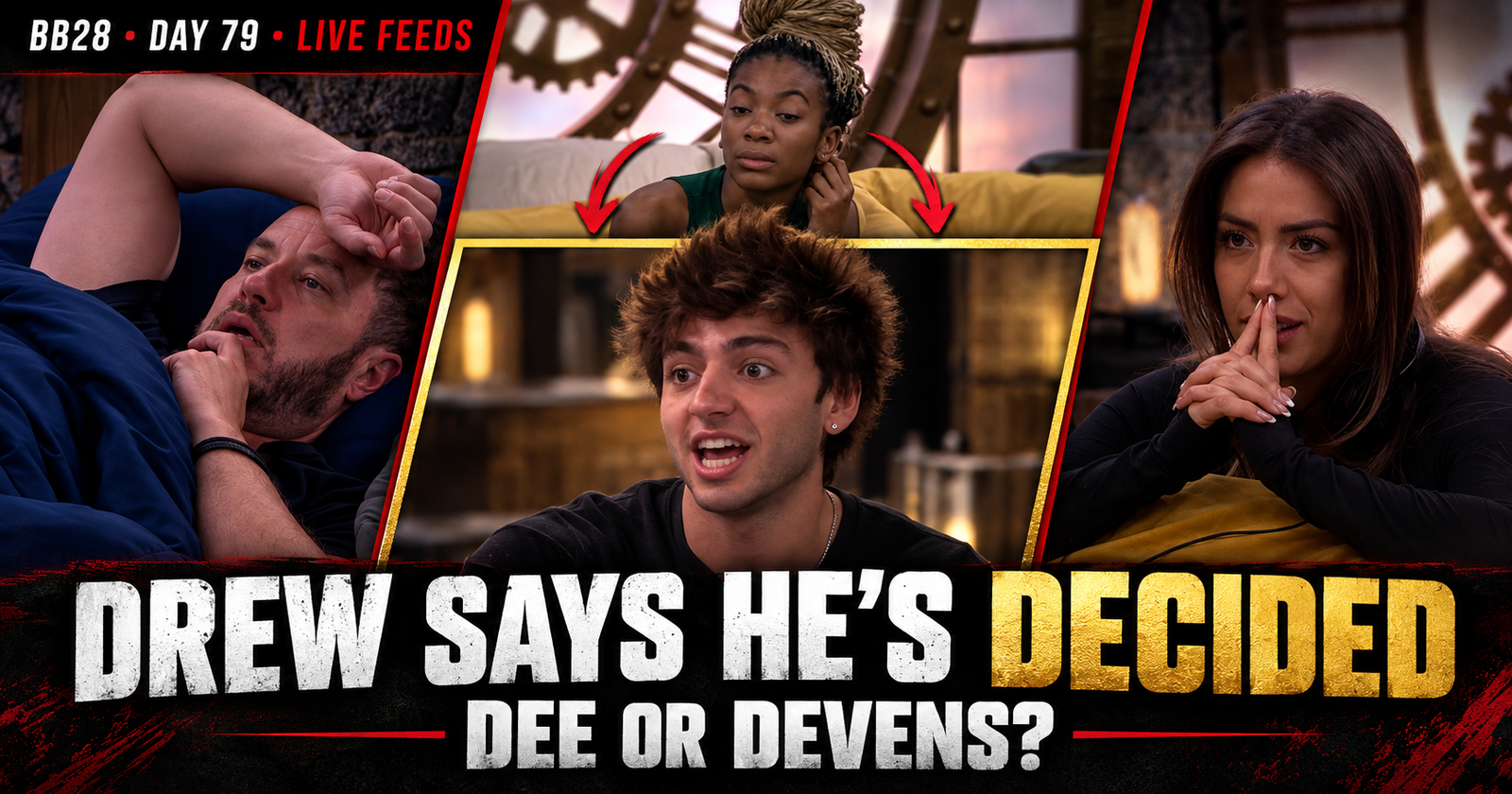
Tag: Rick Devens

  • Big Brother 28 Day 57 Live Feeds Going Into Day 58: 28 More Brutal Truths as Barrett Says “Sharpie It” and Dee and Angela Plot a 6–0 Devens Betrayal

    Big Brother 28 Day 57 Live Feeds Going Into Day 58: 28 More Brutal Truths as Barrett Says “Sharpie It” and Dee and Angela Plot a 6–0 Devens Betrayal

    DAY 57 INTO DAY 58 · WEEK 8 · HOH: DREW

    WEDNESDAY, SEPTEMBER 2 · WAFFLE WEDNESDAY

    The Big Brother 28 Day 57 live feeds going into Day 58 did not kill the Devens blindside.

    They split it into two different blindsides.

    The previous update ended with Barrett continuing to conceal a possible 4–2 vote, Angela correctly sensing danger around him and Drew remaining convinced that Devens would either win BB Lackluster or receive enough support to give Drew a tie to break.

    This continuation begins after Barrett stopped hiding the most important part from the cameras.

    If Devens remains on the block Thursday, Barrett intends to vote him out.

    “Sharpie it.”

    That was the line.

    It was not another vague conversation about exploring options. It was not Barrett telling Melody and Yash what they wanted to hear before crawling back to the Crossovers. It was Barrett alone, explaining why he would rather risk leaving next week than remain loyal until the Icons discarded him in fifth place.

    Barrett wants the move.

    He wants the résumé.

    He wants a game that belongs to him.

    And he does not want a Survivor player walking out of Big Brother 28 with the money.

    Then the week became even stranger.

    Dee and Angela began considering whether they should evict Devens too.

    They did not reach that conclusion because Barrett recruited them. They do not know how fully committed Barrett has become. They arrived there independently because Dee believes Devens is becoming closer to Drew and Barrett, potentially pushing the women beneath a three-man structure.

    The original 4–2 blindside therefore has a new ceiling.

    If Devens loses BB Lackluster, Barrett, Melody, Yash and whichever of LaLa or Taylor wins safety can produce the four votes needed to remove him without Drew receiving a tie.

    If one of Dee or Angela joins them, it becomes 5–1.

    If both do it, Devens leaves 6–0.

    Six people could evict the same man while believing they participated in two separate moves.

    Drew would be the only person excluded from both.

    While all of this sat beneath the surface, Drew spent most of the night alone with Melody. They discussed loyalty, jury management, Barrett’s social game, old betrayals, future moves and the possibility of staying together deep into the game.

    Drew may be losing Devens while rebuilding the relationship most likely to keep him safe afterward.

    That is what makes Wednesday, September 2 a genuine Waffle Wednesday.

    The votes are available.

    The motives are established.

    The nominee is confident.

    The HOH is distracted.

    And one live competition can still erase the entire story.

    Current Big Brother 28 Week 8 status

    • Day: 57 going into Day 58
    • Head of Household: Drew
    • Houseguests remaining: Nine
    • Original nominees: LaLa, Taylor and Yash
    • Power of Veto winner: Yash
    • Power of Veto decision: Yash used it on himself
    • Replacement nominee: Devens
    • BB Lackluster nominees: LaLa, Taylor and Devens
    • Drew’s intended target: LaLa
    • Barrett’s conditional target: Devens
    • Barrett’s position: Firmly intends to evict Devens if Devens loses BB Lackluster
    • Established anti-Devens path: Barrett, Melody, Yash and whichever of LaLa or Taylor wins safety
    • Dee and Angela’s position: Leaning toward evicting Devens but not locked
    • Possible anti-Devens results: 4–2, 5–1 or 6–0
    • Drew’s rescue path: Devens wins safety or one of the established four defects and creates a 3–3 tie
    • Backyard status: Locked for the BB Lackluster setup
    • Current reality: Two separate groups are considering the same eviction without coordinating with each other

    Here are 28 more brutal truths from the Big Brother 28 Day 57 live feeds going into Day 58

    1. Barrett finally said the part Drew cannot afford to hear

    Barrett is no longer merely considering evicting Devens.

    He said he would do it.

    That does not make the eviction official. Devens still has BB Lackluster, Wednesday still has an entire day of conversations ahead and Barrett will not physically cast a vote unless the competition produces the correct final nominees.

    But this is the strongest commitment Barrett can make before Thursday.

    The previous version of the story required interpreting his conversations with Melody and Yash. It required connecting his frustration with the Crossovers, his desire to pull Drew away from the Icons and his willingness to imagine a future without Devens.

    That interpretation is no longer necessary.

    Barrett gave the answer himself.

    If Devens is still sitting there, Barrett is voting him out.

    2. “Sharpie it” was Barrett placing his own credibility on the line

    Big Brother players say plenty of things to cameras that they later abandon.

    The importance of Barrett’s declaration is not that it makes him legally incapable of changing his mind. The importance is how deliberately he framed it.

    He did not say he was leaning.

    He did not say he would see how Wednesday felt.

    He did not say it depended on another conversation.

    He told viewers to write it permanently.

    That increases the cost of retreating.

    If Barrett reverses course, Melody and Yash will know he walked away from the move after allowing them to build around him. LaLa and Taylor will know his promises were situational. Barrett himself will know he surrendered the opportunity he spent two days describing as necessary for his game.

    The commitment is not irreversible.

    It is simply expensive to reverse.

    3. Barrett is not joining another side as much as he is escaping his ceiling

    Reducing this move to Barrett choosing the “newbies” over the Crossovers misses the larger strategy.

    Barrett does not completely trust Melody.

    He knows Yash can beat him.

    He does not feel closely connected to both LaLa and Taylor.

    He still wants Drew.

    This is not a clean alliance transfer.

    It is Barrett refusing to accept fifth place.

    The Crossovers protected him long enough to reach jury, but the structure never gave Barrett equal ownership. Drew, Devens, Dee and Angela had deeper relationships, more established trust and clearer paths to protect one another.

    Mallory’s eviction made the hierarchy impossible for Barrett to ignore.

    Staying loyal might keep him comfortable for another round.

    Removing Devens gives him a chance to become necessary.

    4. The Crossovers’ sudden trust arrived after Barrett stopped believing in it

    Barrett has not forgotten how often the alliance questioned him.

    He saw them prioritize other people during the medieval twist.

    He watched them distrust his relationships.

    He knew Devens worried he might flip before the veto ceremony.

    Then Devens went on the block and everyone suddenly needed Barrett to understand how deeply they trusted him.

    Barrett sees the timing.

    That does not mean every expression of affection was fake. Drew clearly cares about him. Devens enjoys him. Angela and Dee have invested socially in him.

    But trust that becomes loudest when somebody needs your vote does not feel the same as trust demonstrated when nobody requires anything.

    The Crossovers waited until Barrett possessed the deciding ballot to tell him he was indispensable.

    He heard urgency where they wanted him to hear loyalty.

    5. Barrett’s refusal to let a Survivor player win is emotional and strategic

    Barrett specifically said he would be disappointed if a Survivor player won Big Brother 28.

    That is not the most sophisticated argument he gave.

    Devens playing Survivor does not automatically make him undeserving. Barrett still has to beat everyone left, and Yash may be a more immediate competition problem than some of the remaining Icons.

    But the statement explains Barrett’s emotional investment.

    He does not want the season remembered as another game controlled by experienced crossover players. He does not want his role to become helping them reach the end and then hoping they reward him for it.

    The strategic argument is that Devens is powerful, connected and difficult to beat.

    The emotional argument is that Barrett wants this season reclaimed by somebody who began it as a Big Brother player.

    Both motivations lead to the same ballot.

    6. Barrett would rather lose loudly than finish fifth quietly

    Barrett repeatedly returned to one idea.

    He would rather make the move and leave soon afterward than remain obedient, reach fifth and realize he never played a game capable of winning.

    That is dangerous thinking when it becomes an excuse for recklessness.

    Here, it is also honest.

    Barrett’s middle position has been useful. People on both sides talk to him. Multiple players imagine his future HOH helping them. He has avoided exposing his cards.

    But the middle only remains valuable if it eventually becomes a route to power.

    If Barrett continues protecting a four-person structure that ranks him fifth, his excellent positioning becomes an elegant path to losing.

    He is choosing risk because the safe version no longer contains enough upside.

    7. Barrett’s best move will also destroy the easiest version of his game

    If Devens loses BB Lackluster and Barrett votes him out, Barrett cannot return to pretending he is equally loyal to everyone.

    Drew will know Barrett lied.

    Angela will know her suspicion was correct.

    Dee will know the Crossovers were penetrated.

    Melody and Yash will know Barrett can betray somebody close to him while maintaining the relationship until the final moment.

    LaLa and Taylor will know he made the move because he needed them.

    Barrett gains agency.

    He loses ambiguity.

    That does not make the vote wrong. It means the vote requires a second move immediately afterward.

    Removing Devens is only the beginning.

    Barrett still has to survive everyone understanding what he just proved capable of doing.

    8. A Devens BB Lackluster victory may secretly be Barrett’s safest outcome

    Barrett wants Devens evicted.

    He has also admitted that Devens winning BB Lackluster would not be the worst result for him.

    That sounds contradictory until the cost of the vote is considered.

    If Devens wins safety, Barrett never has to expose his ballot.

    Drew can continue trusting him.

    Angela can remain suspicious without receiving proof.

    Melody and Yash know Barrett was willing to act, which still earns him strategic credit with them.

    LaLa and Taylor become the final nominees.

    Barrett retains nearly every relationship.

    A Devens victory would deny Barrett the résumé move he wants, but it would preserve the middle position he has used so effectively.

    The result Barrett says he wants most is not necessarily the result that leaves him safest.

    9. Devens keeps campaigning to the voter who has already chosen the ending

    Devens repeatedly asked Barrett for reassurance.

    He joked about needing Barrett’s vote.

    He told Drew and Barrett that if he survived after losing BB Lackluster, it would be because of them.

    He treated the conversation lightly enough to suggest he still believed the alliance could be restored through familiarity.

    Barrett did not expose the plan.

    That is the brutal part.

    Devens has identified the correct voter and selected the wrong approach.

    He does not need Barrett to feel loved.

    He needs Barrett to believe keeping Devens offers a better winning path than removing him.

    So far, Devens has not supplied that argument.

    He has reminded Barrett of the alliance Barrett is trying to escape.

    10. Devens’ jury threat has failed as a deterrent

    Devens previously helped establish the idea that anyone betraying the alliance would lose the Crossovers’ jury votes.

    That threat only works if Barrett values the promise more than he fears the alternative.

    Barrett does not.

    He believes Devens is bluffing.

    He can imagine Devens reaching jury, cooling down and eventually respecting the move. Barrett may be wrong. Devens could remain bitter. Angela and Dee could punish the betrayal. Drew could view the vote as unforgivable.

    But Barrett understands the central problem.

    A future jury vote is useless if staying loyal prevents him from reaching the final two.

    Devens offered Barrett a punishment for betraying fifth place.

    Barrett decided fifth place was already a punishment.

    11. Barrett wants to remove Devens without removing Drew

    Barrett has repeatedly distinguished Drew from the Icons.

    He said he would keep Drew over an Icon.

    He believes Drew may return to him, Melody and Yash after Devens leaves instead of retreating fully toward Angela and Dee.

    That makes this a restructuring move rather than a personal attack on Drew.

    Barrett is not trying to evict Drew’s ally because he wants Drew destroyed.

    He wants Drew weakened.

    A Drew with Devens, Dee and Angela can treat Barrett as an accessory.

    A Drew without Devens may need Barrett as a bridge to the rest of the house.

    Barrett is using betrayal to create dependency.

    If Drew forgives him, it could be brilliant.

    If Drew recognizes the manipulation and refuses, Barrett may have destroyed his closest relationship for nothing.

    12. Drew keeps giving Barrett reasons to believe fifth place is real

    Drew discussed wanting LaLa, Yash and Taylor removed.

    When Barrett raised the possibility of targeting the Icons, Drew hesitated.

    That hesitation supplied Barrett with the answer.

    Drew imagines a future where the opposite side disappears first and the Icons remain protected deep into the game.

    Where does Barrett fit once LaLa, Taylor, Yash and Melody are gone?

    He fits beneath Drew, Devens, Dee and Angela.

    Drew may not have intended to communicate a final-five hierarchy. He probably believes Barrett is personally closer to him than several people inside that structure.

    But plans matter more than affection.

    Every time Drew describes an endgame filled with Icons, he confirms why Barrett needs to break it now.

    13. Taylor securing Barrett’s vote strengthened the anti-Devens structure

    Taylor asked Barrett about her safety.

    Barrett told her she had his vote.

    Taylor immediately identified that she would still have Barrett, Yash and Melody.

    That exchange mattered because it showed the alternative voting coalition is not theoretical.

    Taylor understands which relationships can protect her.

    Barrett is willing to verbalize that protection.

    Yash and Melody are already positioned beside them.

    If Taylor wins BB Lackluster, she becomes the fourth anti-Devens vote.

    If LaLa wins, the same basic structure exists with LaLa replacing Taylor as the eligible voter.

    The coalition does not need a formal name.

    It needs one safety winner and four matching ballots.

    14. Barrett’s uncertainty about Melody proves this is not a stable alliance

    Barrett openly wondered whether Melody might be playing him.

    He has given her significant information.

    He hopes she trusts him more than Drew.

    He does not know whether she would take him to the end.

    Those doubts are not side notes.

    They show that Barrett is not flipping because he believes Melody provides unconditional security. He is flipping because the current structure provides a clear ceiling.

    That makes the move more rational and more dangerous.

    Barrett is abandoning a known fifth-place path for an undefined path with greater winning potential.

    He may gain power without gaining safety.

    15. Barrett knows Yash may become the next problem

    Barrett did not ignore Yash’s threat level.

    He said Yash would beat most people at the end.

    He questioned whether he could defeat Yash himself.

    He considered whether a future double-eviction HOH should target Yash or an Icon.

    That is important because it prevents the Devens move from becoming blind worship of the other side.

    Barrett understands that evicting Devens does not solve the game.

    It changes which threat needs to be solved next.

    He cannot eliminate every dangerous player Thursday.

    He is prioritizing the threat attached to the structure that currently limits him.

    Yash can become tomorrow’s problem.

    Devens is available now.

    16. Dee and Angela independently arriving at the same vote is the real twist

    Barrett spent days building an anti-Devens option.

    Dee and Angela did not know the full plan.

    Then they began considering the same eviction.

    That is more dangerous for Devens than Barrett recruiting them would have been.

    A recruited voter can blame the recruiter and retreat.

    An independent voter has already supplied her own motivation.

    Dee believes Devens is moving closer to Drew and Barrett.

    Angela believes the balance around the men is becoming uncomfortable.

    Neither needs Barrett to convince her Devens is dangerous.

    Barrett created one blindside.

    Dee and Angela began creating another.

    The two plans happen to share a target.

    17. Dee’s fear is that the Icons are becoming a women’s pair beneath a men’s trio

    Dee described herself and Angela as sitting below Devens, Drew and Barrett.

    That is a harsh read of an alliance she helped control for much of the season.

    It is not completely irrational.

    Devens has spent significant time with Drew and Barrett.

    Drew is HOH.

    Barrett occupies the middle and receives information from everywhere.

    Dee and Angela remain close to Devens, but closeness does not guarantee final priority.

    Dee is asking whether Devens protects her because she is his most important ally or because she is useful while he builds additional routes.

    Her possible answer is to remove him before she receives proof.

    That is either excellent anticipation or an unnecessary act of self-destruction.

    There may be no middle ground.

    18. Angela’s paranoia has progressed from observation to temptation

    Angela spent the previous update watching Barrett.

    She was right.

    Barrett was considering the betrayal she feared.

    The new problem is what Angela wants to do with that information.

    Instead of exposing Barrett and pulling him back, Angela began considering whether she should join the move and let him absorb the consequences.

    That is a significant transformation.

    Angela is no longer merely afraid of losing control.

    She is tempted to use the loss of control as cover.

    The irony is vicious.

    Angela may vote out Devens because she correctly realized Barrett was planning to vote out Devens.

    Her paranoia found the correct target and then inspired her to help him.

    19. Dee’s emotion proves the decision is not casual

    Dee appeared emotional while thinking about evicting Devens.

    That does not make the move strategically correct.

    It does prove she understands what she would be destroying.

    Devens has been a loyal partner.

    He has protected her.

    He has provided competition strength, strategic aggression and a shield large enough to keep attention away from her.

    Removing him would reduce the Icons to Dee and Angela.

    It would also prevent Dee from becoming trapped beneath Devens, Drew and Barrett if her read is accurate.

    Dee is not choosing between loyalty and disloyalty in the abstract.

    She is choosing which future frightens her more.

    20. Angela may have accidentally painted Devens a goodbye present

    Angela made one of her M&M paintings for Devens.

    Devens joked that it looked like a going-away gift.

    At the time, it was a darkly funny observation from a nominee who still believed his alliance could protect him.

    Hours later, the joke looked different.

    Angela began considering whether she should help send him away.

    The painting does not prove intent.

    It does capture the surreal emotional contradiction of the week.

    Angela can care about Devens.

    She can create something personal for him.

    She can fear losing him.

    And she can still decide that evicting him is better for her game.

    Big Brother does not require betrayal to be emotionless.

    It only requires the ballot.

    21. The original 4–2 blindside can now become unanimous

    The previous mathematics remain intact.

    If Devens loses BB Lackluster, Barrett can join Melody, Yash and the safe LaLa or Taylor.

    Four votes evict Devens.

    Angela and Dee keeping him would make the final count 4–2.

    If one of them defects, the count becomes 5–1.

    If both defect, it becomes 6–0.

    That is an extraordinary change because the nomination was supposed to be safe.

    Drew placed Devens on the block expecting his alliance, his tie-breaking vote and Devens’ competition ability to protect him.

    The week has moved from a safe pawn plan to a possible unanimous eviction.

    Nobody forced that progression.

    Drew and Devens volunteered for it.

    22. Dee and Angela cannot blame a unanimous vote entirely on Barrett

    The proposed cover story has a basic mathematical flaw.

    If the vote is 6–0, there is no hidden vote to keep Devens.

    Everyone knows Angela and Dee evicted him too.

    If the vote is 5–1, Drew knows one of them defected. They may argue about which one, but they cannot make the extra anti-Devens vote vanish.

    Barrett can still absorb the emotional blame because he lied directly to Drew and represented the decisive break from the Crossovers.

    He cannot absorb all the numerical responsibility if Dee and Angela join him.

    The women may hide their individual ballots briefly.

    They cannot hide the count.

    If they make the move, they should prepare to own it.

    23. Two separate blindsides make Devens’ danger more stable and the aftermath less stable

    The anti-Devens vote is stronger because it no longer depends on one person’s courage.

    If Barrett wavers, Dee and Angela could still push the result in the same direction.

    If one of the women retreats, Barrett’s original four-vote structure remains available.

    Different motives are protecting the same eviction.

    The aftermath is much less stable.

    Barrett wants Drew pulled away from the Icons.

    Dee and Angela may expect Drew to blame Barrett and return to them.

    Melody and Yash want the power structure weakened.

    LaLa and Taylor want survival and leverage.

    Everyone can agree on Devens without agreeing on what his eviction means.

    The vote can be unified.

    The house afterward will not be.

    24. Drew’s tie-breaking vote is becoming increasingly irrelevant

    Drew has repeatedly treated the tie as his emergency protection.

    At 3–3, he can save Devens.

    That power sounds enormous until the vote becomes 4–2.

    It becomes completely decorative at 5–1.

    At 6–0, it becomes embarrassing.

    Drew built his pawn plan around the assumption that Barrett would remain loyal and the other side could produce no more than three votes.

    Barrett’s defection destroys the tie.

    Dee and Angela’s possible defection buries it.

    Drew possesses the formal power to decide a deadlock.

    Everyone else may decide not to give him one.

    25. Drew identified Barrett’s excellent social game and did nothing with the information

    Drew told Melody that Barrett has the best social game.

    He also acknowledged Barrett’s memory for dates.

    Those are not small observations.

    They describe a player with broad relationships, strong endgame knowledge and enough trust to operate between opposing groups.

    Drew understands the résumé.

    He has not understood the threat.

    That is the defining weakness of his HOH.

    Drew can describe why Barrett is dangerous and still treat him as unquestionably loyal.

    He can recognize Barrett’s middle position and still believe the middle exists to protect Drew.

    He can see every component of the move except Barrett’s willingness to make it.

    26. Drew’s late-night repair with Melody may be the only part of his HOH that works

    Drew and Melody spent hours alone.

    They discussed loyalty.

    Melody made him reaffirm it.

    Drew trusted her with “Project Scorched Earth.”

    Their personal closeness continued.

    Most importantly, Melody told Drew that Yash, Taylor and LaLa remain focused on opposing the Icons.

    That information supports Barrett’s prediction.

    If Devens leaves, Drew may not automatically become the other side’s next target. Angela and Dee remain visible Icons. Barrett may still want Drew. Melody clearly maintains an emotional and strategic connection with him.

    Drew may lose his intended target, lose Devens and lose trust in Barrett.

    He may still leave the week with Melody positioned to protect him.

    That does not rescue the HOH.

    It may rescue Drew.

    27. Melody sees Drew’s value and the résumé attached to removing him

    Melody told Drew that evicting him would be a major move.

    Then she reassured him that she would not do it.

    Both parts matter.

    Melody is emotionally connected to Drew.

    She is also thinking about jury votes, endgame perception and how she can build a winning case after a quiet competition résumé.

    She understands Drew has made moves, survived danger, lied effectively and accumulated reasons for a jury to respect him.

    Keeping Drew can protect her and give her a close ally.

    Removing Drew later could become the move that defines her game.

    Her current promise may be sincere.

    It is not permanent immunity.

    28. Waffle Wednesday is no longer about finding votes against Devens

    The votes exist.

    Barrett has four if the correct person wins safety.

    Dee and Angela could raise the count to five or six.

    The Wednesday question is whether anyone loses the nerve to use them.

    Barrett could reconsider the damage to his relationship with Drew.

    Dee could decide removing her strongest ally leaves her too exposed.

    Angela could panic about becoming the next pawn.

    Melody could prioritize Drew’s wishes.

    Yash could see another route.

    LaLa or Taylor could make a different post-competition calculation.

    And Devens can erase all of it by winning BB Lackluster.

    That is Waffle Wednesday.

    Not a house searching for a move.

    A house staring at several versions of the same move and deciding how brutal it wants the final count to become.

    Final Thoughts on the Big Brother 28 Day 57 live feeds going into Day 58

    The Big Brother 28 Day 57 live feeds going into Day 58 turned Drew’s HOH into a demolition permit for his own alliance.

    Drew wanted LaLa evicted.

    Barrett wanted a résumé.

    Dee wanted to avoid becoming disposable.

    Angela wanted to act before the men controlled her future.

    Melody and Yash wanted the power structure broken.

    LaLa and Taylor wanted another week.

    They may all get Devens instead.

    Barrett’s choice is the most dangerous move he has considered and the clearest argument that he is finally playing to win. Staying loyal probably takes him deeper. It does not necessarily take him anywhere valuable. Removing Devens gives him a chance to reclaim Drew, work with the opposite side and become more than the fifth person attached to a four-person core.

    The price is exposure.

    Dee and Angela face a more complicated judgment.

    They may be correctly detecting that Devens is becoming too close to Drew and Barrett. They may also be preparing to remove the one shield preventing the rest of the house from looking directly at them.

    If they vote Devens out, they cannot stop at the ballot.

    They need replacement relationships, a clear next target and a believable explanation for why cutting their own number improved their position.

    Blaming Barrett will not be enough.

    The vote count will speak.

    Drew’s failure remains the least defensible part of the week.

    He accepted Devens as a volunteer.

    He protected Barrett from the block.

    He planned around a tie Barrett could prevent.

    He cannot compete in the next HOH.

    He recognized Barrett’s social game without recognizing Barrett’s agency.

    And while two separate groups prepared to hijack his HOH, Drew spent the night with Melody discussing loyalty and the future.

    That relationship may save him.

    It does not make this a successful reign.

    Devens still controls the only guaranteed answer.

    Win BB Lackluster.

    If he does, Barrett never casts the revealing vote, Dee and Angela never have to choose betrayal, Drew never needs a tie and the entire anti-Devens structure disappears.

    If Devens loses, the question will not be whether he made a terrible decision by volunteering.

    That answer is already obvious.

    The question will be how many people decide to punish it.

    Four votes would expose Barrett.

    Five would expose a crack inside the Icons.

    Six would reveal that Devens was not blindsided by one side of the house.

    He was abandoned by all of it.

    Make sure to subscribe to the Late Night Crew YouTube channel. Follow @yorkjavon, @kspowerwheels, @MS_MISCHA and @LateNightCrewYT on X.

  • Big Brother 28 Day 57 Live Feeds Update: 28 More Brutal Truths as Barrett Keeps the Devens Blindside Alive and Angela’s Paranoia Finds the Right Target

    Big Brother 28 Day 57 Live Feeds Update: 28 More Brutal Truths as Barrett Keeps the Devens Blindside Alive and Angela’s Paranoia Finds the Right Target

    DAY 57 · WEEK 8 · HOH: DREW

    The Big Brother 28 Day 57 live feeds began with something potentially worse for Devens than another aggressive campaign against him.

    Almost nothing changed.

    Barrett went to sleep having lied directly to Drew about the vote. Melody and Yash went to sleep knowing a Devens eviction could be sitting there if BB Lackluster gives them the right result. Angela and Dee went to sleep worried enough about Barrett to keep talking about him. Drew went to sleep still believing his alliance would hold and Devens would probably win the competition anyway.

    Then everyone woke up.

    The blindside was still there.

    That is where the previous update ended and this continuation begins.

    The late-night story was about Barrett crossing the line from considering a move to actively concealing one. Day 57 is about whether that plan survives daylight once Devens has time to think, Angela has time to watch and Drew has time to realize that the week he created no longer belongs entirely to him.

    So far, Drew has not solved the problem.

    Devens has started asking the right question about Barrett, but he is asking it after volunteering for the block and after Barrett already built an escape route from the Crossovers. Dee understands that a blindside is possible, yet she is still reassuring Devens more than dismantling the vote. Angela is watching who talks to whom closely enough that Barrett himself has noticed.

    Meanwhile, Barrett keeps moving.

    Nothing about the eviction is finished. Devens can still erase the entire plan by winning BB Lackluster. LaLa or Taylor still has to win safety for the clean 4–2 anti-Devens path to exist. One voter changing course could still produce the 3–3 tie Drew believes he can break.

    But Day 57 has already made one thing clearer.

    The people who are most worried about Barrett have more reason to worry than the people trusting him seem willing to admit.

    Current Big Brother 28 Week 8 status

    • Head of Household: Drew
    • Houseguests remaining: Nine
    • Original nominees: LaLa, Taylor and Yash
    • Power of Veto winner: Yash
    • Power of Veto decision: Yash used it on himself
    • Replacement nominee: Devens
    • BB Lackluster nominees: LaLa, Taylor and Devens
    • Drew’s intended target: LaLa
    • Devens’ cleanest path to safety: Win BB Lackluster
    • Hidden anti-Devens structure if Devens loses: Barrett, Melody, Yash and whichever of LaLa or Taylor becomes safe
    • Expected Devens-saving votes: Angela and Dee
    • Possible anti-Devens result: 4–2
    • Drew’s emergency path: An anti-Devens voter defects, the vote falls to 3–3 and Drew breaks the tie
    • Current reality: The blindside remains possible, but it is not locked

    Here are 28 more brutal truths from the Big Brother 28 Day 57 live feeds

    1. The most important thing Barrett did overnight was wake up without changing his mind

    Big Brother blindsides are often more exciting at midnight than they are the next afternoon.

    People get emotional. Somebody floats a huge move. Everyone whispers about résumés. Then the house wakes up, eats breakfast, remembers the consequences and spends the next two days walking backward.

    That has not happened here yet.

    Barrett did not wake up and immediately run back to the Crossovers looking for a way out of what he had set in motion. The relationships supporting the anti-Devens option remain available, and Barrett is still talking comfortably with Melody while managing the suspicion coming from Angela and Dee.

    The vote is conditional.

    Barrett’s positioning is not.

    That distinction is becoming the entire story of Day 57.

    2. A quiet morning was better for Barrett than it was for Devens

    Nothing exploding before noon can look like good news for the nominee.

    In this case, it is not automatically good news.

    Devens needs disruption if he loses BB Lackluster. He needs somebody to expose the structure, frighten Barrett back into line, make Melody or Yash reconsider, or convince the eventual competition winner that keeping him serves that person better than joining the move.

    Barrett needs almost the opposite.

    He needs Drew comfortable.

    He needs Devens suspicious enough to seek reassurance but not suspicious enough to blow up the arrangement.

    He needs Angela worried without producing evidence.

    And he needs the other side to remain confident without broadcasting the vote.

    Silence therefore does not mean the blindside disappeared.

    It means nobody has forced it into daylight yet.

    3. Angela’s paranoia is becoming harder to dismiss because the thing she fears is real

    Angela is watching conversations.

    She is questioning why people are moving around the house the way they are.

    She is worried about Barrett.

    And Barrett knows it.

    Normally that combination would be an easy setup for another story about Angela spiraling herself into a problem that does not exist.

    This time, the problem exists.

    Barrett has privately discussed evicting Devens. Barrett has lied to Drew about that possibility. Barrett has spent time strengthening the relationships necessary to make the vote happen.

    Angela may not possess the complete blueprint, but she is looking in the correct direction.

    That makes dismissing her as merely paranoid one of the most dangerous things the Crossovers can do.

    4. Barrett noticing Angela’s suspicion is more important than Angela expressing it

    The advantage has shifted because Barrett knows he is being watched.

    That allows him to adjust.

    He can shorten conversations.

    He can rotate rooms.

    He can make sure he still gives Drew enough attention.

    He can reassure Devens.

    He can spend time with Angela and Dee without giving them anything concrete enough to confront him over.

    Once a deceptive player knows what behavior is creating suspicion, the suspicious side has lost part of its informational advantage.

    Angela has identified the smoke.

    Barrett has noticed her staring at it.

    Now he gets to decide how carefully he hides the fire.

    5. Devens finally asking whether Barrett could evict him is progress arriving very late

    Devens has started asking the question that should terrify him.

    Would Barrett actually vote him out?

    That is a much healthier question than simply assuming the Crossovers’ numbers remain intact.

    It is also painfully late.

    The ideal time to interrogate Barrett’s loyalty was before Devens volunteered to become Drew’s replacement nominee. The next-best time was before the veto ceremony made the nomination permanent.

    Now Devens can identify danger, but he cannot remove himself from it through strategy alone.

    He needs BB Lackluster or he needs to dismantle votes.

    Recognition still matters.

    It just no longer comes with the same range of solutions.

    6. Dee is holding pieces of the correct read without fully acting like she believes them

    Dee has already entertained the possibility that Devens could leave.

    She understands the résumé incentive.

    She understands that placing an ally on the block was an unnecessary risk.

    She understands that Barrett matters.

    Yet when Devens asks whether Barrett could actually vote against him, Dee still leans toward believing it will not happen.

    That gap is enormous.

    It is possible to identify every ingredient in a blindside and still fail to believe anybody will actually cook it.

    Dee is closer to the truth than Drew.

    She is not yet behaving like somebody certain enough of the truth to tear the house apart looking for the fourth vote.

    7. Saying “I’ll work with the other side if Devens leaves” is a recovery plan, not a rescue plan

    If Barrett defects and Devens goes, Dee can absolutely pivot.

    She may have to.

    But talking about what happens after the eviction does nothing to protect Devens before it.

    That is the strategic trap surrounding the Icons right now.

    Angela is worried.

    Dee can see the danger.

    Devens is asking questions.

    Yet too much of their energy is still aimed at reassurance, emotional management and contingency planning.

    The week requires prevention.

    A post-blindside pivot can help Dee survive the wreckage.

    It cannot put Devens back in the house.

    8. Drew is still treating a Devens BB Lackluster victory like part of his strategy

    Drew keeps returning to the belief that Devens can win the competition.

    Maybe he will.

    Devens is perfectly capable of saving himself.

    But competition ability is not a substitute for vote management.

    Drew chose to create a situation in which an ally must potentially win a three-person safety competition to prevent the HOH’s preferred voting structure from collapsing.

    That is not control.

    That is outsourcing.

    The more Drew talks as if Devens winning is the obvious outcome, the clearer it becomes that he has mentally skipped over the version of Thursday where Devens loses and Barrett gets to make the decision Drew thinks he owns.

    9. Drew’s tie-breaker remains powerful only if Barrett allows Drew to use it

    Nothing about the morning changes the central mathematics.

    If Devens remains nominated and Barrett votes with Angela and Dee, Drew can potentially receive the 3–3 tie he expects and save Devens.

    If Barrett joins Melody, Yash and the newly safe LaLa or Taylor, there is no tie.

    There is no dramatic HOH decision.

    There is no Drew rescue.

    There is a 4–2 vote.

    Drew has constitutional power over a tie.

    Barrett has practical power over whether the tie exists.

    Day 57 has done nothing to change that imbalance.

    10. Barrett is no longer merely deciding whether Devens should leave

    The more revealing part of Barrett’s conversations is what he thinks happens afterward.

    He has envisioned Devens leaving and Drew moving back toward him, Melody and Yash instead of simply falling deeper into Angela and Dee.

    That transforms the blindside from a one-night résumé move into a potential restructuring move.

    Barrett is not necessarily trying to destroy Drew.

    He may be trying to weaken Drew enough that Drew needs him more.

    That is considerably more sophisticated than flipping a vote because Devens is dangerous.

    Remove Devens.

    Separate Drew from the Icons.

    Keep a relationship with Drew.

    Then become the bridge Drew has to cross to rebuild.

    If Barrett can actually execute all four stages, the vote changes his entire game.

    11. Barrett’s relationship with Drew is exactly why betraying Drew’s plan can work

    A weaker bond would make the blindside harder.

    Drew trusts Barrett because he believes Barrett prioritizes him.

    That confidence protected Barrett from the replacement nomination.

    It made Drew comfortable asking Barrett questions without treating every answer like an interrogation.

    It allows Drew to imagine Barrett as part of his future.

    And it gives Barrett room to betray one part of Drew’s structure without necessarily believing the personal relationship has to die with it.

    This is what makes the move dangerous.

    Barrett is not exploiting the absence of trust.

    He is monetizing an abundance of it.

    12. Devens blaming Barrett for some of his uneasiness gave Barrett another reason to detach

    Barrett has now talked about how Devens was rattled and how suspicion began turning toward him.

    That matters emotionally and strategically.

    If Barrett already believed Devens was too dangerous to keep, discovering that Devens is questioning him does not make loyalty easier.

    It reinforces the fear that keeping Devens means keeping a powerful player who no longer completely trusts Barrett.

    Big Brother players often make the mistake of demanding unconditional loyalty from somebody they are simultaneously investigating.

    Devens needs Barrett’s vote.

    Barrett knows Devens has doubts about him.

    That is not the combination that naturally produces renewed trust.

    It is the combination that can turn a contemplated betrayal into self-preservation.

    13. The Crossovers are trying to repair trust after putting trust itself on the block

    There is an absurdity underneath this week.

    Devens volunteered.

    Drew accepted.

    Then the alliance started worrying about whether everyone would vote correctly.

    The entire structure assumes that being allies should be enough to make the pawn safe.

    But if the alliance were secure enough to guarantee the vote, Angela would not be panicking, Devens would not be asking Dee whether Barrett might evict him and Barrett would not be hiding an alternative plan.

    The replacement nomination did not create every crack.

    It placed the alliance directly on top of them.

    Now everybody gets to find out how deep they go.

    14. Reassuring Barrett is not the same thing as securing Barrett

    The Crossovers can make Barrett feel included.

    They can hug him.

    They can talk about future HOHs.

    They can call him family.

    They can tell him they trust him.

    None of those actions forces his ballot.

    That distinction should have become obvious the moment Barrett started operating between both sides.

    A player does not need to hate an alliance to betray it.

    He only needs to believe the betrayal improves his position.

    The Crossovers keep answering a strategic question with social affection.

    Barrett keeps accepting the affection without surrendering the option.

    15. Melody does not need Drew gone to want Devens gone

    This remains one of Drew’s biggest blind spots.

    He can correctly sense that Melody may not immediately target him and still completely misunderstand what she wants Thursday.

    Melody can appreciate Drew keeping her off the replacement seat.

    She can maintain a personal bond with him.

    She can imagine working with him again.

    And she can still vote out Devens.

    Those ideas are not contradictory.

    In fact, Devens leaving may make Drew more useful to Melody because Drew would become less attached to a dominant five-person structure and more desperate for replacement relationships.

    Melody does not need to punish Drew.

    She can remove his shield and leave the person standing behind it.

    16. Yash and Melody want the same Thursday without necessarily wanting the same Week 9

    That should scare anybody assuming the anti-Devens vote requires a stable alliance.

    Melody can imagine a future in which Drew remains workable.

    Yash has shown considerably more willingness to let Drew remain a target.

    Barrett may want to preserve Drew as a close option.

    Those are different endgames.

    They still lead to the same potential vote this week.

    Coalitions are dangerous precisely because they do not need long-term ideological agreement.

    Four people can agree on one eviction and fight each other six days later.

    Devens would still be evicted.

    17. Drew keeps digging through dead alliances because his current one is becoming less reliable

    The Dapper Dans discussion is revealing almost because of how unrealistic it sounds.

    Drew is looking backward.

    He remembers structures that once gave him options and wonders whether they can be rebuilt.

    Yash essentially sees that relationship as cooked.

    That mismatch says more than the alliance name itself.

    Drew is trying to expand his safety net at the exact moment one of the people already inside his current net is quietly cutting a hole in it.

    Rebuilding an old alliance would be useful.

    Recognizing that the present one may not survive Thursday would be more urgent.

    18. Yash can make Drew feel included without restoring anything

    Yash does not have to shut Drew down every time Drew talks about future possibilities.

    That would accomplish nothing.

    He can discuss Barrett winning HOH.

    He can entertain scenarios.

    He can talk about going deep.

    He can let Drew believe there are doors available after this week.

    None of that requires Yash to surrender the Devens vote.

    This is another reason Drew’s social comfort is misleading him.

    People continuing to strategize with the HOH does not mean they intend to obey his eviction preference.

    It means Drew is still useful enough to talk to.

    19. Two different sides wanting Barrett to win HOH tells you how successfully Barrett has positioned himself

    Drew can imagine a Barrett HOH helping him.

    Yash can talk about Barrett being due for one.

    Melody trusts Barrett enough to include him in conversations Drew is not supposed to know about.

    Angela and Dee are suspicious of him but still understand the danger of openly alienating him.

    That is extraordinary coverage.

    It is also temporary.

    The middle looks safest immediately before everybody realizes the same person has promised too much access to too many people.

    Barrett’s current game is powerful because multiple players can look at him and imagine his power helping them.

    His eventual problem will begin when they start comparing what those imagined HOHs actually mean.

    20. Barrett’s best move may also be the move that destroys his ability to hide

    If Devens wins BB Lackluster, Barrett can keep almost everything.

    He never has to cast the revealing vote.

    Drew can continue believing him.

    Angela can wonder without proof.

    Melody and Yash can know he was willing without forcing him to expose it.

    If Devens loses, Barrett faces a much more consequential choice.

    Voting out Devens gives him agency.

    It also gives everyone evidence.

    Drew will know the denial was false.

    Angela will know her suspicion was justified.

    Dee will know the Crossovers were penetrated.

    The other side will know Barrett can convincingly betray people close to him.

    That does not make the blindside a bad move.

    It makes it expensive.

    21. Angela and Dee are in danger of making Barrett’s decision easier by showing him they do not trust him

    There is an uncomfortable feedback loop developing.

    Angela senses Barrett might defect.

    Angela becomes visibly suspicious.

    Barrett notices the suspicion.

    Barrett now has another reason to wonder how secure his future really is with Angela and Dee.

    Dee then has to calm Angela so Barrett does not feel distrusted.

    The alliance becomes responsible for reassuring the possible defector because exposing that it suspects the defector might encourage the defection.

    That is a miserable strategic position.

    And it exists because they placed Devens on the block before making absolutely certain Barrett had nowhere better to go.

    22. Dee trying to plant seeds against Melody does not solve the immediate vote

    Melody is absolutely relevant to the future.

    Drew’s relationship with her matters.

    Her closeness with Yash matters.

    Her ability to slide through another round matters.

    But Devens is nominated now.

    The emergency is not next week’s Melody problem.

    It is this week’s Barrett ballot.

    This is one of those moments where a strong player can be strategically correct about a secondary issue and still be solving the wrong problem.

    If Dee wants Devens protected, every relevant conversation should eventually return to the same question:

    Who are the three votes, who is the potential fourth, and what can be offered to break them?

    Everything else is tomorrow’s problem.

    23. Devens cannot intimidate his way back into certainty

    The earlier jury-vote warning may have sounded powerful when Devens still believed the alliance controlled the vote.

    It becomes less useful the more Barrett believes cutting Devens is necessary.

    Threatening somebody with jury consequences can deter a nervous defection.

    It can also confirm that keeping you is dangerous.

    Barrett has to calculate whether one angry juror is worse than allowing Devens to survive another round with Drew, Dee and Angela around him.

    If Barrett already believes Devens is suspicious of him, the intimidation route becomes even less appealing.

    Devens needs votes.

    Fear is not automatically a vote.

    24. Drew’s relationship repair with Melody could succeed personally and fail strategically at the same time

    Drew and Melody continue finding their way back into conversations.

    That matters.

    There is obvious history there, and Drew may genuinely be improving his chances of not becoming Melody’s immediate target.

    But Drew keeps treating personal reconciliation as if it must produce strategic obedience.

    It does not.

    Melody can forgive Drew.

    She can enjoy him.

    She can decide not to nominate him.

    She can even imagine going deep with him again.

    Then she can walk into the Diary Room and vote Devens out because keeping Devens does nothing for her.

    Drew may successfully repair the relationship while still losing the vote.

    That is what makes this week so brutal for him.

    25. Drew being unable to play in the next HOH makes every mistake this week more expensive

    Drew knows he is vulnerable.

    He keeps bringing it up.

    And he should.

    The HOH who cannot compete next week is supposed to use the current week to leave behind a stable structure.

    Drew may be doing the opposite.

    If Devens leaves, Drew loses an ally.

    If Barrett exposes himself as the flip, Drew loses certainty about another ally.

    Angela and Dee become an obvious pair on one side.

    Melody and Yash become potential options with their own agendas.

    And Drew walks into the next HOH unable to protect himself directly.

    That is why this week cannot be evaluated only by who leaves.

    The aftermath may matter even more.

    26. The vote count has not changed, but the information imbalance has gotten worse for Devens

    On paper, the same possible six votes remain.

    Angela.

    Dee.

    Barrett.

    Melody.

    Yash.

    And whichever of LaLa or Taylor survives BB Lackluster.

    The problem is not the arithmetic.

    It is who knows the arithmetic.

    Barrett, Melody and Yash understand the alternative path.

    Angela understands enough to be scared.

    Dee understands enough to contemplate the consequences.

    Devens understands enough to ask about Barrett.

    Drew still appears to trust that the combination of Barrett’s loyalty, Devens’ competition ability and his own tie-breaker gives him sufficient protection.

    The person with formal power may still have the least useful version of the information.

    27. BB Lackluster is becoming Devens’ clean solution because strategy has made every other solution messy

    If Devens wins, none of this matters Thursday.

    He removes himself.

    Barrett never gets to cast the anti-Devens vote.

    Drew no longer needs a tie.

    Angela and Dee do not need to expose their suspicion.

    Melody and Yash lose the opening.

    LaLa and Taylor become the final nominees.

    That is why the competition is now so enormous.

    It is not merely safety.

    It is an eraser.

    A Devens victory can erase the entire strategic crisis before anyone has to show their cards.

    A Devens loss forces everyone to put those cards on the table.

    28. Drew’s HOH is one competition away from becoming somebody else’s résumé move

    That remains the most unforgiving possibility of Week 8.

    Drew won HOH.

    Drew made the nominations.

    Drew accepted Devens as his replacement nominee.

    Drew protected Barrett from the block.

    Drew told everyone the target he wanted.

    And Drew believes he can protect Devens if the vote ties.

    But if LaLa or Taylor wins BB Lackluster and Barrett follows through, Drew will have supplied almost every mechanism required to evict one of his own strongest allies.

    Barrett will have supplied the decision.

    That is not merely losing control of an HOH.

    That is watching somebody else turn your HOH into their move.

    Final Thoughts on the Big Brother 28 Day 57 live feeds

    The most revealing thing about the Big Brother 28 Day 57 live feeds is that the loudest paranoia in the house may currently be closer to reality than the calmest confidence.

    Angela looks worried because she is watching Barrett.

    She should be.

    Barrett really has entertained the vote she fears. He really has built relationships on the other side. He really has concealed his intentions from Drew. And now he knows Angela is watching closely enough that he has to think about how his conversations look.

    Drew, meanwhile, remains calmer because he thinks he understands the structure.

    Barrett is with him.

    Devens can win BB Lackluster.

    If Devens loses, Drew can break a tie.

    Each individual assumption sounds reasonable.

    Stack them together and they become the trap.

    Barrett does not need to stop caring about Drew to evict Devens. Devens does not have to be a weak competitor to lose one competition. Drew cannot break a 4–2 vote. And the people willing to make that 4–2 happen do not need to remain allies afterward.

    That is why Day 57 feels less like a vote flip being created and more like a previously created vote waiting to learn whether it will be allowed to exist.

    The blindside survived the night.

    Angela’s suspicion survived the reassurance.

    Devens has finally started asking whether Barrett could actually betray him.

    And Barrett is still navigating both sides rather than sprinting home to the Crossovers.

    Nothing is locked.

    Nothing should be written as if Devens has already been evicted.

    BB Lackluster can still destroy the entire story in minutes.

    But if LaLa or Taylor wins safety, Drew may finally discover the difference between possessing a tie-breaking vote and possessing control.

    He can save Devens at 3–3.

    Barrett can make sure he never gets the chance.

    And if that happens, the final indignity of Drew’s Week 8 HOH will be simple: Drew will have nominated Devens, protected Barrett and created the exact vote Barrett needed to make Drew’s week belong to him.

    Make sure to subscribe to our Late Night Crew Youtube Channel. Follow @yorkjavon@kspowerwheels@MS_MISCHA & @LateNightCrewYT on X.
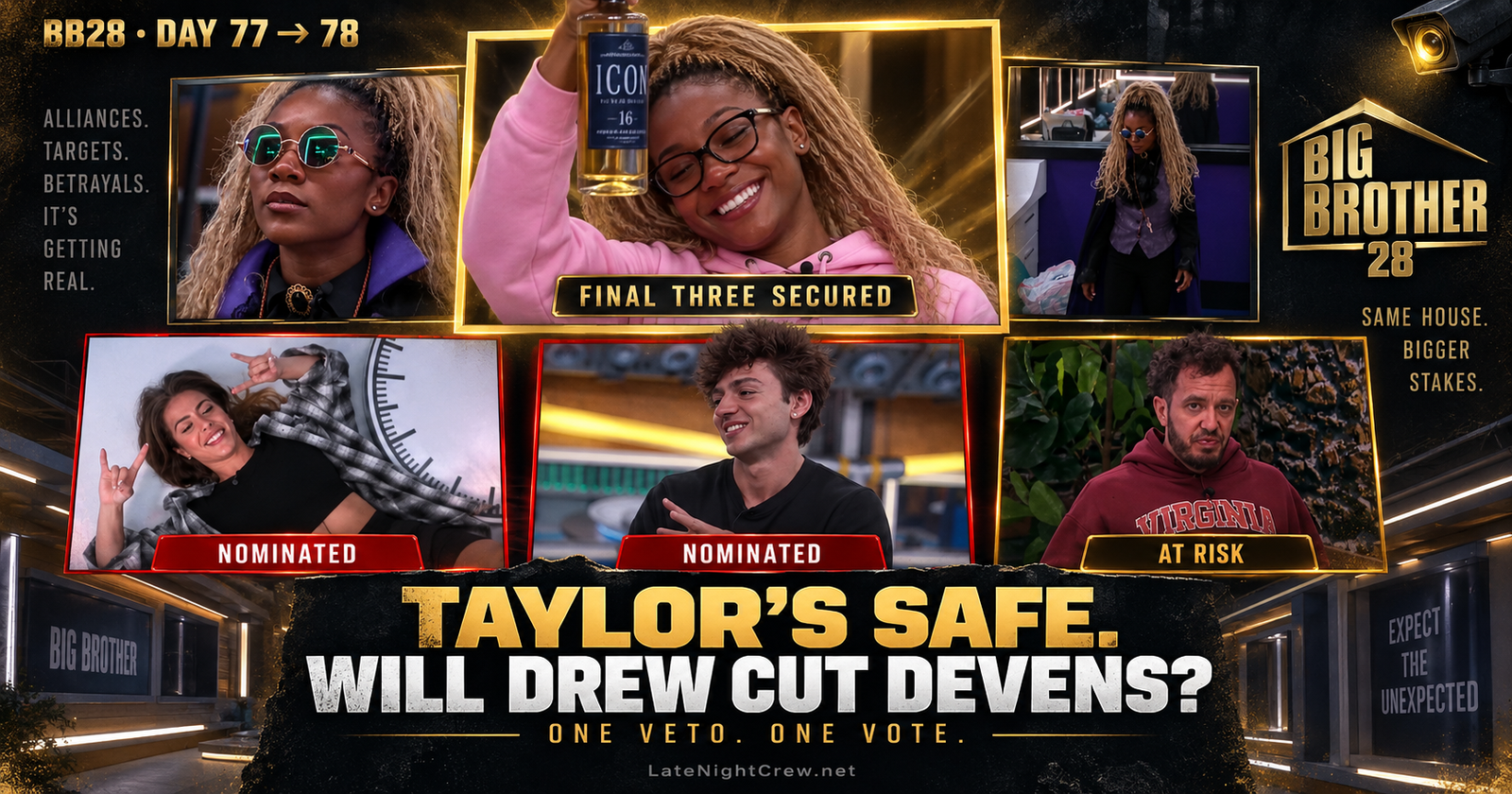
  • Big Brother 28 Day 56 Live Feeds Update Going Into Day 57: 28 More Brutal Truths as Barrett Lies to Drew and a 4–2 Devens Blindside Takes Shape

    Big Brother 28 Day 56 Live Feeds Update Going Into Day 57: 28 More Brutal Truths as Barrett Lies to Drew and a 4–2 Devens Blindside Takes Shape

    DAY 56 INTO EARLY DAY 57 · WEEK 8 · HOH: DREW

    The BB28 Day 56 late-night live feeds did not end with Drew controlling the week. They ended with Drew asking Barrett the one question that mattered, Barrett looking him in the face and giving him the answer Drew wanted, and then Barrett returning to the people helping him prepare the exact outcome he had just denied.

    That is where the previous update ended and this continuation begins.

    The veto ceremony had already put Devens beside LaLa and Taylor. Drew had already made it clear that LaLa was his intended target. Barrett had already privately opened the door to evicting Devens if Devens failed to save himself in BB Lackluster. By late night, the idea was no longer a loose possibility buried inside one conversation. The potential voters were comparing notes, calming suspicions and talking through what the house could look like after Devens walked out.

    Nothing is finished. Devens can still win BB Lackluster. A single expected vote could still break the other way and create the 3–3 tie Drew believes he can use to save him. But the structure of the week has changed. Drew may hold the tie-breaking vote, yet Barrett currently holds the information that decides whether Drew ever gets to use it.

    Current Big Brother 28 Week 8 status

    • Head of Household: Drew
    • Houseguests remaining: Nine
    • Original nominees: LaLa, Taylor and Yash
    • Power of Veto winner: Yash
    • Power of Veto decision: Yash used it on himself
    • Replacement nominee: Devens
    • BB Lackluster nominees: LaLa, Taylor and Devens
    • Drew’s intended target: LaLa
    • Hidden contingency: Barrett, Melody and Yash are prepared to evict Devens if he loses BB Lackluster
    • Expected fourth anti-Devens vote: whichever one of LaLa or Taylor wins safety
    • Expected votes to keep Devens: Angela and Dee
    • Expected number of voters after BB Lackluster: Six
    • Current danger line: a possible 4–2 vote against Devens, with a 3–3 tie still available if one expected anti-Devens voter defects

    Here are 28 more brutal truths from the BB28 Day 56 late-night live feeds going into Day 57

    1. The trap from the afternoon became an operating plan after dark

    The previous update ended with Barrett quietly positioned to turn Drew’s pawn plan against him. The late-night Big Brother 28 Day 56 live feeds showed that this was not a passing emotional reaction or a fantasy Barrett would abandon once Devens felt nervous.

    Barrett kept the plan alive while moving through both sides of the house. He reassured Drew. He let Devens believe the Crossovers still had him. Then he met with Melody and Yash and discussed the week as if Devens leaving were a real, desirable outcome.

    The distinction matters. Houseguests float dramatic ideas every day. Most die the moment someone has to lie, count votes or accept the consequences. Barrett crossed all three thresholds. The blindside is still conditional on BB Lackluster, but the plan itself is no longer hypothetical.

    2. Drew thinks announcing his tie-breaking intention gives him control

    Drew plans to be vocal that he will keep Devens in a tie. On the surface, that sounds forceful. It tells uncertain voters what happens if they split evenly and warns them that a 3–3 vote will fail.

    The problem is that this information does not intimidate a group that believes it can reach four. It helps that group audit its numbers.

    Drew is treating the tie-breaker like a shield when it is really an emergency exit that only opens if Barrett gives him a tie. If Barrett votes with Angela and Dee, Drew gets the public moment he expects. If Barrett votes with Melody, Yash and the BB Lackluster winner, the week ends 4–2 and Drew sits through the reveal without touching the decision.

    His authority is real, but the conditions required to use it are controlled by somebody else.

    3. Barrett lied to Drew when Drew finally asked the right question

    Drew eventually asked Barrett directly whether he was thinking about evicting Devens. It was the cleanest question Drew could have asked, and Barrett answered no.

    That answer was false.

    Barrett did not hedge, ask what Drew had heard or leave himself room to change his mind. He gave Drew the reassurance necessary to stop the investigation. Soon afterward, Barrett was back with Melody and Yash discussing the outcome Drew had just asked him to deny.

    This was the pivotal late-night moment because it removed the comforting excuse that Drew simply had not checked. He checked. Barrett beat the check. Drew’s read now depends less on missing information than on believing a relationship that Barrett is actively using as cover.

    4. Barrett’s lie was a strategic choice, not a panic response

    Barrett had other options. He could have warned Drew that he was undecided. He could have pushed for a concession. He could have blamed the changing house or told Drew that Devens had become too dangerous. Instead, he protected the blindside.

    That choice reveals intent. Barrett understands that the move has value only while Drew, Devens, Angela and Dee believe he remains inside their number. The lie keeps Devens comfortable, prevents Drew from launching an emergency campaign and allows Barrett to continue collecting information from the Crossovers.

    It also raises the cost. If the vote lands 4–2, Barrett will not be able to sell it as a last-minute decision. Drew asked. Barrett denied it. The blindside would therefore be both a vote against Devens and a direct break with Drew.

    5. Barrett, Melody and Yash understand exactly what BB Lackluster must deliver

    The anti-Devens trio did not talk as if every competition result served them equally. They know the plan requires LaLa or Taylor to win safety. That result would leave Devens on the block and turn the winner into the likely fourth vote needed to evict him.

    If Devens wins, the entire structure collapses. LaLa and Taylor become the final nominees, Barrett no longer gets a vote against Devens, and Drew’s original target probably leaves.

    That is why this is not yet a completed blindside. It is a loaded vote waiting for the competition to point it at the correct nominee. The house can do all the whispering it wants, but BB Lackluster still decides whether the coup is available or erased in a few minutes.

    6. The 4–2 vote is real, but it is not locked

    The vote math exposed by the BB28 Day 56 late-night live feeds is clean. If Devens loses BB Lackluster, the anti-Devens count is Barrett, Melody, Yash and whichever one of LaLa or Taylor comes off the block. Angela and Dee are the expected votes to keep him. That produces 4–2 and leaves Drew powerless to intervene.

    But “expected” is doing important work. LaLa and Taylor still have to compete. The winner still has to follow through after becoming safe. Barrett still has to maintain the lie under pressure. Melody and Yash still have to resist whatever promises arrive before the live vote.

    One defection changes 4–2 into 3–3. Drew then breaks the tie for Devens. The honest read is not that Devens is already gone. It is that his survival has become dependent on either winning safety or breaking a coalition he does not fully know exists.

    7. The anti-Devens voters do not need a durable alliance to execute one vote

    Barrett, Melody, Yash, LaLa and Taylor do not need to trust one another for the rest of the season. They do not need a polished alliance name, matching endgame plans or identical targets. Four of them only need to agree that removing Devens now is better than leaving him in the house for another week.

    That limited purpose makes the vote more dangerous than Drew appears to understand. He keeps evaluating relationships as if a coalition must survive next week to be real tonight. It does not.

    A temporary voting bloc can destroy a permanent alliance. Afterward, its members can turn on one another. Devens would still be gone, the Crossovers would still be broken, and Drew would still have spent his HOH creating the opportunity.

    8. Angela sensed the danger before she had the full evidence

    Angela became visibly uneasy when Barrett spent time outside with the other side. She questioned his loyalty, sought reassurance and struggled to hide how much the possibility bothered her.

    Her delivery risked making the problem worse, but the underlying instinct was correct. Barrett was not merely socializing. He was preserving the relationships that give him an alternative to the Crossovers and a path to vote out Devens without standing alone.

    Angela’s problem is that she recognized the symptom while her alliance treated her reaction as the larger threat. Calming her became more urgent than investigating Barrett. That allowed the person she feared to reassure everyone and continue operating. Paranoia can destroy an alliance, but dismissing accurate paranoia can do it faster.

    9. The Crossovers spent too much time proving they were still the Crossovers

    Devens, Drew, Angela, Dee and Barrett moved into reassurance mode. They discussed loyalty, the jury and the idea that the group remained a family. They hugged. They staged the emotional image of unity. They tried to make the alliance feel solid enough that nobody would question it.

    None of that changed the vote count.

    The most dangerous person in the group was able to participate in the reassurance while withholding his actual plan. That is the weakness of alliance theater: it measures who is willing to perform loyalty, not who intends to vote with the group.

    Barrett did not have to reject the hug to betray them. He only had to accept it, smile, and keep his real vote for the people waiting later that night.

    10. The “happy family” moment may become the week’s most embarrassing footage

    The Crossovers’ group embrace was meant to settle nerves. If Devens leaves 4–2, it will instead become the visual summary of how badly the alliance misread its own condition.

    Barrett stood inside the celebration while holding the vote that could end the group. Drew was already promising to protect Devens in a tie. Angela was searching for certainty. Dee was trying to keep everyone composed. Devens needed to believe the structure around him was intact.

    Only Barrett could enjoy both versions of the night. With the Crossovers, he was family. With Melody and Yash, he was part of the plan to remove the family’s most visible strategist. The hug did not expose his duplicity. It gave it better camouflage.

    11. Dee identified the original mistake more clearly than Drew did

    Dee called out the decision that created this mess: Devens volunteering for the replacement seat. She understood that going on the block was not a symbolic favor. It subjected him to a competition he could lose and a vote his allies might not control.

    That judgment is cleaner than the spin surrounding it. Devens believed his résumé, relationships and alliance structure made the risk manageable. Drew believed nominating him could protect the true plan while leaving enough votes to save him. Both assumptions depended on Barrett remaining loyal.

    The moment an alliance’s survival requires one person never to use his options, the pawn is no longer safe. Devens did not volunteer for temporary discomfort. He volunteered to let Barrett decide whether his game continues.

    12. Devens is courting the decisive vote without realizing how far it has moved

    Devens checked in with Barrett, emphasized trust and pushed the idea that the Crossovers remained strong. He clearly understands that Barrett matters. What he does not appear to understand is that Barrett’s value has shifted from nervous ally to possible executioner.

    The more Devens presses for reassurance, the easier it becomes for Barrett to identify exactly what the veterans fear. Barrett can hear their concerns, confirm what they expect and return to the other side with a clearer picture of how to keep the blindside hidden.

    Devens still has weapons. He can win BB Lackluster. He can campaign. He can expose deals and force people to confront the next-week consequences. But reassurance is not evidence, and every calm answer from Barrett currently protects Barrett more than it protects Devens.

    13. Drew noticed the Mallory scrunchie, then talked himself away from the warning

    Drew questioned why Barrett was wearing Mallory’s scrunchie and wondered whether Barrett might be the biggest finesser in the house. That was not meaningless jealousy over an accessory. The scrunchie represented a relationship Barrett had maintained across the divide and a social identity broader than the Crossovers.

    Drew briefly saw the correct picture: Barrett may be close enough to everyone that each side mistakes access for ownership.

    Then Drew returned to reassurance. He told Barrett that Barrett was his priority and accepted the loyalty he received in return. Drew’s instinct located the danger, but his emotional investment negotiated it away. He does not lack clues. He lacks the willingness to follow the clues to the conclusion that would hurt most.

    14. Drew and Barrett’s mutual-priority conversation was unequal

    When Drew told Barrett that Barrett was his game priority, Drew was exposing a real hierarchy. His actions support it. He protected Barrett from the replacement nomination and has repeatedly imagined a path forward that includes him.

    Barrett’s matching reassurance did not carry the same weight. He was already preserving a move that could remove Devens, fracture Drew’s alliance and force Drew to crawl toward him afterward.

    The conversation sounded reciprocal, but the information was not. Drew gave Barrett confidence that their relationship would survive pressure. Barrett gave Drew confidence designed to prevent pressure. One man was defining loyalty. The other was managing a mark.

    15. Drew accidentally handed Melody another piece of his alliance history

    Drew let the name Toolshed slip in front of Melody, tried to cover it, and eventually admitted that it had been the name of an old eight-person alliance. The alliance may be dead, but the mistake still matters.

    It reinforced a larger problem with Drew’s game: people keep learning that his network has more layers, names and abandoned structures than he initially admits. Every accidental disclosure makes his current promises feel less exclusive.

    Melody did not need the Toolshed to be active. She only needed the confirmation that Drew had once built another broad structure and was willing to conceal it. On a night when Barrett was already hiding a vote from Drew, Drew was giving Melody another reason to believe secrecy is simply how his side operates.

    16. Drew keeps trying to solve strategic exposure with personal repair

    Drew spent significant time talking through loyalty, priorities and future relationships. He even joked that he might be bad at the game because he spends so much time looking in the mirror. The joke landed closer to the truth than he intended.

    His problem is not that he lacks social bonds. It is that he keeps using those bonds as proof that people will make decisions against their own interests. Barrett can care about Drew and still evict Devens. Melody can appreciate being spared and still help destroy Drew’s alliance. Yash can have an honest conversation with Drew and still nominate him later.

    Drew is looking for emotional confirmation when he needs an adversarial vote count. The house is giving him warmth. The math is giving him a warning.

    17. Melody can respect Drew’s move and still vote out his pawn

    Melody told Drew that nominating Devens was respectable. That compliment should not be confused with permission to control the outcome.

    From Melody’s perspective, Drew made a move she had wanted to see. He put a dangerous player in jeopardy and spared her from the replacement seat. She can reward that decision by avoiding Drew if she wins the next HOH while still taking the opportunity to evict Devens now.

    That is the subtle punishment waiting for Drew. Melody does not have to declare war on him to dismantle his intended week. She can treat the nomination as evidence that Drew is workable and treat Devens’ eviction as the price of finally having him vulnerable.

    18. Melody’s promise not to nominate Drew does not mean she is saving Devens

    Late in the night, Melody said she would not nominate Drew after he spared her. That gives Drew a plausible benefit even if his target survives. It also explains why Melody can participate in the blindside without viewing Drew as her immediate enemy.

    Her position is more sophisticated than a simple side-versus-side vote. Remove Devens, keep Drew available, and let Drew lose the shield that has repeatedly absorbed attention in front of him. Drew may then have fewer options and more reason to rebuild with her, Barrett or Yash.

    This is why the blindside could isolate Drew without automatically evicting him next. Melody is not promising to preserve his power. She is promising that she may preserve him after helping take it away.

    19. Drew floated a Dapper Dans reunion while Devens was sitting in danger

    Drew entertained the idea of reviving the Dapper Dans with Yash, even as Devens sat on the block and Yash quietly preferred that Devens leave. Yash dismissed the old structure as cooked.

    The exchange exposed the distance between Drew’s memory of his options and the house’s current reality. He still sees abandoned relationships as doors that might reopen if he says the right thing. Yash sees the damage, remembers how Devens handled people who trusted him and has little interest in pretending the old arrangement is intact.

    An alliance cannot be revived by nostalgia alone. Drew is searching for backup plans among people who are already discussing how to use his HOH against him.

    20. Yash gave Drew conversation without giving him control

    Yash talked with Drew about competition wins, targets and the possible benefits of Devens leaving. The conversation was useful to Yash because it let him test Drew’s reaction without revealing the full vote structure around Barrett and Melody.

    Drew appears to believe Yash sees Devens as a target, but that knowledge did not push him to investigate deeply enough. He still expects Devens to win BB Lackluster and still imagines that Barrett remains on his side if Devens does not.

    Yash did not need to lie as cleanly as Barrett. He only needed to keep the most important connection hidden: the anti-Devens voters were no longer isolated individuals. They were comparing their assumptions and preparing for the same result.

    21. Yash’s $5,000 bribe makes the post-Devens landscape messier

    Yash’s accepted bribe prevents him from nominating Dee, Devens or Angela the next time he becomes HOH. If Devens leaves this week, two protected names remain, and Drew is not one of them.

    That restriction helps explain why Yash can favor the blindside without having a perfectly clean follow-up plan. He can remove Devens now, then face a narrower nomination board later. Drew remains available. So do other houseguests outside the protected trio.

    The deal also gives Drew a reason to worry about where Yash’s frustration goes if Devens disappears. Removing one target does not erase the pressure. It redirects it. Drew’s current HOH could therefore eliminate his ally and leave him as the most obvious legal target for a future Yash HOH.

    22. Barrett can improve his position this week and damage it next week

    The BB28 Day 56 late-night live feeds made the upside of Barrett’s choice obvious. Evicting Devens would be a major display of agency. Barrett would help remove a dangerous strategist, prove his value to Melody and Yash, and prevent the veterans from carrying an intact five into the next round.

    It would also expose him.

    Angela and Dee would know he betrayed them. Drew would know the direct denial was a lie. Any argument that Barrett was dragged into the vote would be weakened by the private planning and the timing. The other side might celebrate the move while still recognizing that Barrett can convincingly deceive his closest allies.

    The blindside is not automatically a perfect move. It is a high-upside move with a receipt attached. Barrett’s challenge will be surviving the moment everyone reads it.

    23. LaLa and Taylor are not passengers in somebody else’s blindside

    The conversation naturally centers on Barrett because his defection changes the Crossovers’ count. But LaLa and Taylor control the doorway to the vote.

    One of them must beat Devens in BB Lackluster. The winner then comes off the block and is expected to cast the fourth vote against him. The loser remains nominated beside Devens and benefits directly from that vote.

    That makes the competition both personal and structural. LaLa and Taylor are fighting for individual safety, but either victory can also collapse the power arrangement that put them in danger. If both lose to Devens, all of the late-night planning becomes useless and they face each other on eviction night. Their agency begins before the ballot is cast.

    24. LaLa’s fear is real, but so is the leverage hidden inside it

    LaLa broke down under the pressure of the block and the possibility that her game could end. The emotion was not strategy theater. She has every reason to be scared when Drew wants her out and the final safety competition may decide whether she even reaches the vote.

    Yet LaLa is closer to power than the surface suggests. If she wins BB Lackluster, she does more than save herself. She becomes a voter in a potential 4–2 eviction of Devens. She can help remove the player Drew used as a pawn and leave Drew facing the wreckage of his own nomination.

    The week has reduced LaLa to a target in Drew’s plan, but the competition can turn that target into the vote that invalidates the plan.

    25. Melody’s grief over Mallory is becoming motivation, not paralysis

    Melody admitted that she misses Mallory, regrets how she handled parts of their relationship and wishes she had apologized for the first week. She also confronted the fact that she has not won and needs to start doing it.

    That emotional thread matters because Barrett was one of the people willing to sit with her in it. Their relationship is not built solely on this week’s vote. The comfort, the shared connection to Mallory and the belief that they can still change the game give the anti-Devens plan a human foundation the Crossovers cannot dissolve with one group hug.

    Melody is grieving, but she is not withdrawing. She is turning the loss into a reason to stop watching other people dictate the season.

    26. The late-night alliance map is uglier than the public labels suggest

    The BB28 Day 56 late-night live feeds ended with two overlapping realities. The Crossovers still existed as a public alliance, but Barrett was functioning as a bridge into the anti-Devens vote. Drew remained close to Melody, while Melody wanted Devens out and was willing to keep Drew available afterward. Yash could talk openly with Drew while rejecting the alliance Drew hoped to revive.

    HouseguestPublic or visible positionLate-night operating position
    DrewHOH protecting Devens if neededTrusting Barrett and expecting his tie-breaker to matter
    BarrettCrossover member and Drew priorityPrepared to evict Devens if the competition allows it
    MelodyOutside the Crossovers, spared by DrewWorking with Barrett and Yash while keeping a door open to Drew
    YashVeto winner with old ties to Drew and DevensWants Devens out and sees the old Dapper Dans as finished
    AngelaCrossover loyalistCorrectly worried about Barrett, but unable to prove the betrayal
    DeeCrossover loyalistPrepared to keep Devens and pivot if the alliance is blindsided
    LaLa and TaylorDrew’s intended target and adjacent nomineeEach can become the fourth anti-Devens vote by winning safety
    DevensPawn expecting alliance protectionMust win safety or break a vote structure hidden behind reassurance

    This is not a house split. It is a set of temporary interests hiding inside old labels.

    27. Every BB Lackluster result now creates a different Week 8 ending

    The final competition is not a minor pre-vote formality. It selects which version of the week is even possible.

    BB Lackluster winnerFinal nomineesMost likely immediate outcomeWhat it means for Drew
    DevensLaLa and TaylorLaLa remains Drew’s intended targetDrew’s original plan survives and the blindside disappears
    LaLaTaylor and DevensFour votes may be available to evict DevensDrew can lose his pawn and his alliance structure in one vote
    TaylorLaLa and DevensFour votes may be available to evict DevensDrew’s target can survive while Devens leaves 4–2
    Either LaLa or Taylor, but one voter defectsDevens and the other nomineeA 3–3 tie becomes possibleDrew can save Devens, but the attempted betrayal is exposed

    The competition winner will not merely save one nominee. That person will determine whether Barrett gets the chance to reveal his real vote.

    28. Drew’s HOH could become Barrett’s résumé move

    Drew won the power, selected the nominees, accepted Devens as the replacement and kept Barrett away from the block. If the week ends with LaLa leaving, Drew can claim that the dangerous detour never changed his intended result.

    If Devens leaves 4–2, the story belongs to Barrett.

    Barrett will have used Drew’s trust to remain safe, used Devens’ confidence to prevent a defensive scramble, used his relationships with Melody and Yash to assemble the alternative, and used Drew’s own nomination to remove one of Drew’s strongest allies. Drew will have supplied every formal mechanism. Barrett will have supplied the outcome.

    That is the sharpest possibility entering Day 57: the HOH may get credit for making a move he never wanted, while the person he protected gets credit for finishing it.

    Final Thoughts on the BB28 Day 56 late-night live feeds going into Day 57

    The BB28 Day 56 late-night live feeds did not lock an eviction. They did something more interesting: they separated visible power from usable power.

    Drew has the HOH room, the replacement nomination on his résumé and the authority to break a tie. Devens has an alliance publicly surrounding him and one final competition he can win. Angela and Dee have correctly identified that something could go wrong. None of them currently controls Barrett’s ballot.

    Barrett spent the night living in the gap between what the Crossovers wanted to believe and what Melody and Yash were prepared to do. He reassured the people who think he is their third vote, then protected the plan that would make him the fourth vote against them. That is not an accidental middle position anymore. It is a choice.

    The next result decides whether the choice matters. A Devens victory in BB Lackluster wipes away the blindside and sends the week back toward LaLa versus Taylor, with LaLa still in the greatest danger. A LaLa or Taylor victory opens the vote Drew has been trying not to see. Barrett, Melody, Yash and the newly safe nominee can reach four. Angela and Dee can reach two. Drew can only save Devens if somebody first gives him a tie.

    That is the entire week reduced to one unforgiving fact: Drew can control a 3–3 vote, but Barrett can prevent one.

    Day 56 began with Drew trying to complete a careful target plan. Early Day 57 arrived with his closest protected relationship hiding the vote that could ruin it. Now the house waits for BB Lackluster to decide whether Barrett’s lie remains an invisible piece of positioning or becomes the move that breaks the Crossovers in public.

    Make sure to subscribe to our Late Night Crew Youtube Channel. Follow @yorkjavon@kspowerwheels@MS_MISCHA & @LateNightCrewYT on X.

  • Big Brother 28 Day 55 Live Feeds Update Going Into Day 56: 28 More Brutal Truths as Drew Puts Dee in the Renomination Crosshairs

    Big Brother 28 Day 55 Live Feeds Update Going Into Day 56: 28 More Brutal Truths as Drew Puts Dee in the Renomination Crosshairs

    DAY 55 INTO EARLY DAY 56 · WEEK 8 · HOH: DREW

    Big Brother 28 Day 55 live feeds did not settle Drew’s Week 8 Head of Household reign. They exposed how little control he has over the people he believes he is protecting.

    When we left off in the previous Day 55 update, Yash had won the Power of Veto and was expected to remove himself from the block. Drew was leaning toward using Devens as the replacement nominee, Melody remained the alternative being pushed by Dee, and LaLa remained Drew’s intended eviction target.

    That appeared to be the shape of the week. Then Drew spent the afternoon protecting Melody, briefly entertained Barrett as an alternative, accepted Devens’ offer to become a pawn, learned nothing about Barrett and Melody’s private intentions, and eventually told Melody that neither she nor Barrett would be nominated.

    By approximately 3:09 a.m. PT on early Day 56, Drew had reopened the entire decision.

    After emerging from a lengthy Diary Room session, he began asking why Dee should be allowed to escape the consequences of nominating him and playing selfishly during her HOH. He compared Dee’s competition record with Devens’ weaker performances, rehearsed what he could say at the veto ceremony and asked whether that ceremony could happen later in the day.

    The timing is noticeable. It is not proof that production handed Drew an idea. What the feeds do prove is that Drew went into the early morning treating Devens as his likely pawn and came out treating Dee as a legitimate replacement-nominee option.

    That is where the Week 8 game stands heading deeper into Day 56: Devens remains the established plan, Dee is now a real alternative, Melody and Barrett have received promises of safety, and Drew is discovering that postponing a decision does not make the consequences disappear.

    Current Big Brother 28 Week 8 status

    • Day covered: Day 55 into early Day 56
    • Updated through: Approximately 3:18 a.m. PT on Monday
    • Head of Household: Drew
    • Original nominees: LaLa, Taylor and Yash
    • Power of Veto winner: Yash
    • Expected veto decision: Yash removes himself
    • Replacement nominee: Unresolved
    • Established replacement plan: Devens
    • Active early-morning alternative: Dee
    • Drew’s stated eviction target: LaLa
    • Melody’s status: Drew has repeatedly promised not to nominate her
    • Barrett’s status: Drew told Melody that Barrett would not be nominated
    • Critical vote fracture: Barrett and Melody privately said they would evict Devens if given the opportunity
    • BB Lackluster: Still pending
    • Veto ceremony: Still pending
    • Accuracy line: Neither Devens nor Dee is officially nominated until the ceremony happens

    Here are 28 more brutal truths from the Big Brother 28 Day 55 live feeds

    1. The continuation begins with Drew already searching for permission

    The previous update ended with Drew leaning toward Devens but still circling the decision. The next stretch of the Big Brother 28 Day 55 live feeds showed that Drew was not searching for new information as much as he was searching for emotional permission to make a move he already knew could backfire.

    He wanted a replacement nominee who would not become angry, would not expose him, would not damage his jury standing and would still help eliminate LaLa.

    That person does not exist.

    A replacement nominee is not a ceremonial extra. That person must compete in BB Lackluster and could become one of the final two nominees. Drew kept talking as though he could nominate somebody without forcing that person to confront the possibility of eviction.

    His entire afternoon became an attempt to make the block feel harmless. The block is never harmless.

    2. Devens volunteered, but Drew was the one who needed the favor

    Shortly after the previous cutoff, Drew and Devens continued discussing the replacement nomination as though Devens would probably occupy it.

    The explanation was simple: Devens had volunteered, could act as a team player, might confuse the other side and was expected to remain loyal afterward.

    That arrangement benefited Drew more than it benefited Devens.

    Drew could protect Melody, avoid exposing Barrett and preserve the appearance that his relationship with the Icons remained functional. Devens would assume the actual risk, compete for his life and trust voters Drew had not accurately counted.

    Calling Devens a volunteer makes the arrangement sound noble. In practical terms, Drew needed somebody willing to absorb the danger created by promises Drew made to almost everybody else.

    Devens gave him that somebody.

    3. “Team player” became a polite way of saying expendable

    Drew repeatedly described Devens as somebody willing to take one for the team.

    That sounds flattering until the team’s structure is examined.

    Drew was not volunteering himself. Melody was being protected because Drew feared losing her jury vote and whatever remained of their personal relationship. Barrett was being protected because Drew believed Barrett remained a dependable number. Angela had already received safety. Dee was initially being treated as too valuable or too dangerous to expose.

    That left Devens.

    The most loyal member of a shaky structure was being asked to sit on the block because everybody less loyal had become too politically expensive to nominate.

    That is not how a strong alliance rewards reliability. It is how a deteriorating alliance transfers danger to the person most likely to forgive it.

    4. LaLa remained the target, but Drew kept building escape routes for everybody around her

    Drew continued identifying LaLa as the person he wanted evicted. The problem was not the target. The problem was everything he was willing to risk in order to reach her.

    If Devens became the replacement nominee and lost BB Lackluster, the vote could turn against him.

    If Dee became the replacement nominee and lost BB Lackluster, her competition record and social position could make her more tempting than LaLa.

    If Melody went up, Drew believed he could lose her personally and in the jury.

    If Barrett went up, Drew feared exposing how dependent he had become on Barrett’s loyalty.

    Drew wanted LaLa gone while preserving every fragile relationship surrounding her. Big Brother rarely gives an HOH that luxury.

    Once Yash won the veto, the week stopped being about Drew’s preferred target and started being about which ally he was willing to endanger.

    5. Dee kept campaigning for Melody because she saw a threat Drew refused to address

    Dee spent part of the afternoon continuing to push Melody as the replacement nominee.

    Her argument was not completely unreasonable. Melody had grown closer to Yash, remained difficult to read and had already demonstrated that her emotional relationship with Drew did not guarantee strategic obedience.

    Drew resisted.

    He did not trust Melody completely. He simply believed nominating her would create more immediate damage than keeping her safe.

    That distinction matters. Drew was not protecting Melody because their alliance had been repaired. He was protecting her because he understood that another betrayal could permanently destroy whatever influence he still had over her.

    Dee was analyzing Melody as a game piece. Drew was calculating Melody as a relationship, a jury vote and an emotional consequence.

    Those were never going to produce the same answer.

    6. Drew protected Melody without regaining her loyalty

    Drew eventually made his position clear: he did not want to nominate Melody.

    He later told Devens that he could not put her up. He also told Melody that he had promised the others he would not nominate her.

    That gave Melody safety. It did not give Drew control.

    This is the central mistake underneath Drew’s HOH. He keeps treating protection as though it automatically purchases loyalty. It does not.

    Melody can appreciate not being nominated and still vote differently from Drew. She can spend time in his HOH room, lie beside him, tease him, argue with him and remain strategically closer to Barrett than Drew understands.

    Drew preserved their connection. He did not restore the alliance that existed before Mallory’s eviction.

    Safety kept the door open. It did not erase what happened behind it.

    7. The quiet afternoon gave Drew more time, not more clarity

    The middle of the afternoon looked calm. Houseguests spent time around the pool, cleaned, talked casually and tried to enjoy the backyard.

    Drew even went upstairs to wake Melody.

    Nothing about that calm solved the replacement-nominee problem. It merely delayed the confrontation.

    Drew’s decision-making style becomes weaker when he has too much time. He does not use the extra space to narrow his options. He uses it to imagine every possible reaction until each choice appears equally dangerous.

    That is why the replacement conversation kept moving among Devens, Melody and Barrett before eventually reaching Dee.

    A decisive HOH identifies the unavoidable damage and chooses where it should land. Drew kept trying to discover a nomination that would cause no damage at all.

    The longer he searched, the less believable his promises became.

    8. Melody refused to carry Drew’s decision for him

    When Melody asked whether Drew knew what he was doing with the replacement nomination, the conversation remained awkward and indirect.

    Drew wanted feedback without fully surrendering the information. Melody wanted safety without becoming responsible for selecting the person who would replace Yash.

    That was smart on Melody’s part.

    If she pushed too hard for Devens, Barrett or Dee, Drew could later blame her if the week collapsed. By leaving the final choice with him, she received information while keeping her fingerprints off the nomination.

    Drew has spent much of the season acting as though Melody’s emotional openness means she is strategically transparent. It does not.

    She may be loud about her feelings, but she understands when a decision belongs to the HOH and when accepting ownership would only create unnecessary blood.

    9. Barrett briefly became an option because Drew had promised safety too freely

    As Drew ruled out Melody, Barrett naturally moved closer to the danger.

    Drew considered him because Barrett appeared capable of surviving and because using him could preserve Devens. He also recognized that nominating Barrett might expose too much and push Barrett completely away.

    That was the problem.

    Drew had spent weeks treating Barrett as both an ally and a shield without securing enough loyalty to use him as either. Barrett was useful because he appeared connected everywhere, but those same connections made him dangerous to touch.

    Drew wanted Barrett’s vote, Barrett’s information and Barrett’s loyalty. He did not want the responsibility of testing whether any of those things were real.

    By early evening, Barrett was drifting back toward safety.

    Drew’s fear of discovering the truth about Barrett became stronger than his willingness to nominate him.

    10. Barrett gave Melody the information Devens assumed would remain contained

    During their private evening conversation, Barrett told Melody that Devens had volunteered to become the replacement nominee and was now nervous about it.

    That information immediately changed the value of Devens’ offer.

    A volunteer pawn is safest when the plan stays contained, the votes remain locked and the nominee understands the risk. Instead, Barrett shared the arrangement with somebody already angry at Drew’s broader alliance structure.

    Barrett also told Melody that Drew would not nominate her because he had already lost too many potential jury votes.

    Whether Drew intended that reasoning to travel did not matter. It traveled.

    Melody now knew that her safety was not simply a sign of repaired trust. It was partly a concession to the damage Drew believed he had already done.

    That is a much weaker foundation than loyalty.

    11. Barrett said he would evict Devens, and Melody agreed

    This was the most important private conversation before Drew’s early-morning shift.

    Barrett told Melody that if Devens were nominated and remained vulnerable after BB Lackluster, he would vote to evict him. He told her to keep it quiet.

    Melody said she would vote Devens out as well.

    Drew believed putting Devens on the block preserved Barrett as a vote. Barrett was privately preparing to use that vote against Drew’s replacement nominee.

    That is not a minor communication problem. It is a complete inversion of the plan.

    Drew was about to nominate one ally because he trusted another ally to save him. The supposedly trusted ally had already described how he would do the opposite.

    Barrett was positioning himself to remove a major threat while allowing Drew to take responsibility for creating the opportunity.

    12. Devens’ volunteer plan became more dangerous the moment Melody joined Barrett

    Barrett’s vote alone would have been concerning. Melody joining him gave the anti-Devens side a working foundation.

    The pair did not have to control the entire house. They only needed Yash and whichever original nominee escaped BB Lackluster to recognize the same opportunity.

    Devens had won power, built alliances and positioned himself as one of the most visible strategic players remaining. If he became vulnerable, the other side would have little reason to save him simply because Drew wanted LaLa gone.

    That is the flaw in volunteer-pawn logic. The nominee and the HOH may agree that the move is temporary. The voters never signed that agreement.

    Once Devens touches the block, his threat level becomes everybody’s business.

    13. A Devens nomination could produce the exact 4–2 vote Drew says he wants to avoid

    If Devens becomes the replacement nominee and loses BB Lackluster, the danger is not theoretical.

    Barrett and Melody explicitly said they would evict him. Yash has little reason to preserve the strongest remaining Icon structure. Whichever of LaLa or Taylor wins safety would also have an obvious incentive to remove Devens over the other original nominee.

    That creates a plausible four-vote bloc against him.

    Angela and Dee would be expected to protect Devens, leaving a possible 4–2 result. Drew would not break a tie because there would be no tie to break.

    Individual votes can still move, and BB Lackluster can erase the scenario by saving Devens. The projected count is not a locked vote.

    It is still far more realistic than Drew’s assumption that Barrett will automatically protect his pawn.

    14. Drew’s Barrett read remained one of the worst parts of his HOH

    Drew continued telling Devens that Barrett would not fully go to the other side.

    That belief allowed the Devens plan to feel manageable.

    The feeds showed something very different. Barrett was maintaining relationships across the house, protecting Melody, sharing information with her and quietly preparing to evict Devens if Drew created the opening.

    Barrett did not need to declare war on Drew. He only needed Drew to keep overestimating their relationship.

    That is the beauty of Barrett’s position and the ugliness of Drew’s read. Drew mistakes Barrett’s calm manner for commitment. Barrett can remain friendly, avoid public confrontation and still make the vote that damages Drew most.

    Drew sees Barrett as a dependable bridge. Barrett is using that bridge to move between whichever sides benefit him.

    15. The halfway party interrupted the strategy but did not repair it

    The feeds went down during the evening and returned after the houseguests received a halfway-style celebration.

    There was food, cake, music, drinks, pictures and temporary relief from the game.

    The atmosphere became louder and lighter. Houseguests played with the camera, posed for pictures and enjoyed having survived long enough to reach this stage.

    Underneath the celebration, nothing had changed.

    Devens was still preparing for the block. Barrett and Melody were still hiding their willingness to evict him. Drew was still trying to preserve relationships that could not all be preserved. Dee and Angela still expected their group to remain intact.

    The party gave everyone photographs of unity while the strategy underneath those photographs continued splitting in opposite directions.

    16. The celebration made Drew’s blind spot easier to see

    Drew appeared comfortable moving among people who were privately preparing to defy him.

    That is not because everybody suddenly became loyal. It is because social ease can conceal strategic separation.

    Barrett could take pictures and joke with Devens while planning to vote him out.

    Melody could spend time with Drew while withholding how far her strategic loyalty had moved.

    Devens could participate in the celebration while believing the group would protect him.

    Drew interpreted the absence of open conflict as evidence that his relationships remained functional. In reality, the house had simply learned how to smile while holding incompatible plans.

    People do not have to dislike somebody before evicting them. They only need to believe removing that person improves their position.

    17. Devens’ jury threat revealed that he understood the danger

    After the party, Devens told Dee and Angela that he had agreed to go on the block. He also warned that anyone from their group who betrayed him would not receive jury votes from the Crossovers.

    That was not the statement of a completely comfortable pawn.

    It was leverage.

    Devens understood that volunteering did not guarantee safety. He recognized that the block could become real danger, and he attempted to raise the price of betrayal before anybody cast a vote.

    The threat might intimidate somebody who believes Devens can influence a jury bloc. It might also make voters more determined to remove him before he gains additional control.

    Jury threats rarely create loyalty. They expose how little loyalty the speaker believes already exists.

    18. Dee immediately recognized the hypocrisy in Devens’ threat

    When Angela relayed Devens’ warning, Dee laughed at the contradiction.

    Devens had criticized similar jury-based pressure when Dee considered using it. Once his own game could be at risk, he was willing to make essentially the same argument.

    Dee was right to notice it.

    Players often condemn tactics while those tactics are being used against them and rediscover their value when they need protection. Devens was no exception.

    The larger issue is that Dee’s reaction suggested she did not view the group as emotionally unified. She could understand why Devens made the threat while still recognizing how self-serving it was.

    That tension became even more important once Drew began considering Dee as the replacement nominee a few hours later.

    19. Drew finally told Devens that Melody was off the table

    During their late-night conversation, Drew told Devens that he could not nominate Melody.

    Devens said he understood the jury consequences and the danger of Melody winning BB Lackluster, coming off the block and remaining in the house angry at Drew.

    The exchange clarified Drew’s priorities.

    He was willing to expose Devens because he believed Devens would forgive him. He was unwilling to expose Melody because he believed Melody would not.

    That means Devens’ loyalty made him more disposable, while Melody’s damaged loyalty made her more protected.

    It is backward but common Big Brother logic. The player who complains, threatens consequences or withholds trust often receives more careful treatment than the person who keeps proving reliable.

    Drew rewarded uncertainty and taxed loyalty.

    20. Devens agreed to act annoyed because the plan already required theater

    Devens told Drew that he could act irritated after being nominated.

    The performance was supposed to disguise how coordinated the decision had been.

    That plan underestimated the rest of the house.

    Barrett already knew Devens had volunteered. Melody learned it from Barrett. Dee and Angela knew Devens was preparing for the possibility. There was no meaningful secret left to protect.

    Acting angry might have created a television moment, but it would not have erased the information already circulating.

    The proposed performance also revealed how comfortable Drew and Devens had become with appearance-based strategy. They were planning how the nomination should look before securing the votes that would make it safe.

    A pawn does not survive because the nomination looked convincing. A pawn survives because the numbers are real.

    21. Drew hoped BB Lackluster would solve the vote he failed to secure

    Drew told Devens to win BB Lackluster and expressed hope that he would not have to deal with a tie.

    That was another admission disguised as encouragement.

    If Drew believed his votes were solid, the safety competition would not feel essential. His dependence on Devens winning exposed his uncertainty.

    Using somebody as a pawn and then telling that person to save himself is not a stable plan. It is transferring responsibility for the HOH’s decision onto the nominee.

    Drew wanted credit for protecting Melody, keeping Barrett close and targeting LaLa. He wanted Devens to absorb the nomination and then remove the danger through competition.

    That would allow Drew to preserve every relationship without proving any of them.

    The game rarely provides that clean an exit.

    22. Drew gave Melody two promises that narrowed his decision even further

    Later, Drew told Melody that Barrett would not be the replacement nominee.

    He also reminded her that he had not nominated her and said he was becoming a better ally.

    The moment was revealing because Drew framed basic protection as evidence that their relationship was improving.

    Melody accepted the safety, spent time with him and eventually rested beside him in the HOH bed. None of that required her to return the strategic loyalty Drew wanted.

    By promising safety to both Melody and Barrett, Drew effectively reduced the decision to Devens, Dee or a dramatic reversal.

    At the time, Devens looked like the obvious answer.

    A few hours later, Drew’s frustration with Dee opened another door. The promises made to Melody and Barrett helped push him toward it.

    23. Melody’s accidental comment exposed the distance Drew still refuses to measure

    During the late-night interaction, Melody let it slip that she did not care if Barrett was working on something against Drew.

    The comment was awkward enough to produce an argument, but Melody still climbed into bed with him afterward.

    That sequence perfectly summarized their relationship.

    The personal closeness is real. So is the strategic separation.

    Drew appears to treat the first as evidence that the second can eventually be repaired. Melody can care about him, enjoy being around him and still permit Barrett to organize against him.

    Those positions are not mutually exclusive.

    The problem is not that Drew values the relationship. The problem is that he repeatedly converts emotional intimacy into strategic credit the relationship has not earned.

    Melody’s slip gave him a warning. Whether he understood the warning remains questionable.

    24. At approximately 3:09 a.m. PT, Dee became a real replacement-nominee option

    The most important early Day 56 development happened after Drew returned from a lengthy Diary Room session.

    He began openly considering Dee instead of Devens.

    Drew questioned why Dee should be allowed to escape after nominating him and playing what he described as a selfish game during her HOH. He recognized that putting Dee on the block could produce a vote against her and potentially remove a proven winner.

    This was no longer the vague idea of an impossible alternative.

    Drew began discussing how he could explain the nomination, how Dee’s competition record compared with Devens’ and how the resulting vote might break.

    Dee moved from protected ally to active possibility in one early-morning conversation.

    That is a genuine shift. It is not yet a final decision.

    25. Drew’s case against Dee is part strategy and part delayed resentment

    There is a legitimate strategic argument for nominating Dee.

    She has won competitions, holds substantial influence and already demonstrated that she will prioritize her own game over Drew’s comfort. If she survives, she remains a larger obstacle than Devens in several future competition and jury scenarios.

    Drew’s language, however, was not purely strategic.

    He complained that Dee had been selfish, that she had put him on the block and that everybody was allowing her to get away with it. He was also angry that she had not come to speak with him.

    That is resentment catching up with strategy.

    Drew spent most of the week acting as though last week’s betrayal could be compartmentalized. At three in the morning, he started admitting that he had not actually moved past it.

    26. Nominating Dee would not be a pawn move once Drew admits she could leave

    Drew acknowledged that Barrett could cast a vote against Dee and that the house could remove a winner.

    That statement destroys any attempt to describe Dee as a completely safe pawn.

    If Drew nominates her knowing a stray or coordinated vote could eliminate her, he is accepting the possibility that she becomes the target.

    Dee’s competition record makes that danger larger. Players do not often receive a clean opportunity to remove somebody who has repeatedly proven capable of gaining power.

    Drew might still tell Dee that LaLa is his target. The house is not obligated to honor that preference.

    Once Dee sits on the block after BB Lackluster, the vote belongs to the six eligible voters. Drew only participates if they split evenly.

    Putting Dee up would be a real attack, whether Drew uses that language or not.

    27. Asking for a later veto ceremony proves Drew knows the decision is unfinished

    At approximately 3:17 a.m. PT, Drew asked whether the ceremony could happen later in the day.

    That request matters because it shows he was not merely venting.

    He wanted more time.

    He began rehearsing a nomination explanation based on Dee’s competition wins and Devens’ weaker competition record. He also discussed what he might tell Yash if the vote went badly and Yash gained power afterward.

    Drew was not simply comparing names. He was already preparing speeches and cover stories for the possible aftermath.

    That does not mean Dee will be nominated. Drew has reversed himself repeatedly, and another conversation could send him back to Devens.

    It does mean the original plan is no longer secure enough to report as settled.

    The ceremony delay gives every interested player another opportunity to influence him.

    28. The only accurate conclusion is that Drew is choosing between two dangerous betrayals

    Devens remains the established replacement-nominee plan. He volunteered, discussed the performance with Drew and spent the night expecting that he could be used.

    Dee is now the active early-morning alternative. Drew articulated strategic and personal reasons to nominate her, practiced how he could explain it and requested additional time before the ceremony.

    Neither outcome is official.

    Putting up Devens risks handing Barrett, Melody, Yash and the surviving original nominee the opportunity to evict him.

    Putting up Dee risks detonating Drew’s remaining connection to the Icons and placing a proven winner in front of voters who may not give her back.

    Drew protected Melody and Barrett, the two people least committed to following his preferred vote, and narrowed his final choice to two people who had been more willing to work with him.

    That is the real story of this HOH.

    Final Thoughts on the Big Brother 28 Day 55 live feeds

    The Big Brother 28 Day 55 live feeds began with Drew trying to preserve an alliance structure that was already splitting underneath him. They ended in early Day 56 with Drew finally considering whether one of the people inside that structure deserved protection at all.

    For most of the night, Devens appeared destined to become the replacement nominee. He volunteered, accepted the risk, discussed how he would react publicly and threatened jury consequences if anybody betrayed him.

    The problem was never whether Devens would cooperate. The problem was whether the votes would.

    Barrett and Melody privately prepared to evict him. Yash would have little reason to save him. LaLa or Taylor could join that group after winning safety. Drew’s assumption that Barrett would remain loyal created a path where the supposed pawn could leave by a clean 4–2 vote.

    The late move toward Dee changes the danger but does not remove it.

    Dee has legitimate reasons to believe Drew owes her protection, even after she nominated him. She helped create the conditions that kept him in the house, remained part of his larger structure and expected that Devens’ volunteer offer would prevent her from touching the block.

    Drew now appears to be asking a different question: why should Dee’s previous power protect her from the consequences of how she used it?

    That is the right question several days late.

    If Drew nominates Dee, he cannot pretend the move is harmless. Her competition history, visibility and influence would make her an immediate eviction possibility. Barrett would not need to organize an elaborate betrayal. He might only need to cast the vote Drew has already admitted could come.

    Meanwhile, Drew has promised safety to Melody and Barrett while receiving no corresponding promise that either will honor his preferred eviction.

    That is the contradiction defining his HOH. The people he is protecting are preparing to play around him. The people he is considering nominating are the ones he expects to remain loyal afterward.

    Yash’s veto created the opening. Drew’s promises created the trap.

    The veto ceremony will determine whether Devens becomes the pawn he volunteered to be, whether Dee becomes the winner Drew finally decides should not “get away with it,” or whether another reversal sends the week somewhere else entirely.

    Until that ceremony happens, the replacement nominee remains unconfirmed.

    What is confirmed is that Drew’s HOH has stopped being a straightforward attempt to remove LaLa. It has become a test of whether Drew can recognize the difference between the people who care about him, the people who work with him and the people who will actually vote the way he needs.

    Those are three different groups.

    Stay with Late Night Crew for the veto-meeting result, the final BB Lackluster scenarios and the next Big Brother 28 live feed update.

    Make sure to subscribe to our Late Night Crew Youtube Channel. Follow @yorkjavon@kspowerwheels@MS_MISCHA & @LateNightCrewYT on X.

  • Big Brother 28 Day 55 Live Feeds Update: 28 More Brutal Truths as Drew Admits Mallory Was His Biggest Regret and Devens Pushes Melody Toward the Block

    Big Brother 28 Day 55 Live Feeds Update: 28 More Brutal Truths as Drew Admits Mallory Was His Biggest Regret and Devens Pushes Melody Toward the Block

    The Big Brother 28 Day 55 live feeds spent Sunday doing what this season keeps doing best: turning a quiet house into a confession booth and letting the person with power explain, without meaning to, why he still does not control it. The competition was over and the ceremony had not happened, but nearly every late-night and morning conversation pushed Week 8 toward the same question: will Drew make his own decision, or choose the least painful way to let somebody else make it for him?

    The previous LateNightCrew.net live feed update ended at 1:57 a.m. PT with Yash holding the veto, Devens emerging as the likely replacement nominee and Melody still carrying the damage from Mallory’s eviction. This continuation begins after that cutoff. It does not recycle the blackout, Haley’s elimination, Drew’s HOH win, the original nominations or Yash’s veto victory as new information.

    What happened next mattered because the night stopped being theoretical. Melody reopened Drew’s hidden alliance with Devens, told him Mallory deserved jury and rejected his attempt to call Mallory his biggest regret. By morning, Devens was trying to avoid becoming Drew’s pawn by reviving the Melody replacement plan, Drew was openly admitting he had no idea how many mistakes viewers had watched him make, and Barrett’s supposedly universal loyalty was producing two different stories in the same conversation.

    Current Big Brother 28 Week 8 status

    • Head of Household: Drew
    • Original nominees: LaLa, Taylor and Yash
    • Power of Veto winner: Yash
    • Expected veto result: Yash is expected to remove himself Monday
    • Replacement nominee: Not confirmed; Devens remains the leading possibility
    • Active alternative: Devens has pushed Melody as the replacement, but Drew continues to resist taking that shot himself
    • Drew’s stated target: LaLa
    • BB Lackluster and eviction status: Pending
    • Verified continuation window: After 1:57 a.m. PT through 12:35 p.m. PT, or 3:57 a.m. through 2:35 p.m. CT, Sunday

    Here are 28 more brutal truths from the Big Brother 28 Day 55 live feeds:

    1. This continuation starts after 1:57 a.m. PT, not back at the blackout

    The last update established the Week 8 structure. Haley had been eliminated before jury, Drew had won HOH, LaLa, Taylor and Yash were nominated, and Yash had won the veto. It also established that Devens was the most likely replacement without pretending Monday’s ceremony had already happened.

    The new record begins when Drew and Melody returned to game talk after 2:27 a.m. PT. That boundary matters. A continuation should advance the story, not repackage yesterday’s spoilers with a new timestamp and call it reporting.

    2. Melody reopened the alliance wound Drew never actually closed

    At 2:29 a.m. PT, Melody confronted Drew about being in a full alliance with Devens when Devens had nominated her. The question was bigger than one old nomination. She was forcing Drew to acknowledge that his relationship with the Icons was not a temporary arrangement he stumbled into after Mallory left. It had shaped earlier decisions while he continued presenting himself to FAP as though he were still emotionally and strategically available.

    Drew could flirt around that fact, but he could not explain it away. Melody now understands that information she needed to evaluate him was withheld while her game was exposed.

    3. Drew asked Melody how to build a redemption arc because he knows his game needs one

    One minute later, Drew asked what he should do for a redemption arc. That was not the language of an HOH convinced he had played a clean middle. It was the language of somebody aware that his television story, jury story and live-feed story may all be turning against him.

    The problem is that Drew still treats redemption like an image adjustment. A real redemption arc would require a decision that costs him something. Asking the person he betrayed to workshop better optics is easier than changing the behavior that made the optics bad.

    4. Melody’s answer was brutal because it was simple: Drew does not listen

    Melody told him she could explain what he needed to do, but he would not do it because he does not listen. Drew answered that he barely listens to the instructions for competitions.

    The joke landed on the real problem. Drew hears warnings, recognizes the danger and then chooses the path that postpones confrontation. Mallory warned him. Melody warned him. Barrett has warned him. Now even Drew’s cam talks show that he knows he may be making the wrong choices. Awareness has not produced accountability; it has only made the avoidance more obvious.

    5. Drew called Mallory his biggest regret and Melody immediately called him a liar

    At 2:40 a.m. PT, Melody said putting Mallory on the block was wrong and that the eviction broke her heart. Drew agreed and called Mallory his biggest regret. Melody did not reward the confession. She told him she did not believe him.

    That response was earned. Drew did not nominate Mallory, but he helped make the replacement plan safe, concealed the Crossovers and voted her out. Calling the result a regret after benefiting from it asks Melody to credit his sadness more than his action. She refused.

    6. Regret without accountability is just nostalgia in the HOH room

    Drew also said he and Barrett were angry about what happened to Mallory. That does not erase the vote. Both men had opportunities to turn private frustration into public resistance, and the attempted flip arrived too late to save her.

    Drew is trying to preserve two versions of himself: the player who chose the Icons and the friend who hated losing Mallory. Both feelings can be real, but only one became a vote. Big Brother does not grade private discomfort as a move.

    7. Melody told Drew exactly where her jury vote would have gone

    Melody said Mallory deserved to reach jury. When Drew asked whether she would have voted him out, Melody answered that she would have chosen Mallory over him.

    That should terrify Drew more than another argument. Melody was not merely mourning her friend. She was telling him that his handling of the week damaged how she measures his value in the game. Drew keeps talking about who can beat him at the end, but his larger problem is that people who cared about him are beginning to see his middle game as betrayal without ownership.

    8. Drew used Mallory’s inevitable eviction to excuse his own vote

    Melody reminded Drew that FAP had a deal not to vote one another out. Drew answered that Mallory was leaving anyway.

    That is the excuse of a player who wants the benefits of agency without accepting its cost. A vote still communicates loyalty even when the final margin is decided. Drew chose the majority, helped produce the 6–2 result and then treated the outcome as something that simply happened around him. Mallory’s eviction may have been inevitable by the time he entered the Diary Room. His decision to validate it was not.

    9. Saving Angela first made Drew’s loyalties visible before he could narrate them

    Melody returned to the medieval twist and told Drew that she did not feel safe when he gave Angela safety before her. She said the order exposed his alignment with the Icons and made her wonder what would have happened if Haley had won and eliminated her.

    That is the kind of evidence Drew cannot soften with another promise. In a pressure situation, he protected Angela first. Melody was left to interpret the hierarchy from his action, and she reached the same conclusion Barrett had already reached from the Crossovers: when Drew has to choose, the Icons receive the protection and his other relationships receive an explanation.

    10. Drew’s Final Two plea admitted that Barrett’s social game scares him

    Drew pulled Melody closer and joked that she should take him to the Final Two because nobody would vote for him. He also raised the possibility that Barrett would win and pointed toward Barrett’s closeness with the Icons.

    Even as a playful pitch, it revealed how Drew is thinking. He no longer assumes surviving the middle will automatically produce respect. He sees Barrett occupying many of the same lanes with less visible damage, and he understands that Melody may reach the end with stronger personal reasons to punish him. Drew’s problem is not that nobody sees his game. It is that more people are beginning to see it clearly.

    11. The affection between Drew and Melody did not repair their strategic relationship

    The conversation softened after the confrontation. Drew and Melody remained close on the HOH couch, discussed the veto, joked about sleeping arrangements and eventually moved toward the bed. Drew placed her under the weighted blanket, played with her hair and offered to let her keep the bed while he used the couch. Melody rubbed his arm before saying goodnight.

    None of that reversed what she had said. She still did not trust him with her preferred targets. She still called him a liar. She still said Mallory deserved jury and that she would have kept Mallory over him. Physical comfort can coexist with strategic distrust, and Drew keeps confusing continued affection with restored loyalty.

    12. The verified overnight record ends at 3:19 a.m. PT, with Melody finally leaving

    Melody got out of the HOH bed around 3:14 a.m. PT, used the bathroom, said goodnight and was brushing her teeth by 3:19. That is the final verified beat of the late-night sequence.

    The distinction is small but important. The previous article responsibly stopped at 1:57 because that was where its detailed record ended. This continuation fills the missing hour and 22 minutes without inventing an exact sleep time for Drew or pretending cameras showed more than they did.

    13. Sunday morning reset the house with bacon, eggs and one surviving Zingbot wound

    Big Brother began waking the house shortly after 9:00 a.m. PT, with the feeds returning to active rooms around 9:27. Devens cooked bacon, Angela worked on scrambled eggs and the morning initially looked more like a shared kitchen shift than the setup for a replacement-nominee fight.

    The lighter conversation included the aftermath of Zingbot. Devens had apparently been hit with jokes about sunscreen, hydration, the gym not working and his age. The house could laugh about the roast. Devens was much less relaxed about the possibility that Monday’s ceremony would put him in real danger.

    14. LaLa tried to replace Haley in Devens’s game before he could write her off

    At 10:29 a.m. PT, LaLa caught Devens alone and offered herself as a new person in his corner. She pointed out that Haley’s elimination had cost him a vote and presented herself as the available replacement.

    It was an aggressive piece of survival work from someone already on the block. LaLa was not waiting for Monday’s BB Lackluster to save her. She was trying to create value with a player who might soon sit beside her and who could influence Dee, Angela, Drew and Barrett if the week fractured.

    15. Devens turned LaLa’s pitch into another reason to avoid the block

    Devens told LaLa they might end up nominated together. After she left, he immediately filled Angela in, admitted that the replacement possibility scared him and returned to the idea of putting Melody up instead.

    That sequence exposed the difference between Devens’s public confidence and private urgency. He wants Drew to believe he can be a team player. He wants the house to believe he has the votes. He also wants every available person to keep applying pressure until somebody else takes the chair.

    16. Angela does not want Devens nominated, but concern is not a complete plan

    Angela quietly told Devens that she did not want him used as the replacement. Devens then encouraged her to work on Barrett while he remained careful with Drew.

    That assignment matters because Barrett is the vote neither side can safely count without him. Dee and Angela can reassure Devens all morning, but if he lands beside LaLa or Taylor after the BB Lackluster, their two votes are not enough to control the eviction. The Icon plan only becomes safe if Barrett stays cooperative or Drew breaks a tie in Devens’s favor.

    17. Devens says he can survive the block while privately acting afraid of it

    Later, Devens told Dee he could accept being nominated because he believed the votes were there. Earlier, he had told Angela that he was scared and wanted Melody in the seat instead.

    Those statements are not mutually exclusive, but they are revealing. Devens believes he has a path to survive; he does not believe that path is comfortable. His pawn confidence is partly strategic theater designed to keep Drew calm. His campaign against Melody is the insurance policy that shows how much he would prefer not to test it.

    18. The Melody replacement campaign never stopped; it only changed shifts

    Devens said he had pushed Drew hard enough to nominate Melody and needed to become hands-off. He then suggested Dee or Angela could continue applying pressure.

    That is not backing away from the plan. It is redistributing the work. Devens understands that another direct push could make Drew defensive or expose his fear, so he is trying to let the same message reach Drew through different mouths. The Icons are not abandoning the Melody option. They are trying to make it feel like Drew reached it himself.

    19. Drew admitted he does not know how many mistakes the audience has watched him make

    During a morning cam talk, Drew wondered how many wrong decisions viewers knew he had made that he did not recognize.

    That may be the most honest sentence of his HOH. He knows the live feeds contain information he lacks, and he knows his reads may be failing. The frustrating part is that several of his mistakes do not require outside knowledge. Melody has told him directly that she does not trust him. Barrett has shown him the house sees his Icon loyalty. Drew is not missing all the evidence. He is struggling to act on evidence that threatens his preferred relationships.

    20. Drew’s answer to uncertainty is still to ride with the Icons

    Drew said he wanted to stay with the Icons as long as possible because he believed he and Barrett could beat them in future competitions. That is less a strategy than a promise to postpone the dangerous part of the strategy.

    Dee and Devens have already proved they can win power. Angela remains socially protected. Drew is betting that he can help preserve a functioning trio, reach the point where numbers are worse and then outcompete them with Barrett. The plan assumes the Icons will remain useful, loyal and beatable for exactly as long as Drew needs. That is an enormous amount of faith in people he claims he may eventually cut.

    21. Drew wants Yash to make the betrayal he will not make himself

    Drew also imagined a future two-nominee week in which Yash wins power and targets Devens or Angela. That is the cleanest summary of Drew’s game: protect the Icons now, keep Yash available and hope Yash performs the betrayal later.

    It allows Drew to preserve his emotional relationships while still fantasizing about the strategic result. It also gives Yash agency Drew refuses to claim. If Yash takes the shot, Yash earns the résumé credit, chooses the timing and decides which Icon leaves. Drew would merely benefit from another player doing the difficult part for him.

    22. The Icons would not merely nominate Melody; they could control what happens next

    Drew acknowledged that Devens wanted Melody as the replacement and believed the Icons would attack her in the vote if she touched the block. That is why this is not a harmless pawn alternative.

    Putting Melody up would expose her to the BB Lackluster and give Dee, Angela and Devens a direct opportunity to convert weeks of suspicion into an eviction. Even if Melody survived, Drew would have nominated the person whose loyalty he is still trying to reclaim. The move could save Devens for one week by destroying Drew’s remaining credibility with Melody for the rest of the season.

    23. Drew would rather somebody else target Melody because he still wants her loyalty

    In his strategy talk with Devens, Drew said he would prefer another player to go after Melody. That is not the same as wanting her protected. It means Drew sees her as expendable but does not want his fingerprints on the decision.

    He wants Melody available as an emotional ally, possible endgame number and shield against the opposition. He also knows she may choose Yash, Taylor and LaLa over him. Drew’s solution is to keep her until somebody else removes the complication. Once again, he wants the outcome without the ownership.

    24. Drew and Devens called themselves team players while planning around each other

    Drew floated using Devens as the replacement because Devens supposedly had the votes to stay. They described themselves as team players and discussed riding together toward the end.

    Earlier in the same morning, Drew had imagined Yash targeting Devens or Angela. Devens, meanwhile, was trying to move the nomination onto Melody before accepting the pawn assignment. Their partnership is real enough to produce cooperation and flexible enough to include plans that endanger one another. “Team player” is doing a lot of work for two men already imagining how somebody else can remove the other person’s closest option.

    25. Barrett’s social game is now an acknowledged threat, not just a fan theory

    Drew and Devens discussed how strongly Barrett is positioned. They recognized that the other side believes Barrett is fully with them, while Drew made clear he was not considering Barrett as the replacement.

    That is Barrett’s advantage in one conversation. The opposition sees a trusted number. The Icons see a possible vote. Drew sees an untouchable ally. Devens sees the person Angela needs to influence. Barrett does not need formal power when nearly every plan requires his cooperation and the HOH refuses to place him at risk.

    26. Barrett gave Drew and Devens two different versions of the replacement plan

    In the final verified late-morning strategy talk, Devens said Barrett wanted Melody nominated. Drew said Barrett had told him to put Devens up.

    That does not prove which version is complete. Barrett may be tailoring his answer to each relationship, one of the men may be simplifying what he heard, or the conversations may have changed as the morning developed. What is confirmed is that Drew and Devens walked away with opposing impressions of Barrett’s preference. The safest player in the house is once again standing between two plans without publicly owning either one.

    27. LaLa is selling Devens a future while keeping Barrett, Yash and Taylor as her real structure

    LaLa later told Barrett that she had warned Devens about her pitch because she did not want him hearing it from somebody else. She made clear that her real plan with Barrett, Yash and Taylor remained intact, while speaking as though Devens was still the expected replacement and the people protecting him believed they had the votes.

    That is not LaLa abandoning her side. It is LaLa trying to build an emergency lane through the person most likely to become the replacement. If Devens survives, she wants credit for reaching out. If the anti-Icon side gets the opportunity to vote him out, she still has her original structure. The risk is that a double-lane only works while both lanes believe they are the priority.

    28. Devens is the likely replacement nominee, not the confirmed replacement nominee

    Nothing verified through 12:35 p.m. PT establishes that Monday’s ceremony has happened or that Drew has locked the decision beyond reconsideration. Yash is expected to use the veto. Devens remains the most discussed replacement. Melody remains the active alternative. Barrett, Dee and Angela are not realistic choices under Drew’s current strategy.

    If Devens goes up, his safety depends on the BB Lackluster result and Barrett’s vote. If Melody goes up, Drew protects the Icons by betraying another person he claims he wants in his endgame. The distinction between likely and confirmed is not cautious wording for its own sake. It is the difference between reporting the game and writing the episode before the house plays it.

    Final Thoughts

    The Big Brother 28 Day 55 live feeds turned Drew’s first HOH into a study in delayed ownership.

    He called Mallory his biggest regret, but Melody correctly measured that confession against the vote he cast. He asked for a redemption arc, then returned to the same structure that created the need for one. He told Devens they could operate as team players while privately hoping Yash would target Devens or Angela later. He wants Melody gone eventually, but he wants another HOH to do it. He wants the Icons intact for now, but he wants Barrett beside him when the time comes to beat them.

    Devens understands the danger more clearly. He can say he has the votes and still know that a pawn only remains safe while Barrett stays obedient. That is why the morning campaign against Melody mattered. Dee and Angela can continue the push while Devens pretends to step back, allowing the Icons to protect their number and hand Drew another explanation for sacrificing somebody outside their trio.

    LaLa is not waiting quietly. Her pitch to Devens is insurance, not surrender, and her real work with Barrett, Yash and Taylor keeps the possibility of an anti-Icon vote alive. Barrett remains the hinge because every side believes some version of him belongs to them. The moment he has to cast a vote instead of offer reassurance, one of those versions will collapse.

    Yash still owns the action that created this crisis. He will use the veto. Drew will name the replacement. The BB Lackluster will determine which two nominees face the vote. Until those steps happen, Devens is likely, Melody is possible and every stronger claim is pretending uncertainty has already been edited out.

    The Big Brother 28 Day 55 live feeds did not show an HOH taking control. They showed Drew recognizing the damage, asking how to repair it and then looking for another person to make the decision that repair would require.

    Make sure to subscribe to our Late Night Crew Youtube Channel. Follow @yorkjavon@kspowerwheels@MS_MISCHA & @LateNightCrewYT on X.

  • Big Brother 28 Day 54 Live Feeds Update Going Into Day 55: 28 More Brutal Truths as CBS Blinks, Haley Is Eliminated and Yash Forces Drew’s Hand

    Big Brother 28 Day 54 Live Feeds Update Going Into Day 55: 28 More Brutal Truths as CBS Blinks, Haley Is Eliminated and Yash Forces Drew’s Hand

    The Big Brother 28 Day 55 live feeds opened with two days of missing game, one eliminated Houseguest, a new HOH, three nominees and a network pretending its abrupt reversal was another cute twist.

    The previous LateNightCrew.net live feed update ended with Barrett exposing the Crossovers, trying to save Mallory and arguing that Drew’s loyalty to the Icons made Drew the more dangerous person to keep. That attempted flip failed. Mallory was evicted 6–2, Drew voted with the Icons, and the 1,000th episode ended by taking the live feeds away from the same people CBS had spent 90 minutes thanking for keeping the franchise alive.

    When the feeds finally returned at approximately 8:04 p.m. ET Saturday—more than a day earlier than Julie had announced—the game had already moved past the medieval elimination. Haley was gone before jury. Drew had won HOH. LaLa, Taylor and Yash were on the block. About three hours later, Yash won the Power of Veto and turned Drew’s first HOH from a comfortable act of service for the Icons into a decision that could expose exactly where Drew intends to finish this game.

    That is the real continuation of the Day 52 story. Barrett’s rebellion did not save Mallory, but it made Drew’s position impossible to misread. The blackout did not stop the game; it stopped the audience from verifying it. CBS did not repair that decision by turning the cameras back on early. It merely allowed viewers to see the damage after the most important part had already happened.

    Current Big Brother 28 Week 8 status

    ● Medieval elimination: Haley was eliminated and did not make jury

    ● Head of Household: Drew

    ● Original nominees: LaLa, Taylor and Yash

    ● Veto players: Drew, LaLa, Taylor, Yash, Dee and Melody

    ● Power of Veto winner: Yash

    ● Expected veto result: Yash is expected to remove himself at Monday’s meeting

    ● Replacement nominee: Not confirmed; Devens emerged as the leading possibility in Drew’s late-night conversations

    ● Drew’s stated target: LaLa

    ● BB Lackluster and eviction status: The replacement nominee, final safety winner and eviction vote are all still pending

    28 more brutal truths from the Big Brother 28 Day 55 live feeds

    1. The feeds returned early because the original decision became indefensible

    CBS announced that the live feeds would remain down until after Sunday’s episode. Julie did not present that as a possibility. She told viewers to put their screens away, go outside and smell the flowers because the feeds would not be back until the show had finished using the blackout as a spoiler shield.

    Saturday night, after more than 43 hours of animals and an increasingly hostile response from the community, the cameras came back around 8:04 p.m. ET. CBS can package that reversal as “expect the unexpected,” but changing a bad decision after two days of backlash is not a creative twist. It is a retreat with a marketing caption.

    The pressure mattered. If the early return had always been the plan, telling paying viewers to disappear until Sunday was an unnecessary lie. If it was not the plan, the audience forced production to reconsider. Neither explanation makes the original blackout smarter.

    2. The blackout did not protect a twist; it removed the evidence

    Big Brother’s live feeds are not a decorative bonus attached to the television edit. They are the part of the format that lets viewers see how power is negotiated, how stories are built and what production leaves out.

    While the cameras were off, Haley’s game ended, Drew apparently faced her in the decisive puzzle, the house entered jury, a new HOH was crowned, nominations were made and the strategic fallout from Mallory’s eviction continued without an audience. Sunday’s episode can show a polished sequence of those events. It cannot replace the conversations that led into them or the immediate reactions that followed.

    Production did not merely keep an outcome secret. It took custody of the only record and reserved the right to tell viewers which pieces mattered.

    3. Telling the fanbase to go outside misunderstood the relationship CBS sells

    Julie’s instruction to put the screens away and smell the flowers landed badly because it treated live-feed viewers like people who had forgotten real life existed. These are paying customers following a product CBS markets as continuous access to the house.

    When that access disappears during a historic, game-altering period, frustration is not evidence that viewers need a wellness intervention. It is the predictable response to a company removing the central feature of the product and then speaking to its customers as though their investment is the problem.

    People can touch grass and still notice when a network is playing in their faces. Those two activities are not mutually exclusive.

    4. The alumni video made the condescension feel organized

    CBS followed Julie’s message with an official video built around former Houseguests asking the audience to bear with the blackout and find other things to do. Whatever each person intended, the finished product sounded like production had assembled a go-along, get-along response team to explain why the fans should stop complaining.

    That was the wrong assignment. Alumni did not owe the audience an apology for a decision they did not make, and the audience did not need lifestyle suggestions from people appearing on the network’s official account. CBS needed to explain why the feeds were off, what subscribers were losing and why a 1,000-episode celebration required less transparency than an ordinary weekend.

    Instead, it outsourced the scolding and called it community engagement.

    5. The Taylor Hale “break-in” stunt turned a legitimate complaint into a skit

    The next official response showed Taylor Hale supposedly trying to break into the Big Brother house to restore the feeds. It was meant to be playful. In context, it looked like CBS was using a former winner to perform concern while the company still controlled the switch.

    Nobody believed Taylor had breached production security. Nobody needed another bit. Viewers wanted the cameras restored and a straight answer about why they had been shut off in the first place.

    The stunt did not join the audience’s frustration. It converted that frustration into branded content.

    6. The 1,000-like goal was engagement bait disguised as accountability

    CBS then announced that 1,000 likes would bring the feeds back Saturday night. The goal was so low that the community cleared it within minutes. That was the point: the network transformed an obligation it had already decided to fulfill into an easy social-media win.

    It was not the fanbase earning the feeds back. Subscribers had already paid for access. It was CBS asking the same people it had dismissed to reward the official account before the company reversed course.

    An apology would have acknowledged the contradiction. A like goal monetized it.

    7. The “feeds are back” announcement preserved the contradiction in one image

    CBS announced that the feeds were back Saturday night after first telling viewers to put their screens away until Sunday. Big Brother Daily’s response captured the mixed message immediately.

    The screenshot works because it requires no complicated theory. CBS said the feeds would be gone for the weekend. CBS then celebrated returning them before the weekend was over. The reply underneath—pointing out that viewers had been told to put their screens away—said more than the official victory lap.

    The audience was not confused. The messaging was contradictory.

    8. Episode 1000’s backlash did not end when the credits rolled

    LateNightCrew.net’s “The Death of Big Brother” argued that the milestone episode was less interested in preserving the franchise’s full history than in certifying a safe, network-approved version of it. The next 48 hours strengthened that argument.

    Janelle was crowned over Danielle as the best player never to win. The Cookout was placed above Chilltown, the Renegades, the Brigade and other foundational alliances. Dan was selected over Dr. Will as the favorite winner. Those people and groups all have legitimate cases. The problem was presenting compressed fan-poll results as though 26 years of strategic history had been conclusively settled by a television package built around the alumni CBS most wanted on camera.

    The retrospective awards reduced complicated legacies to a handful of production-friendly conclusions. Danielle’s strategic impact, Dr. Will’s foundational game and Marvin’s influence on the backdoor were easier to flatten than to examine. Then the broadcast celebrated the fans, shut them out of the house and instructed them to find something else to do.

    The problem was never that a nostalgia show had winners and losers. It was that CBS treated curation as history, promotion as gratitude and silence as suspense.

    9. The overflow “warehouse” showed how the alumni celebration was tiered

    Dozens of former Houseguests came to Los Angeles for the 1,000th episode. The main studio could not seat everyone, but the solution shown online was a warehouse-like overflow soundstage with rows of basic chairs facing a few television monitors.

    Some alumni defended the arrangement by noting the obvious capacity limits. That explains why every person could not sit behind Julie. It does not explain why a production celebrating 1,000 episodes invited that many people without creating an overflow experience worthy of the milestone.

    The visual hierarchy was impossible to miss: a selected group became part of the televised celebration while many of the people who helped build the franchise watched the celebration of themselves from another room.

    10. The afterparty looked like an obligation completed at the lowest acceptable cost

    There was a red carpet and there was an afterparty. That is more accurate than claiming CBS provided nothing. It is also fair to say the images looked closer to a lightly dressed production-lot mixer than a once-in-a-franchise gala.

    That matters because reports before the show said many alumni were expected to cover their own travel and lodging without an appearance fee. Asking former Houseguests to make that investment, placing much of the group in overflow and then providing a cheap-looking backlot reception made the entire weekend feel less like gratitude than a bulk invitation built around CBS’s content needs.

    The alumni could enjoy seeing one another and the production could still have treated the milestone cheaply. Both can be true.

    11. Former Houseguests were caught between defending the show and admitting what they saw

    The alumni reaction was not uniform. Some complained about the invitation terms and warehouse setup. Some defended the studio limitations, emphasized the reunion and pointed to the afterparty. Others appeared in official content asking fans to accept the blackout.

    That split is part of the story. Big Brother alumni remain connected to the franchise socially and professionally. Many want future invitations, interviews, cameos and opportunities. CBS benefits when criticism is reframed as viewers overreacting rather than production underdelivering.

    The fairest target is still the company. Former Houseguests did not turn off the feeds or choose the overflow plan. The ones used to lecture the audience should nevertheless understand why fans heard the network speaking through them.

    12. Mallory’s eviction is the wound underneath every Week 8 conversation

    The Day 52 counterplan failed. Mallory lost the BB Lackluster to Drew and was evicted 6–2, with only Barrett and Melody voting to keep her. Drew chose the Icons’ preferred result even after crying about Mallory leaving and understanding how badly that vote would damage his relationship with Melody.

    When the feeds returned, Mallory’s absence still controlled the emotional temperature. Barrett said he missed her. Melody admitted she had awakened crying. Drew went quiet. The Mosh Pit did not survive the week, and FAP did not repair itself simply because the surviving members could sit in the same room.

    The vote ended Mallory’s game. It did not end the consequences of Drew choosing the Icons over the people who believed they were closest to him.

    13. Haley became the second casualty of the blackout weekend

    Haley survived Mallory’s eviction only to lose the medieval elimination while the feeds were down. She left before jury, reducing the house to nine and turning the remaining group into jurors.

    Her exit is especially revealing because the audience did not watch the danger build. There was no live campaign to follow, no complete competition sequence and no chance to compare the edited version with the house’s immediate account. The first visual confirmation was Haley’s photo turning gray when the feeds returned.

    That is an elimination presented as a Sunday spoiler rather than a human story. Whatever viewers think of Haley’s game, she deserved a departure that was more than a missing face and a result reconstructed from other people’s conversations.

    14. The houseguests’ fragments are not a substitute for the full medieval rules

    Taylor described the twist as frightening and said it made her cry. Yash said the uncertainty made the experience feel primal because they could not see clearly and did not know enough about what was happening. He later asked production if he could keep a peacock piece connected to the competition involving Haley.

    The final Time Capsule also identified Keanu as the Mystery Competitor, while Britney, Tiffany, Cody and Keanu were incorporated into the medieval presentation. Their presence is confirmed. The exact function each person served across the full elimination sequence is not.

    Those details tell us the atmosphere was intense. They do not provide a complete bracket, rule set or sequence. Until the episode airs, any confident reconstruction of every stage would be pretending that scattered late-night comments equal a full record.

    The confirmed outcome is Haley’s elimination. The exact path remains partially obscured because CBS chose to obscure it.

    15. Drew’s account places him opposite Haley in the decisive puzzle

    Drew later described competing against Haley in a tall, uneven puzzle that made him sweat. He estimated a three-by-three-by-six structure before Yash calculated that description as 54 pieces. Drew’s wording was informal, but the conversation strongly indicates that he beat Haley in the puzzle that ended her game.

    That result matters beyond Haley’s eviction. Drew survived the BB Lackluster on Thursday, apparently survived the medieval danger and then won the next HOH. In a compressed stretch of game, the person Barrett wanted evicted became the person with the most institutional power in the house.

    Barrett’s failed move did not merely leave Drew alive. It left him alive with proof that the house had reason to fear him.

    16. Drew won HOH, but Melody apparently came close enough to haunt the basket

    Drew confirmed the Week 8 HOH win, while the returning conversations identified Melody as the runner-up. His basket contained several items associated with Melody’s preferences, including products and red wine he said were for her. The house joked that production may have expected Melody to win.

    That is a funny production detail attached to an uncomfortable strategic result. Melody nearly gained the power to answer Drew’s betrayal. Instead, Drew won and immediately had to decide whether to use the HOH to repair that relationship or protect the alliance that caused the damage.

    His nominations provided the answer.

    17. Drew’s first HOH ended the fiction that he could remain in the middle

    Drew spent much of the season benefiting from overlapping relationships. The Crossovers connected him to Dee, Angela and Devens. FAP connected him to Mallory, Melody and Barrett. His personal bond with Melody allowed him to feel separate from the Icons even while voting with them.

    HOH removes that luxury. Nominations are not tears, explanations or private doubts. They are choices recorded on the memory wall.

    Drew could have used the week to pressure the Icons after they sacrificed Mallory and damaged his closest relationships. Instead, he protected all three Icons and nominated three people outside their core. His middle position did not survive contact with power because it was never as neutral as he wanted everyone to believe.

    18. Nominating LaLa, Taylor and Yash was an Icon-protection plan

    LaLa, Taylor and Yash became Drew’s original nominees. Dee, Angela and Devens all remained safe. Barrett and Melody also remained off the block, allowing Drew to claim he had protected the people closest to him while still doing the Icons’ immediate work.

    That framing is convenient. Protecting Barrett and Melody for one ceremony does not erase the larger structure. Drew placed three anti-Icon options in danger and guaranteed that at least two would face the BB Lackluster unless the veto changed the board.

    This was not revenge for Mallory. It was continuity after Mallory.

    19. LaLa’s anger is justified, but volume will not choose the replacement nominee

    LaLa was furious about hitting the block again and directed plenty of anger toward Drew. She also remains his stated target because he views evicting the Wall winner as something that would improve his résumé.

    That makes her danger concrete. Drew is not merely using LaLa as an expendable nominee while planning a secret strike elsewhere. His late-night conversation with Barrett returned to the idea that removing her would count as a meaningful accomplishment.

    LaLa can expose Drew’s hypocrisy and still leave Thursday. Her survival requires a competition result and votes, not only an accurate description of how badly he played her.

    20. Taylor immediately treated the veto result as a vote problem

    Taylor did not spend the entire night performing outrage. She talked through the replacement options, suggested Devens and asked Drew directly whether she would have him in a possible 3–3 eviction tie. Drew refused to confirm or deny it.

    That exchange captured Taylor’s position. She understands that Yash’s veto does not automatically save her. If Devens becomes the replacement nominee, the BB Lackluster result will determine whether the house gets a clean shot at him or whether LaLa and Taylor remain trapped together.

    Taylor is trying to make Drew imagine himself as the deciding vote before he has even admitted whom he will nominate. That is the right question, even if she did not receive an answer.

    21. The veto draw gave Drew and the Icons every chance to keep control

    Drew, LaLa, Taylor, Yash, Dee and Melody played in the Power of Veto competition. The draw included the HOH, all three nominees, one Icon and the person most personally complicated for Drew.

    Dee or Drew could have frozen the nominations. Melody could have won and forced everyone to reveal which relationship she valued. LaLa or Taylor could have removed herself and preserved Yash as a target.

    Instead, the nominee with the strongest incentive to create chaos won the exact power he needed.

    22. Yash’s veto win forces Drew to name the person he was trying not to name

    The competition was the see-saw balance-beam veto, and Yash won it. There is no credible reason for him not to remove himself Monday. Once he does, Drew must choose between Barrett, Melody, Dee, Angela and Devens.

    That list is more revealing than the original nominations. Dee and Angela are not realistic choices under Drew’s current strategy. He told Barrett and Yash that he was not putting up Barrett or Melody. That leaves Devens as the obvious available name if Drew keeps those promises.

    Yash did not win safety for the entire opposition. He did something strategically more useful: he removed Drew’s ability to complete an Icon-friendly week without risking an Icon-adjacent relationship.

    23. Yash’s pitch to Drew was self-serving and extremely well aimed

    Yash told Drew there were no hard feelings over the nomination. He argued that he had voted with the Icons the previous week because they had protected him, not because he valued Mallory more than Drew. He described the replacement decision as a rare chance to take a swing without getting blood on Drew’s hands and encouraged him to make the kind of HOH fans would remember.

    Every part of that pitch benefited Yash. It also addressed Drew’s exact vulnerabilities: his fear that viewers and alumni dislike his game, his need to see himself as a respected player and his desire to preserve options outside the Icons.

    Good persuasion does not require selflessness. Yash gave Drew a story in which nominating Devens could be bold, defensible and useful to their future relationship. That is much stronger than simply demanding a big move.

    24. Devens is the leading replacement possibility, not the confirmed nominee

    Drew discussed putting Devens up with Barrett and said he could have fun with it. Devens had previously indicated that he was still willing to serve as a pawn, although Drew initially sounded reluctant to accept. By late night, Drew was deliberately refusing to tell Yash the replacement name.

    The evidence points toward Devens. It does not establish that the ceremony has happened or that Drew cannot change his mind before Monday.

    That distinction matters because Big Brother coverage has a bad habit of promoting a probable plan into a completed event. The current status is simple: Yash holds the veto, Drew owes the house a replacement nominee, and Devens is the most discussed option after Drew publicly ruled out Barrett and Melody. Anything stronger is premature.

    25. The Icons are trying to turn Melody into Drew’s emergency exit

    Dee, Angela and Devens spent portions of the night encouraging suspicion around Melody. The argument was that she was playing Drew, valued Yash, Taylor and LaLa more, and could be removed if Drew needed a replacement nominee. Devens reportedly wanted Melody considered even after previously volunteering himself as a pawn.

    Drew resisted the idea and told Barrett that Melody would not go up. That does not make the Icon pressure irrelevant. They are planting a justification that can be used later, and Drew has already demonstrated that he can recognize their move hurts his relationships while cooperating with it anyway.

    Dee’s private concern about Devens becoming closer to Drew and Barrett adds another layer. Yash was also testing an individual lane with Angela, calling her his “dawg” and saying they should ride together while still acknowledging Taylor as his number one. The Icons are protecting their position, but they are not free of internal suspicion. Their strength comes from acting together more consistently than everyone else, not from trusting without reservation.

    26. Drew and Melody can flirt through the damage, but they cannot joke it away

    Drew and Melody spent the night moving between teasing and real endgame tension. Melody pressed him on whether he would keep her over Devens. Drew talked about losing to the remaining competition threats. She later sat outside with him, said Mallory’s absence still felt wrong and listened as he teased her about a dream in which he nominated her.

    The conversation was softer than their post-eviction confrontation. It was not a repaired final two.

    Melody now knows Drew hid the Crossovers and voted Mallory out. Drew now worries that Melody values the opposition more than she values him. They can care about each other, sit on separate couches after 1:00 a.m. and still be strategically unsafe together. Affection does not restore information that was withheld or votes that were cast.

    27. A Devens replacement nomination would make Barrett the hinge again

    If Yash removes himself and Devens goes up, LaLa, Taylor and Devens would enter the BB Lackluster. One of them would win safety, leaving two final nominees and six voters. A 3–3 tie would put the eviction decision in Drew’s hands.

    If Devens wins safety, LaLa and Taylor remain, and LaLa is in serious danger because Dee, Angela and Devens already support Drew’s target. If LaLa or Taylor wins safety, the other woman sits beside Devens. Yash, Melody and the safe nominee could provide three votes to evict Devens. Dee and Angela would be expected to protect him. Barrett would then determine whether Devens leaves 4–2 or the vote reaches 3–3 and allows Drew to save him.

    That is why Barrett’s position remains central after his failed attempt to save Mallory. The house contains overlapping groups, but Barrett is the person whose vote can convert private resistance into an actual consequence for the Icons.

    28. Early Day 55 ended with a quieter house, not a settled one

    By 12:14 a.m. PT, Dee, Devens, Barrett and Angela were asleep in the open bedroom. Yash hugged Taylor goodnight shortly before 1:00 a.m. Drew and Melody remained outside after 1:00, talking about jury, Mallory, the veto and what their lives might look like after the game.

    After the strategic conversations ended, Drew invited Melody into the HOH room. She opened the red wine that seemed destined for her basket, and they drifted into stories about school, old jobs, wine bars, inflation and Melody’s two-job schedule outside the house. The verified overnight tracker ends at 1:57 a.m. PT with both of them still awake. It would be inaccurate to invent an “everyone asleep” timestamp after the detailed record stops; what can be confirmed is that the rest of the visible house was down and the final active room had moved entirely into personal small talk.

    Nothing about the quieter ending resolved Monday. Yash will use the veto. Drew still has to name a replacement. The Icons still want to preserve their three. Melody still has reasons not to trust Drew. Barrett still occupies both the Crossovers and the potential counterweight to them. LaLa and Taylor still need the BB Lackluster to break correctly.

    The feeds returned, but the house did not return to the position CBS froze on Thursday night. Two women were gone, jury had begun and Drew’s safest possible HOH had already become a test he could no longer cry his way around.

    Final Thoughts

    The Big Brother 28 Day 55 live feeds returned early enough to expose the Week 8 structure and too late to restore what the blackout took.

    Haley’s elimination, Drew’s HOH and the original nominations all happened without an audience. The fragments houseguests shared cannot recreate the immediate fear, bargaining and positioning that CBS withheld. Sunday’s episode will provide a version of the medieval twist. It will not provide the missing feeds.

    The network’s handling of the backlash made the decision worse. Julie told viewers to put their screens away. Alumni were placed in official content that amounted to the same instruction. Taylor’s fake rescue turned anger into a skit. The 1,000-like goal turned access into engagement bait. Then CBS announced that the feeds were back as though it had solved a problem created by somebody else.

    Episode 1000 was supposed to prove that Big Brother understood its history. Instead, the warehouse-like overflow room, the cheap-looking afterparty, the sanitized retrospective and the feed blackout showed a franchise far more comfortable staging appreciation than practicing it.

    Inside the house, Drew has arrived at the decision his middle game was designed to postpone. He protected the Icons with his original nominations. Yash’s veto now requires him to risk Devens, betray his promise to Melody or Barrett, or make an even less defensible move against Dee or Angela. Keeping the replacement secret may make Drew feel powerful. The available choices still reveal who made his HOH possible and whose game he is willing to end.

    Yash has done what the Day 52 opposition could not: he has used a competition win to force the question. Barrett may again hold the vote that answers it. Melody may again have to decide whether her personal connection to Drew is worth more than the strategic evidence against him. LaLa and Taylor may again need the BB Lackluster before any anti-Icon plan becomes real.

    CBS gave the feeds back. It did not give back the missing two days, Haley’s full exit or the trust it spent the weekend mocking.

    And Drew has the HOH room, but Yash now owns the decision everyone will remember.

    Make sure to subscribe to our Late Night Crew Youtube Channel. Follow @yorkjavon@kspowerwheels@MS_MISCHA & @LateNightCrewYT on X.

  • Big Brother 28 Day 52 Live Feeds Update: 28 More Brutal Truths as Melody Commits to Cutting Drew and Barrett Spills Yash’s Bribe Deal

    Big Brother 28 Day 52 Live Feeds Update: 28 More Brutal Truths as Melody Commits to Cutting Drew and Barrett Spills Yash’s Bribe Deal

    The Big Brother 28 Day 52 live feeds update now has the answer that last night’s rebellion was missing: Melody says she is voting Drew out.

    The person whose hesitation could have rescued Drew is now telling Mallory and Barrett that she is prepared to make the cut. Barrett says he is doing the same. Meanwhile, Angela and Devens are still discussing a vote count that includes Barrett on their side.

    Somebody is counting a relationship that no longer comes with the vote.

    The previous update ended with Barrett exposing his work with the Icons and helping build an alternative to Mallory’s eviction. Thursday has moved that story forward. Melody has given a firmer answer. Barrett has told Mallory about Yash accepting Dee’s bribe and disclosed another alliance. Mallory and Taylor have discussed helping each other in the BB Lackluster. Dee is warning Drew that votes can change and privately worrying that he might throw the competition to Mallory.

    Drew has spent the week trying to make the people who nominated him comfortable. Now those people need him uncomfortable enough to compete.

    The Icons have not lost the vote yet. They still have a route to the outcome they want. But their protection of Drew is running into an obvious limitation: three people promising to save somebody cannot cast five votes.

    This update covers Thursday, August 27, through the pre-show feed shutdown around 1:45 p.m. Pacific. The competition preview below was added afterward.

    Tonight’s BB Lackluster competition preview

    Here is a look at tonight’s BB Block Buster, better known around here as the BB Lackluster. Drew, Mallory and Taylor enter with three different survival problems. One wins safety; the other two face the eviction vote.

    Watch tonight’s BB Lackluster competition preview

    The competition decides whether the house gets to vote on Drew at all. If he wins, the people who want him out have to choose between Mallory and Taylor instead.

    Current Big Brother 28 Week 7 status

    ● Head of Household: Dee

    ● Original nominees: Drew, Taylor and LaLa

    ● Power of Veto winner: LaLa

    ● Veto result: LaLa removed herself; Dee nominated Mallory in her place

    ● Current nominees: Drew, Taylor and Mallory

    ● Icons’ preferred outcome: Evict Mallory if she remains nominated; keep Drew over Taylor if Mallory wins safety

    ● Developing countervote: Melody and Barrett say they will evict Drew; that plan still requires Drew to lose the BB Lackluster and the necessary votes to hold

    28 more brutal truths from the Big Brother 28 Day 52 live feeds update

    1. Melody has moved from considering the cut to stating her vote

    Last night, Melody’s willingness to evict Drew over Taylor remained the question hanging over the counterplan. Thursday morning brought a more direct answer.

    In her conversation with Mallory and Barrett, Melody said she was voting Drew out. Barrett agreed and said he was not changing his position.

    Keeping Melody’s vote now requires her to reverse an answer she has given to the two people most invested in seeing her stick with it.

    She can still change her mind before the Diary Room. For now, the countervote no longer depends on reading her frustration as an answer. She has supplied one.

    2. Drew keeps supplying the argument against keeping him

    Melody’s frustration is about repeated opportunities to tell her the truth and Drew continuing to withhold it. His willingness to evict her closest friend gives that frustration an immediate consequence.

    She does not have to establish that Drew dislikes her. She has to decide whether his priorities leave room for her game when the Icons want something else.

    Drew can care about Melody and still choose an arrangement that leaves her exposed. Both can be true.

    For Melody, voting him out would mean accepting that closeness has not produced the protection she expected. Keeping him would mean trusting that the next conflict ends differently despite the evidence from this one.

    3. Barrett’s position survives into the final stretch of the feeds

    Barrett did not leave his objection behind in Wednesday night’s conversations.

    Thursday afternoon, when Mallory asked him to take Melody far, he told her he did not intend to keep sticking with the people he had been working with. That is consistent with his morning promise to vote Drew out.

    He has spent another day around the people trying to preserve the Crossovers, and he is still telling Mallory that he wants out of the arrangement.

    Overnight resistance has become a morning commitment and an afternoon reaffirmation. The Icons can keep the conversations pleasant. That is not the same as getting his vote back.

    4. Barrett admits the Icons did work that benefited him

    During his camera talk, Barrett acknowledged that the Icons had done plenty of his dirty work. He also did not want his entire game reduced to going along with them.

    That is a more honest account than pretending he has spent seven weeks fighting the power structure.

    He benefited from it. He helped maintain it. Now the costs have reached people he wants to keep, and he wants another direction.

    Barrett deserves credit if he follows through on a move that changes his position. He does not get to erase his role in the arrangement because he finally dislikes the person it is targeting.

    5. Barrett’s plan for the aftermath is less convincing than his vote plan

    Barrett also considered whether the Icons could still trust him after Drew leaves.

    That is possible in a limited, practical sense. Players can work with somebody who just voted against them when the next set of circumstances demands it.

    But continuing to talk is different from restoring the same trust. Evicting Drew would remove a person the Icons are actively trying to protect and expose Barrett’s willingness to organize elsewhere.

    Barrett cannot assume he gets the strategic benefit of breaking their plan without the relationship cost. His next problem would be making the people who voted with him dependable enough that he does not immediately need forgiveness upstairs.

    6. Barrett tells Mallory that Yash accepted Dee’s bribe

    The new disclosure is not that a BB Bribe exists. Dee’s deal was already part of this week’s conversations.

    Barrett tells Mallory that Yash took Dee’s offer. That gives her information about a restriction affecting someone she might otherwise expect to help attack the Icons.

    Knowing who wants the trio weakened is only part of the calculation. Mallory also needs to understand what those people can do if they win power.

    The disclosure helps her evaluate the next week as well as this vote. If her survival plan ends with somebody else winning HOH, she needs to know whether that person can actually make the nominations she wants.

    7. The Red Corner disclosure expands the problem beyond Drew

    Barrett also identifies the Red Corner while giving Mallory more information.

    The value is not simply another alliance name. It gives her another reason to question how much of the house’s earlier structure she understood while making decisions.

    After the Crossovers admission, Mallory already knows Drew and Barrett had commitments they did not fully explain to her. Additional disclosures make it harder to treat that as one isolated misunderstanding.

    Barrett is giving her information she can potentially use. He is also revealing how much information he previously kept. Any new working relationship has to account for both parts.

    8. Mallory considers making the Mosh Pit Haley’s problem

    Mallory discusses another approach if her attempts to secure the Icons’ votes fail: tell Haley about the Mosh Pit and try to pull her away from them.

    For now, it remains a threat Mallory is considering. Haley has not become a secured vote because Mallory has information she might dislike.

    The logic is clear. Instead of only asking Haley to care about her eviction, Mallory could give Haley a reason to question her own place in the structure.

    The risk is just as clear. Haley could take the information upstairs, reinforce the target and leave Mallory with no additional vote. Information becomes useful only if it changes the recipient’s incentives.

    9. Barrett is not selling Mallory another comforting vote count

    While sharing information, Barrett also tells Mallory he does not think she can obtain Drew’s vote or the Icons’ votes in the dangerous pairing against Taylor.

    That is an unpleasant answer, but it is more useful than treating every sympathetic conversation as progress.

    Mallory can keep campaigning. She should not confuse the existence of another pitch with evidence that the pitch has worked.

    Her best route and her backup route are not equally strong. Keeping Drew nominated gives the countervote a target. Drew winning removes that target and adds a voter who has said he will evict her. Barrett is finally making that distinction clear to her.

    10. Haley takes Mallory’s campaign back to Dee and Drew

    Haley’s morning conversation with Dee and Drew includes a report on Mallory asking for her vote. Haley questions the relationship Mallory is trying to invoke and disputes the idea that Yash would evict Taylor.

    Whatever Haley says about wanting Mallory in jury, this conversation shows where she is taking the information.

    That does not prove she can never change her mind. It does mean Mallory cannot reasonably count her as a secured vote against the Icons’ preference.

    A campaign can fail quietly. The person hearing it does not have to announce a rejection if they are already carrying the details to the people organizing your exit.

    11. Haley’s read on Yash has to stay attached to the right pairing

    Haley is skeptical that Yash would vote Taylor out to save Mallory. That question belongs to the scenario in which Drew wins safety.

    It should not be carried into the other two scenarios as proof that Yash will protect Drew.

    Yash has been working to evict Drew. Keeping Taylor over Mallory and keeping either woman over Drew are entirely compatible priorities.

    This is why the house’s loose talk about who somebody is “with” keeps producing unreliable counts. The relevant question is who they would evict from the two people actually sitting there. Until the BB Lackluster ends, those two names are not settled.

    12. Angela and Devens are still counting Barrett

    The morning count between Angela and Devens includes Barrett among the votes they expect to keep Drew.

    That assumption is now running directly against Barrett’s private commitments.

    They have heard warning signs. This is not a situation in which nobody has suggested he might resist. The error is continuing to treat their relationship with him as more reliable than his stated determination to protect the people they are willing to lose.

    If Barrett follows through, the missing vote will not appear because the Icons explain that he belongs in the Crossovers. They need another person to replace him. An alliance name cannot fill the seat.

    13. Dee reduces Barrett’s objection to his attachment to Mallory

    When Angela asks about Barrett speaking with her, Dee describes his frustration in terms of Mallory being his girl.

    His attachment to Mallory clearly matters. The mistake would be assuming that explains the entire problem.

    Barrett has also discussed his own game, the Icons’ influence and whether remaining with them leaves him anything he can claim for himself. He is considering the cost of protecting Drew while losing other relationships.

    Treating this as an emotional episode to wait out could leave Dee addressing the wrong concern. Barrett is upset about Mallory, but he is also questioning the arrangement that made her expendable.

    14. Dee’s warning to Drew is a necessary admission

    In the storage room with Angela and Drew, Dee tells him to compete for safety because votes could change at the last minute. Drew says he will.

    That warning is more realistic than acting as though being protected by the HOH makes him safe.

    It also means Drew should not be described as having received no warning whatsoever. He is being told there is risk, even if he does not know every commitment against him.

    Dee can promise her own position. She cannot promise that Barrett and Melody will carry out hers. The BB Lackluster is Drew’s way to remove that uncertainty before the vote, and she knows it.

    15. The Icons worry their reassurance has made Drew too comfortable

    Dee and Devens later discuss the concern that Drew could throw the competition to Mallory.

    That is their concern, not confirmation that he has decided to do it.

    The problem is partly of their own making. Reassuring Drew encourages loyalty, but too much reassurance can make him believe he can afford a gesture that leaves him available for eviction.

    Now Dee wants him worried enough to compete without revealing how shaky the protection might be.

    Drew needs the clearest possible answer: if he wins, he is safe. If he loses, promises from the Icons are only part of the count.

    16. Mallory tells Drew exactly why she does not want him to win

    Mallory asks Drew about throwing the competition, and the exchange includes a conditional response about her winning. She also tells him that his victory would be disastrous for her.

    Drew’s response leaves Mallory depending on a condition neither of them can guarantee before the competition starts.

    The important part is that the conflict is now spoken aloud. Drew’s most direct route to safety is the result Mallory fears most.

    They can remain close enough to have an emotional conversation while facing opposite competitive interests. Mallory cannot build her survival around the assumption that Drew will surrender his own guaranteed safety to protect her.

    17. Taylor and Mallory discuss helping each other in the competition

    Before the feeds shut down, Taylor and Mallory talk through a plan for a spot-the-difference setup.

    The proposal involves sharing a count and having the other person answer one higher, with the roles reversible. Mallory had previously discussed that approach with Drew.

    That is a concrete attempt to coordinate against the result both women want to avoid. It is also dependent on the actual challenge allowing the idea to be useful.

    Their conversation does not establish that they can cooperate successfully once the competition begins. It does show that their shared interest in keeping Drew available has moved beyond a discussion of votes.

    18. Taylor can help Mallory without making Mallory’s interests identical to hers

    A Taylor win would save Taylor and leave Mallory facing Drew. Under the proposed count, that is a favorable pairing for Mallory.

    A Mallory win would save Mallory and leave Taylor facing Drew. That requires the same cooperation to travel in the other direction.

    The two women therefore have a reason to support each other, but each still benefits most directly from winning herself.

    Melody’s clearer commitment improves Taylor’s second route. It does not make her own competition unnecessary. Taylor should welcome the vote plan and still compete as though she cannot afford to test it.

    19. Yash is looking beyond one eviction

    In the final stretch of the feeds, Yash talks with Mallory about removing Drew on the Icons’ HOH, then winning power and putting the trio under pressure. Haley is part of the replacement-nominee discussion if an Icon comes down.

    The ambition is to make Dee’s HOH the beginning of a sustained attack on the trio, rather than a week they escape with their structure intact.

    It gives the countervote a purpose beyond punishing Drew. The idea is to remove a reliable number for the Icons and then challenge the trio directly.

    For that sequence to work, the right people need to survive, somebody needs to win HOH, and the winner needs the freedom and willingness to carry it out.

    20. Yash winning HOH is not the unrestricted solution Barrett wants

    Barrett’s camera talk includes hoping Yash wins HOH if Barrett cannot.

    The bribe complicates that hope. The deal has been described as preventing Yash from nominating the Icons on his next HOH. Barrett should not plan around a looser version without knowing the actual restriction.

    Yash can help organize a vote against Drew while still being constrained in what he can do with nomination power. Those are different actions.

    If Barrett wants an immediate shot at the trio, winning himself or relying on another unrestricted ally is a clearer route. Hoping someone else handles the difficult part is especially weak when that person’s options have already been limited.

    21. Dee considers turning the bribe into a reason to target Yash

    Dee discusses telling a future HOH about the bribe to try to redirect danger toward Yash. Mallory and Melody are among the possible winners she is thinking about.

    That is a new use for the information: a way to influence somebody else’s nominations.

    There is a problem with treating it as a future revelation. Barrett has already told Mallory that Yash accepted the deal.

    Dee may still have details Mallory does not know, and her pitch could still create suspicion. But she cannot assume the basic disclosure will arrive as a surprise. Information loses some of its force when the intended recipient has already heard it.

    22. Devens is willing to discuss targeting the person the bribe restricts

    Devens also talks about taking a shot at Yash.

    There is a strategic argument for it. A player can be restricted from nominating you and still help organize votes that weaken you. Yash’s work against Drew demonstrates the difference.

    There is also a cost. Removing someone whose next HOH cannot freely target the Icons may be less useful than removing an unrestricted opponent.

    Devens has to compare those risks. This discussion does not establish a settled target for a week that has not started. It does show that Yash accepting the money has not purchased dependable loyalty in either direction.

    23. LaLa’s priorities still change the count with the opponent

    LaLa’s preference for Taylor is not evidence that she is automatically following Dee’s wishes.

    If Drew wins safety, keeping Taylor works against Mallory. If Taylor wins, keeping Mallory works against Drew. The same preference can help the Icons in one scenario and hurt them in another.

    That is why LaLa cannot simply be assigned to a permanent voting side.

    The players seeking Drew’s eviction need her cooperation against him. Mallory cannot extend that into a promise that LaLa will abandon Taylor if Drew becomes safe. These are separate decisions, and treating them as one has been a recurring source of false confidence.

    24. Five votes beat Dee’s preference; four give it another life

    Eleven houseguests remain. Once one nominee wins safety, there are two nominees, an HOH and eight regular voters.

    Five votes settle the eviction without Dee breaking a tie.

    Four votes against Drew could produce a 4–4 split. If the other four keep him, Dee can carry out her stated preference and save him.

    The countervote has enough people on paper. It does not have a spare vote under that projection. Every commitment matters.

    The house can celebrate how many people are angry with the Icons. Anger is not the unit being counted. The result depends on the eight people eligible to vote after the competition.

    25. If Taylor wins, Drew faces a workable five-vote majority

    A Taylor BB Lackluster win leaves Drew and Mallory nominated.

    The proposed votes against Drew are Taylor, LaLa, Yash, Melody and Barrett. Angela, Devens and Haley are the expected votes to keep him if they maintain the Icons’ preference.

    That produces a possible 5–3 eviction of Drew.

    Melody is protecting Mallory in this version. Barrett is doing the same. Their current statements align with the interests of Taylor, LaLa and Yash.

    This is a projection, not a result. One person changing sides could turn five into four and return the decision to Dee. The fact that the count works does not mean the people have finished carrying it out.

    26. If Mallory wins, Melody’s new commitment matters most

    A Mallory BB Lackluster win leaves Drew and Taylor nominated.

    The proposed votes against Drew become Mallory, Barrett, Melody, Yash and LaLa. That is another potential 5–3 result.

    This is the scenario most improved by Melody’s morning statement. She would be choosing Taylor over Drew, rather than choosing Mallory over Drew.

    Her answer is firmer than it was overnight. It still needs to survive the emotional pressure of the actual decision. If she changes course while the other projected positions hold, the vote becomes 4–4 and Dee can evict Taylor.

    Mallory winning guarantees Mallory’s survival. Saving Taylor as well requires everyone to finish the plan.

    27. If Drew wins, Mallory’s rescue becomes much harder

    A Drew BB Lackluster win leaves Mallory and Taylor nominated and gives Drew a vote.

    Angela, Devens, Haley, LaLa and Drew could supply five votes to evict Mallory. Barrett and Melody are her strongest defenders. Even granting her Yash’s vote, that leaves only three votes to keep her against that projected five.

    Moving one of those five creates a tie. Dee can still evict Mallory. A majority rescue would require two changes from that projected lineup.

    That is why an encouraging conversation with Angela cannot be treated as enough. Drew winning would do more than protect Drew. It would remove the shared target holding the countervote together and force the house to choose between the women.

    28. The countervote is stronger; the result is still unwritten

    Thursday has made the countervote more credible. Melody has given a firmer answer, Barrett has repeated his position, and Taylor and Mallory have discussed helping each other keep Drew vulnerable.

    What holds these people together is a specific opportunity. Remove Drew from the block, and several of them immediately want different outcomes. Even a successful vote would leave them to work out whom they protect next and who gets sacrificed when their preferences clash.

    They have an eviction plan. Turning it into lasting control would require more than surviving one ceremony together.

    The final test is specific. Drew must remain nominated, five votes must hold, and the people celebrating the possibility must accept responsibility for making it happen.

    Final Thoughts

    The Big Brother 28 Day 52 live feeds have made Drew’s position more dangerous because the people he expected to remain emotionally attached are beginning to describe a vote that serves their own games.

    Melody’s commitment is the biggest advance. Barrett’s disclosures give Mallory more information, while his afternoon position indicates that another round of contact with the Icons has not ended his countercampaign. Taylor and Mallory have a common competitive interest in keeping Drew available.

    None of that makes Barrett a flawless strategist. He is still entertaining the idea that he can break the Icons’ preferred vote and preserve their trust. His hope for a Yash HOH also runs into the restriction attached to Dee’s bribe. A useful move can come with an incomplete plan for what follows.

    The Icons are not powerless. Drew winning gives them a strong route to removing Mallory. One defection from the proposed majority against Drew could let Dee decide a tie. Their mistake would be treating either possibility as a promise that everything is under control.

    Drew now has a warning and a competition to play. Mallory still needs every possible route because his safety is her worst outcome. Melody and Barrett have said what they intend to do.

    Tonight decides whether those words become a vote, or another conversation the Icons survive.

    Make sure to subscribe to our Late Night Crew Youtube Channel. Follow @yorkjavon@kspowerwheels@MS_MISCHA & @LateNightCrewYT on X.
  • Big Brother 28 Day 51 Live Feeds Update Going Into Day 52: 28 More Brutal Truths as Barrett Turns on Drew and the Icons Face a Blindside

    Big Brother 28 Day 51 Live Feeds Update Going Into Day 52: 28 More Brutal Truths as Barrett Turns on Drew and the Icons Face a Blindside

    The Big Brother 28 Day 52 live feeds begin with Barrett actively working to evict Drew, a development that changes the entire argument around Mallory’s survival.

    The earlier Day 51 update centered on Mallory recognizing the danger she was in while Haley moved back toward the Icons despite Yash’s warning. By the end of Wednesday night, that danger had produced an actual counterplan. Barrett was no longer simply upset that Dee wanted Mallory out. He was telling Mallory and Melody that he and Drew had been working with the Icons from the beginning, questioning Drew’s willingness to sacrifice them, and discussing how to send him home instead.

    Drew responded to the same pressure by moving closer to the people who nominated him. He told the Crossovers that he would vote Mallory out if he won safety. He discussed eventually voting Melody out, too. Later, he cried about Mallory’s possible departure and hoped she would win the BB Blockbuster — the BB Lackluster in these updates.

    The tears and the agreement can both be real. One expresses how Drew feels. The other tells Mallory what he intends to do.

    Yash and Taylor now have a potential opening through Barrett, with LaLa’s opposition to Drew helping make the numbers possible. Melody increasingly understands that preserving Drew could mean preserving the Icons’ influence over her own game. Her willingness to act on that understanding remains especially important if Mallory wins safety and Drew faces Taylor.

    Dee still holds the HOH room. Angela and Devens still want to protect Drew. Haley is still giving them reasons to believe she will cooperate. But the people discussing a countervote no longer need to persuade the Icons that their target is wrong. They need five votes against Drew and a BB Lackluster result that leaves him available.

    That is a much more serious problem than another evening of complaining about the house’s power structure.

    Current Big Brother 28 Week 7 status

    ● Head of Household: Dee

    ● Original nominees: Drew, Taylor and LaLa

    ● Power of Veto winner: LaLa

    ● Veto result: LaLa removed herself; Dee nominated Mallory in her place

    ● Current nominees: Drew, Taylor and Mallory

    ● Icon preference: Evict Mallory if she remains nominated; evict Taylor if Mallory wins safety

    ● Developing counterplan: Evict Drew if he remains nominated after the BB Lackluster

    ● Eviction status: The final pairing and eviction vote are still pending

    28 more brutal truths from the Big Brother 28 Day 52 live feeds

    1. Barrett finally puts his vote behind the objection

    Barrett’s objection to losing Mallory now has a proposed action attached to it: vote Drew out instead.

    Earlier, his concern could be absorbed into another conversation about how difficult the week was. The Icons could hear him out, reassure him about the Crossovers and expect him to accept their decision. His discussions with Yash, Taylor, Mallory and Melody make that assumption much less comfortable.

    He is trying to assemble a result the HOH room does not want. Until the votes happen, it remains a plan. It is nevertheless a meaningful change from asking the people targeting Mallory to reconsider.

    2. The confession includes Barrett’s own betrayal

    Barrett admitted that both he and Drew had been working with the Icons since the beginning. When Melody complained about Drew lying to her, Barrett acknowledged his own part in it.

    That admission gives his argument credibility because he is exposing something that also damages him. It does not erase the weeks in which Mallory and Melody were operating without that information.

    Barrett deserves credit for finally providing something useful. He does not get to become the innocent member of a secret arrangement simply because he is the first one willing to disclose it.

    3. Drew’s willingness to evict Mallory changes what Barrett is defending

    Barrett’s pitch is no longer only about keeping someone he likes. He is arguing that Drew will continue choosing the Icons over Mallory and Melody when their interests collide.

    Drew’s willingness to evict Mallory over Taylor gives that argument substance. Mallory is someone he is close to. Taylor is someone he repeatedly says he wants out. Yet the Icons’ preference is overriding that personal hierarchy.

    For Barrett, keeping Drew now means preserving a relationship that may help dismantle the other relationships he wants to protect. Their closeness cannot resolve that conflict by itself.

    4. Yash finally has a connection into the votes he needs

    Yash has wanted Drew out. What improves his position is Barrett becoming willing to carry that argument to Mallory and Melody.

    Yash recognized that persuading Melody to cut Drew would be more effective coming from someone closer to her. Barrett could provide firsthand information about Drew’s priorities instead of asking her to accept another opponent’s accusation.

    That is useful coalition building. Yash does not need to deliver every conversation himself. He needs the right person to explain why keeping Drew may cost the people who have been protecting him.

    5. Removing Drew would weaken the Icons without putting an Icon on the block

    Drew’s value to Dee, Angela and Devens extends beyond one eviction vote. He connects them to Barrett and to the relationships around Mallory and Melody.

    Keeping him while removing Mallory would preserve that connection and weaken the people least comfortable with it. Removing Drew could produce the opposite result: the surviving players would have fewer reasons to keep accepting the Icons’ decisions through him.

    That makes the proposed eviction more consequential than settling an argument inside FAP. It could remove a useful source of protection and information for the house’s central three.

    6. The proposed six still have to prove they can work together

    The emerging possibility brings Barrett, Mallory, Melody, Yash, Taylor and LaLa onto the same side of a vote against Drew.

    That does not make them a settled alliance with a shared endgame. Barrett still prefers Mallory to Taylor. LaLa prefers Taylor to Mallory. Melody’s attachment to Drew has not vanished because she is angry with him.

    Those differences explain why the BB Lackluster matters so much. The six can share an interest in removing Drew while disagreeing sharply about what happens if he wins safety. A successful vote would give them a starting point, not solve every relationship between them.

    7. Drew understands whose move this is

    In his conversation with Barrett, Drew recognized that the Icons’ decision made sense for them and hurt the people around him. He also understood that Melody would blame him for the position they were in.

    His problem is not a complete inability to see the arrangement. He can describe it and still cooperate with it.

    The Icons offer him immediate protection. Mallory and Melody offer relationships that require him to resist the people holding power. Drew keeps choosing the more comfortable promise even while acknowledging what it costs.

    8. Drew acknowledges loyalty from Mallory and Melody, then rewards someone else

    After the late Crossovers meeting, Drew told Dee that Mallory and Melody had been loyal to him and Barrett. He also described lying to other people for the sake of the game and his loyalty to the Icons and Barrett.

    That is a revealing hierarchy.

    He is not explaining that Mallory and Melody abandoned him first. He is acknowledging what they provided while reassuring Dee that the competing arrangement remains his priority.

    Mallory and Melody do not need to prove they care more. They need to decide whether continuing to protect Drew serves them when he is openly prioritizing people outside their group.

    9. Melody is already part of Drew’s future sacrifice argument

    Drew told the Crossovers that he would be willing to vote Melody out when her time came. He framed his sympathy for Barrett around the idea that he would probably campaign for Melody and need the group to talk him through it.

    That was a hypothetical future decision, not a new target announcement for the current week. It still matters.

    Drew is already describing how the alliance should manage his emotions while removing another person close to him. Melody’s concern that the Icons could keep Drew and come for her next has a clear strategic basis.

    10. Blaming Barrett is easier than questioning Dee

    Drew worried that Barrett’s campaigning was unsettling the group and could endanger his own survival. He told Devens that he would partly blame Barrett if he walked out the door.

    There is a practical concern underneath that complaint: a nominee cannot casually ignore the people promising to keep him. But Drew is directing more pressure at the person campaigning for Mallory than at the HOH who put both of them in this position.

    The arrangement works beautifully for the Icons if resisting their target becomes the betrayal while making the nominations becomes something everyone else must accommodate.

    11. The late tears do not reverse the promised vote

    Drew later cried during a camera talk and said he hoped Mallory would win. He spoke as though winning the BB Lackluster was the way she could stay.

    That emotion should not be dismissed as automatically fake. It also should not be mistaken for a change in strategy.

    Earlier that night, Drew had told the Icons he would vote her out if he became a voter. Hoping the competition removes the need to make that choice is not the same as refusing to make it.

    Mallory’s campaign has to account for his stated vote, however upset he is about casting it.

    12. Mallory moves beyond waiting for reassurance

    Mallory pressed Angela for a vote and argued that Taylor would threaten the Icons while she would offer Angela protection. She also worked through how to approach Haley rather than assuming their personal connection would be enough.

    Those conversations are more useful than simply repeating that she was told she was safe. They make the prospective voter explain what they gain by keeping her.

    The weakness is that Mallory is still trying to secure promises from people whose private conversations point in another direction. Her campaign improves when she asks specific questions. It remains vulnerable whenever a comforting answer substitutes for a dependable count.

    13. Angela’s reassurance is not a confirmed change of vote

    Angela told Mallory she could stay over Taylor, and the two hugged. That gave Mallory something she desperately wanted to hear.

    Angela had also been participating in the effort to protect Drew and support the Icons’ plan. Barrett questioned whether the reassurance to Mallory was truthful when Mallory repeated it to him.

    The contradiction must stay visible. Angela saying she will keep Mallory is a fact about the conversation. Angela breaking from the plan is a separate claim that the conversation alone does not establish.

    Mallory cannot safely build her entire rescue around the warmer version of Angela’s message.

    14. Haley’s hands are not tied

    Haley told Mallory that she did not want to work with the Icons but that her hands were tied.

    That framing gives away the decision before the vote is even cast. Haley has a vote. What she fears is the consequence of using it against the people she has chosen to trust again.

    There can be a legitimate argument for protecting those relationships. She should own that argument. Presenting cooperation as something she is powerless to avoid makes the choice sound compulsory when it is still hers.

    The earlier warning from Yash now meets the same obstacle: Haley values keeping the relationship intact.

    15. The Crossovers meeting exposes the limits of Haley’s inclusion

    While Haley’s vote remained important, the late HOH meeting centered on Dee, Angela, Devens, Drew and Barrett. When Devens raised telling Haley they were upstairs, Angela declined.

    That does not prove Haley is everyone’s next target. It does show that being useful to this week’s count is different from being included in this particular group’s discussions about its future.

    Haley is helping preserve a structure that still holds important conversations without her. She needs to assess that position by what access and protection it actually provides, not only by how good reconciliation feels.

    16. Haley identifies a hole in Dee’s vote count

    Haley correctly challenged the assumption that the Icons could keep Drew against Mallory simply by counting the people they expected to cooperate.

    LaLa would not provide the same vote in that pairing as she would against Taylor. Yash wanted Drew out. Barrett’s determination to protect Mallory made him an unsafe number for the Icons to assume.

    That left Angela, Devens and Haley as the obvious three votes to evict Mallory in that scenario. Three cannot produce a tie in an eight-person vote.

    Haley can recognize the weakness in the plan while still choosing to support it. Her accurate count does not make her part of the counterplan.

    17. The Icons have warning signs, even if they do not know every commitment

    A planned blindside does not mean Dee, Angela and Devens have noticed nothing.

    Haley raised the possibility that Barrett would keep Mallory over Drew. Devens and Drew discussed Barrett’s campaigning as a threat to the five. Drew worried about it affecting his own eviction chances.

    They have enough information to know there is risk. What remains uncertain is whether they fully understand how far Barrett is willing to go and whether Melody will join him in every necessary scenario.

    The counterplan’s advantage depends on concealing commitments and holding votes, not on the Icons being incapable of recognizing danger.

    18. Dee has a defensible target and a dangerous assumption

    Removing Mallory can benefit Dee. It damages a competing set of relationships while leaving Drew, who is currently promising loyalty, inside the house.

    The risky assumption is that Barrett will accept losing Mallory because he still has the Crossovers.

    Dee nominated Drew and Mallory during the same HOH. The relationships affected by those nominations are now comparing the cost of continuing to cooperate. She cannot control how they answer merely by insisting that the five remain together.

    The move has strategic logic. Whether Dee has enough control to complete it is the question the countervote exposes.

    19. The effort to pull Barrett closer may push him away

    Yash relayed Devens’s reasoning that removing Mallory could bring Barrett closer to him. Barrett’s reaction made clear why that calculation could backfire.

    Taking away someone’s preferred ally does not guarantee they will become more dependent on the person responsible. They may decide the remaining arrangement is too costly to preserve.

    Barrett’s talks with Yash and Taylor offer an alternative to returning to the Icons after losing Mallory. The very relationship the Icons want to weaken is helping connect the people who could vote against their interests.

    That is the consequence they risk underestimating.

    20. The HOH meeting does not end Barrett’s countercampaign

    The Crossovers gathered late, reassured each other and discussed staying together. Drew emphasized his commitment. Dee expressed hope that the conversation would solidify the group.

    Afterward, Barrett was again talking with Yash and Taylor about the other outcome. He also told Mallory that Drew was now supporting her eviction and continued discussing the possibility of voting Drew out with Melody.

    The order matters. His participation in the HOH meeting did not erase the conversations that followed it.

    Drew appears to be treating the meeting as reassurance. Barrett’s subsequent behavior shows that reassuring a group and accepting its plan are different things.

    21. Melody’s anger creates an opening, not an automatic fifth vote

    Melody increasingly described Drew as someone who would protect the Icons ahead of her and Mallory. She also acknowledged how difficult it was to turn against someone she considered a close friend and ally.

    Later, while discussing a blindside with Barrett, she indicated that she thought she could do it. Barrett still wanted her to tell him what she decided.

    That is movement. It is not permission to report every hypothetical vote as locked.

    Keeping Mallory over Drew is the clearer choice for Melody. Keeping Taylor over Drew asks her to accept a different relationship and a different future. That distinction remains the pressure point.

    22. Taylor is campaigning to different audiences for different reasons

    With Angela, Taylor raised the danger of allowing the close group around Drew and Mallory to carry too much influence into jury. She also offered a closer working relationship.

    With Yash and Barrett, the appeal centered on removing Drew as a number for the Icons and creating room for the remaining players to act.

    Taylor also wanted Melody reminded of her claimed role in keeping Melody over Lyric. That is a specific attempt to make preserving Taylor feel reciprocal rather than unfamiliar.

    These are useful campaign arguments. They should not be confused with proof that every relationship she pitches is equally secure.

    23. LaLa’s vote still depends on who sits beside whom

    LaLa’s position remains essential to understanding the count: she prefers keeping Taylor over Mallory and keeping Mallory over Drew.

    That makes her an available vote against Drew without making her an automatic vote to save Mallory in every scenario.

    The same person can help the Icons’ preferred result if Drew wins the BB Lackluster and help defeat it if Taylor wins. Counting LaLa as permanently belonging to either eviction camp produces the wrong answer.

    Her priorities are more consistent than a single label would suggest. The opponent changes, so the vote changes.

    24. A Taylor BB Lackluster win gives Drew his clearest danger

    If Taylor wins the BB Lackluster, Drew and Mallory remain nominated. Taylor becomes one of the eight voters.

    The proposed five against Drew are Taylor, LaLa, Yash, Melody and Barrett. Angela, Devens and Haley are the expected votes against Mallory if they maintain the Icons’ preference.

    That would evict Drew 5–3 without giving Dee a tie to break.

    Barrett is crucial because the earlier path to saving Drew relied on getting him to abandon Mallory. His countercampaign is built around refusing that choice.

    This is a workable majority, not a completed result. A single defection from that five could produce a 4–4 tie and restore Dee’s ability to keep Drew. The plan needs every one of those votes.

    25. A Mallory BB Lackluster win makes Melody the hinge

    If Mallory wins the BB Lackluster, Drew and Taylor remain nominated. Mallory becomes a voter.

    The proposed five against Drew become Mallory, Barrett, Yash, LaLa and Melody. This is the major improvement in Taylor’s position: Barrett is now discussing cutting Drew instead of being safely counted on Drew’s side.

    If all five follow through, Drew leaves 5–3. If Melody keeps Drew while the other four vote against him, the count becomes 4–4, assuming Angela, Devens and Haley also keep Drew. Dee can then evict Taylor.

    Melody is the commitment the group is still working hardest to secure, though Barrett must hold his position as well. Mallory winning guarantees Mallory’s safety. It does not automatically guarantee Taylor’s survival.

    26. A Drew BB Lackluster win leaves Mallory needing more than Angela

    If Drew wins the BB Lackluster, Mallory and Taylor remain nominated — and Drew gets a vote.

    His stated willingness to evict Mallory changes the earlier calculation. Angela, Devens, LaLa, Haley and Drew could provide five votes against her if they maintain those positions. Barrett and Melody are her strongest defenders; Yash has wanted to protect her but has also considered following the majority if the rescue is not there.

    Even if Yash votes to keep Mallory, moving Angela alone from that five creates a 4–4 tie. Dee can still evict Mallory.

    Mallory would need another change in that lineup to build five votes to stay. That could involve Haley or Drew reversing course, but neither should be counted as secured.

    Angela’s reassurance therefore cannot solve the problem by itself. Drew winning would remove the counterplan’s target and add a potentially decisive vote against Mallory.

    27. Sharing a couch after midnight does not repair FAP

    The later hours included ordinary conversation again. Drew, Mallory, Melody and Barrett spent time together, and the house did not remain in continuous confrontation. Mallory was still awake and pacing later in the night.

    None of that establishes that the strategic damage was repaired.

    People can keep talking, joke about life outside the house and still intend to cast opposing votes. The useful evidence is what they say about the final pairings and what they tell the people assembling the count.

    A quieter room should not be written as a reunited alliance without an actual agreement to support that conclusion.

    28. The blindside still has to survive the BB Lackluster and the vote

    Late in the night, Yash and Taylor were still seeking confirmation and discussing how to keep the plan from getting out. Their excitement reflected a possibility they wanted to create, not an eviction they had already accomplished.

    There is no BB Lackluster winner or eviction result in this update. The house’s discussion of a possible double eviction is preparation, not confirmation of a format change.

    Under the current voting setup, five votes can defeat Dee’s preference. Four can leave the decision with her.

    The counterplan is more developed than it was earlier on Day 51. Thursday still requires a favorable competition result and people willing to carry their private promises into the Diary Room.

    Final Thoughts

    The Big Brother 28 Day 52 live feeds open with a serious threat to the Icons’ preferred eviction because Barrett has started doing more than objecting to it.

    His admission gives Mallory and Melody information they should have had much earlier. His talks with Yash and Taylor create a possible majority. His continued campaigning after the Crossovers meeting shows that the reassuring conversation upstairs did not settle the disagreement.

    Drew is taking the opposite approach. He is offering the Icons the cooperation they need: Mallory can go, Melody can eventually go, and Barrett should stop making the group nervous. That may buy him protection from Dee, Angela and Devens. It also gives the people outside that arrangement a stronger reason to remove him.

    Dee and Devens are not wrong to see Mallory as valuable to the players around her. Their problem is assuming they can dismantle those relationships without creating a better reason for the survivors to work together. Haley has already identified the gap in their Drew-versus-Mallory count. They have been warned.

    Melody now has to decide what preserving Drew actually preserves for her. Barrett has to maintain a position that becomes more expensive the closer it gets to a vote. Taylor needs the people benefiting from her willingness to keep Mallory to return the favor if Mallory wins instead.

    Mallory still has to compete as though she cannot trust any of it. Drew winning remains a dangerous outcome for her, and neither an emotional conversation with Angela nor anger at the Icons supplies a missing fifth vote.

    But the night changed who could be blindsided. Mallory is no longer the only person who may discover that the people offering comfort were discussing a different vote somewhere else.

    Make sure to subscribe to our Late Night Crew Youtube Channel. Follow @yorkjavon@kspowerwheels@MS_MISCHA & @LateNightCrewYT on X.

  • Big Brother 28 Episode 23 Review & Recap: LaLa Wins Veto as Dee Blows Up Mosh Pit and Puts Mallory on the Block

    Big Brother 28 Episode 23 Review & Recap: LaLa Wins Veto as Dee Blows Up Mosh Pit and Puts Mallory on the Block

    Big Brother 28 Episode 23 did not expose some brilliant master plan hiding underneath Dee’s second HOH.

    It exposed a house that keeps identifying the exact same problem, explaining the exact same problem in the Diary Room and then voluntarily helping that problem become worse.

    Everybody knows Dee, Devens and Angela are the most obvious unbreakable trio in the game.

    Everybody knows the Icons will choose each other over everyone else.

    Everybody knows Dee has repeatedly turned on people who believed they were working with her.

    Everybody knows Devens used the Diamond Power of Veto to hijack Yash’s HOH and send Kamu home.

    Everybody now knows Dee used another twist to buy protection for all three Icons from Yash’s next HOH.

    And somehow, after all of that, the rest of the house continues treating actually doing something about the Icons like an optional extracurricular activity.

    Episode 23 picked up with the fallout from Dee nominating Drew, LaLa and Taylor, moved through one of the messiest alliance arguments of the season, showed Drew somehow talk himself back into Dee’s good graces, gave LaLa a clutch Power of Veto win and ended with Dee doing exactly what the Mosh Pit should have realized she was capable of doing from the moment it was created.

    She nominated Mallory.

    An alliance that was barely a week old had already put two of its own members on the block.

    Drew and Barrett were furious.

    Mallory and Melody were furious.

    Everyone suddenly wanted to complain about how badly Dee plays Big Brother.

    There is only one problem.

    They helped put her in this position.

    They threw competitions.

    They protected the Icons.

    They voted out Kamu.

    They knowingly joined an alliance whose three-person center had been together since the beginning of the season.

    And now they are shocked that the people who have consistently chosen each other are continuing to choose each other.

    At some point, this stops being Dee fooling everyone.

    It becomes everyone else fooling themselves.

    The Nomination Ceremony Was Less an Argument Than an Audit of Everyone’s Lies

    Sunday left us at the beginning of the explosion.

    Episode 23 finally let it breathe.

    Taylor wanted to know exactly what she supposedly said about targeting the Icons and exactly who had carried that information back to Dee.

    Drew became the obvious focal point.

    LaLa pushed back.

    Taylor pushed back.

    Drew started explaining conversations that had happened with different combinations of people.

    Barrett became part of the fact-checking.

    Mallory and Melody were dragged into it.

    Yash’s name came up.

    And the more everyone argued about who had or had not discussed targeting the Icons, the more ridiculous the entire conversation became.

    Because they had all discussed it.

    Maybe not in the same room.

    Maybe not in exactly the same language.

    Maybe Taylor was in the shower for one portion of a conversation Drew was referencing.

    Maybe LaLa did not specifically name every member of the trio during every discussion.

    Maybe Drew combined separate conversations while defending himself.

    Those details matter when determining who was telling the truth about specific moments.

    They do not change the larger reality.

    The house had discussed going after the Icons because going after the Icons is the obvious strategic conversation any competent group of Big Brother players should have been having.

    That should not have been scandalous.

    What was scandalous was watching everyone suddenly act like acknowledging the biggest visible trio in the house was some unforgivable betrayal.

    Taylor Was Right About Drew — and Drew Was Right About the House

    Taylor had a legitimate argument.

    Drew was combining information from conversations that did not all include the same people.

    Taylor correctly pointed out that she was literally elsewhere during part of what he was describing.

    That matters.

    If you are going to publicly expose somebody’s game, you should at least be accurate about which conversation that person participated in.

    But Drew’s larger claim was not invented.

    People had been discussing the Icons.

    Mallory and Melody had discussed them.

    LaLa had discussed them.

    Taylor had been involved in anti-Icon strategic conversations.

    Yash had already nominated two of them.

    Drew and Barrett themselves have discussed eventually needing them gone.

    The entire argument became people fighting over ownership of an idea almost everybody already understood.

    That is what made the scene so revealing.

    The problem was never that people wanted to target the Icons.

    The problem was that nobody wanted Dee, Devens and Angela to know they personally wanted to target the Icons.

    Those are two very different things.

    And that fear is exactly why the Icons continue getting away with this.

    Drew Somehow Saved Himself by Blowing Up Everybody Else

    This was the strangest strategic result of the entire confrontation.

    Drew entered the nomination ceremony as somebody Dee distrusted enough to nominate despite supposedly being aligned with him.

    He left the confrontation with Dee believing he had finally shown loyalty.

    Drew did not repair that relationship by calming the room.

    He repaired it by making the room worse.

    He defended himself.

    He exposed conversations.

    He pushed information into the open.

    He effectively demonstrated that when forced to pick between protecting his relationships outside the Icons and proving himself to Dee, he was willing to choose Dee.

    And Dee loved it.

    The post-ceremony change in her attitude toward Drew was almost comical considering she had just put him on the block.

    Suddenly Drew was her little weasel again.

    Suddenly his willingness to speak up was proof of loyalty.

    Suddenly the person Dee had decided was suspicious enough to nominate was somebody she trusted again.

    That should tell Drew everything he needs to know about his relationship with Dee.

    Unfortunately, Drew continues learning the correct lessons approximately three days after they become useful.

    Dee Repairing Drew Immediately Made His Nomination Look Even Worse

    This is the part Dee’s defenders should have a difficult time explaining.

    If Drew publicly defending himself at the nomination ceremony was enough to restore Dee’s trust, why did he need to be nominated in the first place?

    What did putting him on the block accomplish that an aggressive conversation could not have accomplished?

    Dee endangered an ally.

    She publicly exposed distrust inside the Mosh Pit.

    She gave Mallory and Melody another reason to question the Icons.

    She irritated Barrett.

    She forced Drew to choose sides in front of everybody.

    Then, after Drew chose her side, she essentially said everything was fine again.

    That is not controlled chaos.

    That is creating a problem and then congratulating yourself when the person affected by the problem helps clean it up.

    Drew has played an unnecessarily messy game.

    That remains true.

    But Dee did not need to nominate him to discover that.

    Yash Taking the BB Bribe This Week Was Correct — Taking It Last Week Would Have Been Stupid

    The criticism of Yash accepting Dee’s $5,000 BB Bribe misses how dramatically his circumstances changed in one week.

    Last week, Yash had power.

    He was HOH.

    He had won the veto.

    He had Dee and Angela on the block.

    He had Kamu as a shield and close ally.

    Dee approached him with $5,000 and wanted him to voluntarily surrender control of a week he was already controlling.

    Why would he do that?

    The winner of Big Brother gets $750,000.

    Five thousand dollars was not remotely enough compensation for Yash to voluntarily neutralize one of the most important HOHs of his game while he was sitting in the strongest position he had held all season.

    Rejecting the Bribe last week was correct.

    Then everything collapsed.

    Devens used the Diamond Power of Veto.

    Dee came off the block.

    Kamu went up.

    Angela won the Blockbuster.

    The house voted Kamu out 8-1.

    Yash lost his closest competitive shield.

    Dee won the next HOH.

    And suddenly Yash was looking at the very real possibility that he would be nominated and evicted before he ever had another opportunity to use the power he was so concerned about preserving.

    That changes the calculation completely.

    This week, the $5,000 was almost secondary.

    The real payment was survival.

    Yash was not merely selling future nomination freedom for five grand.

    He was exchanging some future HOH flexibility for the ability to remain in the house long enough to potentially win another HOH at all.

    That is why accepting the deal this week makes sense even though rejecting it last week also made sense.

    Context matters.

    Last week, Yash had leverage.

    This week, Dee had leverage.

    Yash adapted.

    That is what players are supposed to do.

    The BB Bribe Is Still an Absurdly Powerful and Poorly Explained Twist

    Yash making the correct decision does not mean the power itself is well designed.

    The language of the agreement matters.

    Dee paid Yash $5,000 to keep Dee, Devens and Angela safe for the week the next time he wins HOH, provided doing so mathematically makes sense.

    Yash accepted.

    His side is binding.

    The verbal safety promises he received from the Icons are not.

    That imbalance alone is ridiculous.

    Yash legally binds his future HOH.

    Dee, Devens and Angela shake his hand and promise something back.

    They can break their promise.

    He cannot break his.

    That is an enormous amount of game influence for $5,000.

    And production badly needs to explain the mechanics more clearly.

    What happens if Yash wins HOH at a point where there are not enough non-Icons available to fill every required nomination seat?

    What happens after a veto is used?

    What happens if protecting all three Icons becomes mathematically impossible?

    The episode gave us the key phrase: “if it mathematically makes sense.”

    That appears to be the escape valve.

    If Yash literally runs out of legal non-Icon options, production cannot require an impossible nomination. At that point, one or more Icons would seemingly have to become eligible.

    But viewers still do not know the complete hierarchy.

    Does Yash have to exhaust every available non-Icon before touching one Icon?

    If one Icon must become eligible, does Yash choose which one?

    How are replacement nominations treated?

    Does winning and using his own veto affect what production considers mathematically possible?

    Those are not tiny technicalities.

    Those are potentially season-changing rules.

    If you are going to introduce a power capable of restricting the future nominations of an HOH, the audience should not have to reverse-engineer its boundaries from one qualifying phrase in an edited conversation.

    The Bribe Also Gives Yash a Bizarre Incentive to Avoid Winning HOH

    There is another unintended strategic consequence.

    Why should Yash be desperate to win the next HOH?

    If winning means he is forced to protect the three people he most wants broken apart while potentially nominating people he may need as numbers, throwing an HOH could actually become strategically rational.

    That is terrible twist design.

    A power should create strategic choices.

    It should not make a contestant think, “Maybe I am better off not winning because production will enforce somebody else’s deal through my HOH.”

    If Yash wins anyway, his best option is straightforward: make the strongest nominations he legally can within the agreement, preserve as many useful relationships as possible and force production to clarify the “mathematically makes sense” provision if the numbers create an impossible situation.

    But the fact that we even have to discuss whether a player should avoid winning HOH because another contestant purchased control over his future nominations shows how invasive the BB Bribe is.

    LaLa Finally Did What Everyone Else Keeps Refusing to Do: Win When It Matters

    Then came the veto.

    Dee played as HOH.

    Drew, LaLa and Taylor played as nominees.

    Angela and Barrett were selected to join them.

    And then Big Brother took what should have been an important Power of Veto competition and wrapped it inside one of the most unnecessarily sexualized competition presentations of the season.

    The “Feel the Burn” theme was built around exaggerated ’80s workout material, but the jokes and movements repeatedly leaned into sexual innuendo.

    At a certain point, it stopped feeling like harmless camp.

    It became uncomfortable.

    Big Brother has always had juvenile humor.

    The show has always pushed contestants into embarrassing costumes, messy punishments and deliberately ridiculous competitions.

    That does not mean every idea is automatically funny because production labels it comedy.

    There is a difference between making Houseguests look silly and designing a competition around movements and prompts that are obviously intended to look sexual on camera.

    That distinction matters even more because these players are competing for actual safety.

    They cannot simply say, “This is embarrassing, I would rather not participate,” without potentially sacrificing their games.

    That creates an entirely different dynamic than contestants willingly making sexual jokes themselves in the house.

    Production designed the competition.

    Production decided what movements players would perform.

    Production decided how long to linger on them.

    Production decided how to edit the reactions.

    And production decided this was the presentation they wanted for a prime-time Power of Veto competition.

    The result felt less like clever Big Brother absurdity and more like forced sexual humor that overstayed its welcome.

    The competition did not need that.

    LaLa winning was already enough of a story.

    She was nominated.

    She was vulnerable.

    She needed power.

    And she won it.

    That should have been the focus.

    Instead, the episode repeatedly undercut an important game moment by trying too hard to squeeze comedy out of sexualized physical movements.

    It was inappropriate, unnecessary and one of the weakest creative decisions of an otherwise consequential episode.

    LaLa’s Veto Win Deserved Better Than the Competition Around It

    Strip away all of the production nonsense and LaLa deserves real credit.

    She did not need Dee to reconsider.

    She did not need Angela to keep a promise.

    She did not need Drew to stop exposing conversations.

    She did not need the vote to flip.

    She won the Power of Veto.

    Her name was coming off the block.

    Done.

    For all the criticism LaLa receives about the messiness of her social and strategic game, she has shown an ability to compete when she actually needs safety.

    That matters.

    And it is unfortunate that one of her most important wins of the season was packaged inside a competition that treated sexual innuendo as if it were automatically entertaining.

    LaLa’s win was meaningful enough without it.

    Drew, Barrett, Mallory and Melody Have Very Little Room to Complain About Power

    This is where the complaining from the Mosh Pit side becomes difficult to take seriously.

    Mallory has already acknowledged that throwing the HOH could end up being the mistake that costs her the game.

    Barrett literally explained in the Diary Room that all he cared about was somebody from Mosh Pit winning and, once Dee was ahead, he did not care about beating her.

    Melody openly admitted she was not really trying.

    Think about how absurd that looks now.

    They had just watched Yash’s HOH get completely hijacked by the Diamond Power of Veto.

    They had just watched Kamu get evicted.

    They knew the Icons were still intact.

    They knew Dee was one of the Icons.

    They knew the Mosh Pit had barely existed long enough to develop trust.

    And they decided Dee winning power was good enough.

    Now Dee has nominated Drew.

    Now Dee has nominated Mallory.

    Now everyone is furious.

    Power is not something you can keep outsourcing and then complain about when the person you outsourced it to uses it differently than you wanted.

    If you believe Dee is erratic, stop throwing HOHs to Dee.

    If you believe Devens is dangerous, stop letting his alliance control nominations.

    If you believe the Icons will turn on you, stop assuming their HOH is effectively your HOH.

    At some point, “We thought we were safe” stops being an explanation.

    It becomes an admission of bad gameplay.

    The Mosh Pit Was Never a Real Alliance — It Was a Kamu Eviction Plan With a Name

    This week’s outrage becomes even more absurd when remembering why the Mosh Pit existed in the first place.

    The alliance was not formed after weeks of building trust.

    It was not some organic seven-person group that gradually realized they had shared long-term interests.

    It appeared when the Icons needed votes against Kamu.

    That should have been the giant flashing warning sign.

    Mallory even clocked what was happening.

    The structure helped consolidate the numbers necessary to eliminate one of the strongest players who was openly willing to oppose the Icons.

    Then Kamu left.

    Mission accomplished.

    And almost immediately, the Icons began looking inward.

    First Drew.

    Then Mallory.

    How did nobody see this coming?

    More accurately, how did they see it coming and still decide to play along?

    The Mosh Pit was useful to Dee, Devens and Angela because it gave them enough insulation to survive the immediate war with Kamu and Yash.

    Once Kamu was gone and Yash was restricted by the Bribe, the value of protecting every Mosh Pit member dropped dramatically.

    That is not complicated.

    It is exactly how temporary majority structures work.

    The mistake was Drew, Barrett, Mallory and Melody treating a temporary voting arrangement like a long-term insurance policy.

    Voting Out Kamu Looks Worse With Every Passing Day

    Last Thursday’s 8-1 vote looks increasingly terrible for almost everyone outside the Icons.

    Kamu was dangerous.

    Nobody needs to rewrite history.

    He was a major competition threat.

    He was aggressive.

    He had relationships throughout the house.

    Leaving him in the game carried risk.

    But the question is not whether Kamu was dangerous.

    The question is dangerous to whom?

    For Drew, Barrett, Mallory and Melody, Kamu was also a giant shield standing directly between them and the Icons.

    Yash said it himself last week.

    Kamu was a sword and a shield.

    That was correct.

    Kamu was willing to take the shot.

    Yash was willing to take the shot.

    The Icons knew it.

    That is why removing Kamu benefited them so much.

    Mallory and Melody considered keeping him.

    Then they backed away.

    Drew helped pull them back.

    Barrett voted with the majority.

    Kamu left 8-1.

    And what happened immediately afterward?

    Dee won HOH and nominated Drew.

    LaLa won the veto.

    Dee nominated Mallory.

    You could not write a cleaner example of players eliminating somebody else’s threat and then discovering that they were next in line.

    Everyone outside the Icons who helped evict Kamu should look at this week and understand exactly what they purchased with that vote.

    Nothing.

    They removed the person the Icons needed removed.

    Then the Icons returned to shopping.

    Drew and Barrett Are Finally Mad at the Icons — About Three Weeks Too Late

    Drew and Barrett being angry makes complete sense emotionally.

    They have fed information to the Icons.

    They have protected them.

    They have voted with them.

    They have repeatedly tried to operate as the bridge between different groups.

    And within one Dee HOH, Drew was nominated and Mallory became the replacement nominee and target.

    That should infuriate them.

    The problem is what they do with that anger.

    Because Drew and Barrett have already spent enormous amounts of time privately recognizing the flaws in the Icons’ game.

    They know Dee is erratic.

    They know Dee turns on allies.

    They know the trio will choose each other.

    They know Devens has viewed Drew as expendable before.

    They know their own position becomes worse as people outside the Icons disappear.

    Then they walk upstairs and work with them again.

    That is the recurring disease of this season.

    Players diagnose their games perfectly in private and refuse treatment in public.

    Drew can spend an hour telling Barrett they eventually need Devens gone.

    Barrett can explain why Dee’s move makes no sense for him.

    Then power changes hands and both start searching for another person who can take the shot for them.

    Nobody wants blood.

    Everybody wants somebody else to bleed.

    The House Has Known About the Icons Since Day One

    The most unforgivable part of the entire season is that the Icons are not hidden.

    This is not a secret trio that quietly formed while everybody looked elsewhere.

    The season literally began by introducing the concept of reality Icons entering the house.

    The original players competed through the premiere structure that brought those veterans into the game.

    Then Dee, Devens and Angela aligned.

    And they have remained the most consistent alliance in the season.

    Think about that.

    Big Brother normally punishes visible trios.

    Especially veteran trios.

    Especially veteran trios where everybody knows the three people have an obvious reason to stick together.

    Yet the rest of the house has spent weeks forming alliances that include the entire trio instead of forming a coalition designed to break them apart.

    Toolshed fractured.

    Crossovers became messy.

    FAP became messy.

    Covenant took damage.

    Mosh Pit lasted approximately long enough to evict Kamu.

    The Icons?

    Still Dee.

    Still Devens.

    Still Angela.

    People keep asking where the loyalty is in this house.

    It is sitting directly in front of them.

    They just keep refusing to target it.

    The Icons Are Not Nearly Good Enough at Big Brother to Justify This Level of Deference

    This is where I have a major problem with the way the season is developing.

    The Icons are surviving.

    That does not automatically mean the Icons are playing great Big Brother.

    Dee has won competitions.

    She deserves credit for that.

    Devens has gathered information, maintained useful relationships and correctly used his Diamond Power of Veto to protect his core.

    Angela has survived dangerous situations and won an important Blockbuster.

    They are not doing nothing.

    But as a strategic unit, they are also wildly messy.

    Dee repeatedly burns people who are helping her.

    Devens has repeatedly allowed his threat level to become obvious.

    Angela’s relationships can swing from intense loyalty to intense conflict.

    The trio has been openly identifiable almost from the beginning.

    Their surrounding alliances repeatedly discover they are expendable.

    That is not some Derrick Levasseur-style invisible structure quietly controlling the house.

    It is a giant neon sign saying, “There are three of us and we are always choosing each other.”

    And somehow nobody takes it down.

    The Icons deserve credit for taking advantage of bad opposition.

    They do not deserve credit for making the opposition bad.

    Production Has Made It Far Too Easy for the Icons to Recover From Their Mistakes

    Then there is production.

    Nothing we have seen proves that production fixed a competition or directly decided an outcome.

    That distinction matters.

    America voted players into the Time Capsule.

    Players still had to compete.

    Houseguests still made their own terrible decisions.

    But Big Brother designed the game in which those decisions occurred.

    And that design has repeatedly broken in the Icons’ favor.

    The season started by making the veteran Icons central to the premiere.

    The newbies participated in the mechanism that brought them into the game.

    Then the three Icons were given the opportunity to compete for the first HOH, which Dee won.

    Later, Devens received the Diamond Power of Veto.

    When Yash finally won HOH and directly attacked the Icons, Devens used that power to pull Dee down and nominate Kamu himself.

    One week later, Dee still possessed the BB Bribe.

    She used it to bind Yash from freely nominating any of the three Icons during his next HOH when mathematically possible.

    Look at that sequence without the television music.

    The house finally targets the Icons.

    A twist saves one of them and allows another Icon to choose the replacement nominee.

    Their biggest opposition player goes home.

    An Icon wins the next HOH.

    Another twist then restricts the previous HOH from targeting all three Icons the next time he wins.

    And now, on top of strategically intrusive powers, production turned an important Power of Veto competition into a sexualized gag reel that distracted from the actual stakes.

    At some point, production has to understand what this season looks like from the outside.

    Again, that is not proof of a fixed game.

    It is a game-design and presentation problem.

    Big Brother keeps installing guardrails around the exact trio the rest of the house already refuses to target while simultaneously undercutting serious game moments with production choices that feel more interested in forcing a television bit than respecting the competition.

    The Icons do not need this much help.

    And the show does not need to sexualize contestants performing for safety in order to manufacture entertainment.

    Everybody Becomes a Legend in the Diary Room

    Episode 23 also continued one of the funniest recurring themes of Big Brother 28.

    Everybody is fearless when talking to the camera.

    The Diary Room doors close and suddenly people are ready for war.

    They are coming for Dee.

    They are done with the Icons.

    They cannot trust them.

    They are going to make a move.

    They see exactly what is happening.

    Then they leave the Diary Room and ask Dee what she wants for dinner.

    It is becoming exhausting.

    Talking aggressively in the Diary Room is not gameplay.

    Recognizing that Dee is untrustworthy is not gameplay.

    Telling America that Devens needs to go is not gameplay.

    Privately promising that you will eventually take a shot is not gameplay.

    Gameplay is winning HOH and putting them on the block.

    Yash did it.

    He was one power away from potentially changing the season.

    Then the house rewarded the Icons by voting out his closest ally.

    That should have been the lesson.

    Instead, everybody returned to confessionals to talk about how dangerous the Icons are.

    We know.

    Do something.

    Devens Sees the Opening and Pushes Mallory

    Once LaLa won the veto, Dee had to replace her.

    And Dee’s options were largely restricted by decisions Dee had made herself.

    She did not want Haley up.

    Yash had accepted the BB Bribe.

    Drew had suddenly repaired enough trust that Dee wanted to keep him.

    That meant Dee had to start looking inside Mosh Pit.

    Devens saw Mallory.

    This was one of Devens’ better strategic reads.

    Mallory was sitting inside a four-person structure with Melody, Drew and Barrett that could eventually overpower the three Icons.

    She had competition ability.

    She had enough relationships to become dangerous.

    And unlike Taylor, removing Mallory would directly damage the structure surrounding Dee.

    For Devens, that makes sense.

    For Dee, the move is much more complicated.

    Because Dee is the one taking the shot.

    Devens gets Mallory weakened or evicted.

    Dee gets the blame.

    That is a pretty good deal for Devens.

    Dee Decides Breaking Her Own Alliance Is Somehow the Solution to Her Alliance Being Unstable

    Dee openly identifies what she wants.

    She wants Drew, Barrett, Mallory and Melody broken apart.

    Read that again.

    Those are four people inside the alliance supposedly protecting her.

    Dee looks at a majority structure containing herself, Devens, Angela, Drew, Barrett, Mallory and Melody and becomes concerned that four members might eventually choose each other over the Icons.

    Of course they might.

    That is how a seven-person alliance works when three people are visibly inseparable.

    The solution should have been managing those relationships well enough that the four did not feel urgency to strike.

    Instead, Dee decides to attack first.

    That can work.

    But once you do it, stop pretending those people betrayed you by no longer trusting you.

    Dee nominated Drew.

    Then she prepared to nominate Mallory.

    The Mosh Pit did not collapse because Mallory was secretly plotting a coup.

    It collapsed because Dee stopped pretending the alliance was mutually protective.

    Mallory Gets the Warning Everybody Should Have Seen Coming

    Mallory eventually learns she is in danger.

    And the emotional reaction makes sense.

    She had voted with Dee.

    She had helped send Kamu home.

    She had accepted Mosh Pit as at least enough of a working structure to feel protected.

    Now she was about to become the replacement nominee.

    But strategically, Mallory also has to own her part in getting here.

    She threw power away.

    She knew Mosh Pit was suspicious.

    She had already questioned whether it was created primarily to evict Kamu.

    She knew the Icons were tightly connected.

    She still helped evict Kamu.

    She still let Dee win HOH.

    That does not make Dee trustworthy.

    It makes Mallory’s trust in the structure a mistake.

    There is a difference.

    LaLa Uses the Veto and Dee Officially Blows Up Mosh Pit

    At the veto meeting, LaLa did exactly what she needed to do.

    She used the Power of Veto on herself.

    Dee stood up.

    And Mallory became the replacement nominee.

    The final three heading toward Thursday became:

    Drew.

    Mallory.

    Taylor.

    That visual said more about the Mosh Pit than any alliance meeting could.

    Two members of the supposed majority were sitting beside one of the people that majority had been organized against.

    The HOH was another member of the alliance.

    The other three-person center remained completely safe.

    That is not an alliance.

    That is a hierarchy.

    Dee, Devens and Angela are at the top.

    Everybody else keeps applying for the position immediately underneath them.

    Drew and Barrett Being Shocked Is Almost the Punchline

    Drew and Barrett being pissed about Mallory going up is understandable.

    But the outrage has an unintentionally funny quality.

    What exactly did they think was going to happen?

    They have repeatedly watched the Icons protect the Icons first.

    They watched Devens use the Diamond Veto on Dee.

    They watched the power send Kamu home.

    They watched Dee nominate Drew.

    They know Dee is capable of changing targets every six conversations.

    They know their four-person substructure makes the Icons nervous.

    And Barrett voluntarily stopped trying to beat Dee in the HOH competition because he was satisfied with a Mosh Pit member winning.

    This is why throwing competitions can become fatal.

    You are not merely surrendering power.

    You are accepting somebody else’s judgment.

    If you do not trust that person’s judgment, why are you giving them the keys?

    What the Episode Got Right

    For all of the strategic frustration, Episode 23 was a very good Big Brother episode when it focused on the actual game.

    The nomination ceremony fallout was real conflict created by actual gameplay.

    Drew fighting his way back into Dee’s trust gave the episode a meaningful strategic reversal.

    LaLa winning the veto created immediate consequences.

    Devens identifying Mallory as the more valuable target moved the week in a logical direction.

    Mallory discovering she was vulnerable gave the veto meeting emotional weight.

    And Dee nominating a second member of Mosh Pit made the alliance fracture impossible to ignore.

    But the veto competition itself belongs outside that praise.

    The outcome mattered.

    The presentation did not enhance it.

    If anything, the sexualized humor distracted from LaLa’s achievement and made the segment feel cheaper than the strategy surrounding it.

    Big Brother is at its best when ridiculous competitions exist alongside serious stakes.

    It does not need to turn contestants into props for forced sexual humor to accomplish that.

    Where the House Actually Stands

    Dee is still HOH.

    LaLa won the Power of Veto and removed herself.

    Drew, Mallory and Taylor are now the three nominees heading into the BB Blockbuster and live eviction.

    Mallory has become the preferred target for the Icons.

    Drew has somehow moved from Dee’s original target back toward being useful to her.

    Yash remains protected from Dee this week after accepting the Bribe, while his next HOH is restricted by the deal whenever protecting all three Icons remains mathematically possible.

    LaLa is safe because she won safety herself.

    Taylor remains vulnerable but has benefited enormously from Dee turning inward.

    Melody loses her closest partner if Mallory leaves.

    Barrett has finally started confronting how little control he actually has inside the Icons’ structure.

    And the Icons remain exactly what they have been all season:

    The clearest loyal trio in the house.

    The difference is that everybody else is finally starting to admit it.

    Whether they actually do anything about it is another question.

    Final Thoughts

    Big Brother 28 Episode 23 was essentially the bill coming due for a house that has spent too much of the season outsourcing its own gameplay.

    The Icons are not some invisible strategic masterpiece.

    Everybody sees them.

    Everybody names them.

    Everybody discusses eventually targeting them.

    Everybody complains about them.

    Everybody understands Dee turns on allies.

    Everybody understands Devens is dangerous.

    Everybody understands Angela will choose the other two.

    And everybody keeps helping them.

    Kamu was one of the few players willing to openly participate in dismantling that structure.

    The house voted him out 8-1.

    Mallory and Melody considered changing course and backed down.

    Drew helped keep the vote on Kamu.

    Barrett followed the numbers.

    Then Dee won the next HOH and immediately started cutting into their structure.

    That is not bad luck.

    That is cause and effect.

    Yash accepting the Bribe does not suddenly make his rejection last week wrong. Last week he had power and no reason to sell it. This week he needed safety badly enough that the same $5,000 came attached to something infinitely more valuable: another week in the game.

    LaLa understood the simplest lesson of the episode better than anyone.

    If you want control, win something.

    She did.

    Mallory did not.

    Barrett intentionally backed off.

    Melody did not try.

    Drew lost.

    And now everyone wants to complain about what Dee did with power they voluntarily allowed her to have.

    The Icons deserve criticism.

    Production deserves even more scrutiny for a season structure that has repeatedly given the visible veteran trio extraordinary ways to recover from danger.

    And production also deserves criticism for thinking an important veto competition needed to be turned into an extended sexualized joke.

    It did not.

    The Houseguests were competing for safety.

    The competition already mattered.

    LaLa’s win already mattered.

    There was no reason to make grown adults perform exaggerated sexualized movements for a CBS punchline and then package the discomfort as entertainment.

    Big Brother can be crude.

    It can be ridiculous.

    It can be juvenile.

    That still does not make every sexual joke good television.

    The rest of this cast deserves no exemption either.

    At some point, you cannot keep blaming Dee for turning on allies while repeatedly volunteering to become her next ally.

    You cannot complain that the Icons are impossible to beat while throwing competitions to them.

    You cannot spend an entire Diary Room session explaining why Devens has to leave and then spend the next week trying to convince Devens to get someone else out for you.

    And you definitely cannot watch a seven-person alliance form specifically when three people need help evicting Kamu, help them evict Kamu and then act stunned when those same three people decide the temporary alliance has served its purpose.

    The Icons are still together.

    Kamu is gone.

    Yash is restricted.

    Drew is on the block.

    Mallory is on the block.

    And somehow, most of the house still has not reached the only conclusion that matters.

    Stop talking about taking the shot.

    Take it.

    Episode Grade: B

    The nomination ceremony fallout, Drew’s remarkable recovery, LaLa’s veto win and Dee’s decision to nominate Mallory made Episode 23 one of the more consequential Wednesday episodes of the season.

    The strategy was messy, but it was real.

    The conflict came from players making decisions instead of production inventing an argument for them.

    LaLa’s win mattered.

    Mallory’s nomination mattered.

    And the Mosh Pit finally collapsing after barely surviving one eviction cycle was the kind of immediate consequence Big Brother needs.

    But the episode drops from the B+ range because production actively hurt its own show during the Power of Veto competition.

    The sexualized movements and innuendo were unnecessary, uncomfortable and distracting from a competition with legitimate strategic stakes. It felt like production was more interested in manufacturing a viral gag than letting the game carry the segment.

    Add that to a season twist structure that continues hanging over everything—the BB Bribe remains too powerful and too vaguely explained, the Icons continue benefiting from a format that repeatedly gives them ways around danger—and the production fingerprints are becoming increasingly difficult to ignore.

    This was still strong Big Brother television whenever the players were allowed to play Big Brother.

    The frustrating part is how often production seems convinced that is not enough.

    Make sure to subscribe to our Late Night Crew Youtube Channel. Follow @yorkjavon@kspowerwheels@MS_MISCHA & @LateNightCrewYT on X.

  • Big Brother 28 Day 51 Live Feeds Update: 28 More Brutal Truths as Mallory Sees the Blindside Coming and Haley Chooses the Icons Despite Yash’s Warning

    Big Brother 28 Day 51 Live Feeds Update: 28 More Brutal Truths as Mallory Sees the Blindside Coming and Haley Chooses the Icons Despite Yash’s Warning

    The Big Brother 28 Day 51 live feeds update did not deliver another target change. It delivered the moment Mallory finally understood that Dee’s reassurances were not matching the house moving around her.

    Day 50 ended with Dee and Devens privately committed to evicting Mallory if she remained nominated after the BB Lackluster. Mallory still believed Taylor was the target. Barrett and Drew still treated the Crossovers like a five-person structure capable of surviving Dee nominating Drew and replacing LaLa with Mallory. Taylor had begun selling herself as a weapon against the Icons. Yash wanted Drew removed instead.

    Day 51 exposed what all of those positions were worth under pressure.

    Mallory packed her suitcase, cried alone and admitted that sitting beside Drew felt dangerous. Barrett told her not to panic because the Icons would warn him and Drew before targeting her. The problem was that the Icons were already discussing Mallory’s eviction with Drew while debating whether Barrett could be trusted with the truth. Drew said he would rather lose Taylor, but he was fine following the group. Then he helped Devens plan how to bring Barrett into the move without Barrett warning Mallory.

    That is not FAP fighting back. That is one member helping the people targeting another member control the blast radius.

    Dee and Devens still have the clearest plan, but they do not yet possess every vote needed to execute it under every BB Lackluster result. Haley repeatedly said that she personally wanted Taylor out, then promised Dee she would not act selfishly. She accidentally said Taylor was leaving before correcting herself to Mallory. Later, when Yash warned her that the Icons could burn her again, Haley said she felt as if she had gotten her friends back.

    LaLa made her position more precise. She would keep Taylor over Mallory, but she would keep Mallory over Drew. Barrett said he wanted to protect Mallory, then admitted he might follow the house. Yash remained committed to pushing Drew. Melody kept reassuring Mallory with a vote count built on people whose loyalties change with the final nominees.

    The target is stable inside the HOH room. The vote is not.

    Thursday still contains three different eviction games, and the BB Lackluster decides which one the house must play.

    Current Big Brother 28 Week 7 status

    ● Head of Household: Dee

    ● Original nominees: Drew, Taylor and LaLa

    ● Power of Veto winner: LaLa

    ● Veto result: LaLa removed herself; Dee nominated Mallory in her place

    ● Current nominees: Drew, Taylor and Mallory

    ● Current primary target: Mallory if she remains nominated after the BB Lackluster

    ● Current Icon backup target: Taylor if Mallory wins the BB Lackluster and the final nominees are Drew and Taylor

    28 more brutal truths from the Big Brother 28 Day 51 live feeds update

    1. The plan is stable, but the majority is not

    Dee and Devens did not wake up Wednesday reconsidering the week. They returned to the same conclusion they reached Tuesday night: Mallory is the most valuable person to remove if she remains exposed.

    What they do not possess is one universal vote count that works against both Drew and Taylor.

    That distinction matters. The HOH room can repeat that Mallory is the target until it sounds permanent. Thursday will not ask Dee and Devens what they prefer. It will ask whether they can turn that preference into four votes and Dee’s tie-breaker, or five votes that prevent Dee from standing up and publicly owning the eviction herself.

    The Big Brother 28 Day 51 live feeds update is therefore not about choosing the target again. It is about discovering whether the target survives contact with the actual voters.

    2. The real campaign against Mallory is about structure and jury influence

    Taylor and Yash have been arguing that Drew, Barrett, Mallory and Melody cannot all remain intact long enough to carry their shared influence into the next phase of the game.

    Devens reached the same destination from the opposite side.

    He does not care whether those four use one alliance name. He cares that they can protect each other, compare information and become a voting bloc large enough to shape both future evictions and the season’s final judgment. Removing Mallory damages the cluster without removing Drew, the member least trusted by the other two FAP women.

    That is why Mallory remains the better target for the Icons than Taylor. It is not because Taylor is harmless. It is because Mallory’s removal breaks more relationships at once.

    3. Mallory finally sees that Dee’s reassurance is not protection

    Mallory spent Tuesday trying to believe that Taylor remained the target because Dee told her Taylor remained the target.

    By Wednesday afternoon, her behavior told a different story.

    She packed her suitcase, cried alone in the hot-tub room and said she believed she could be going home. She was especially afraid of remaining nominated beside Drew. That fear is strategically justified. Drew has more protection inside the Crossovers than Mallory realized, and the people protecting him are trying to convert his survival into loyalty.

    Mallory does not yet possess the full plan. She finally understands that the plan she was given cannot be trusted.

    4. Packing is not campaigning

    Recognizing danger is better than sleeping through it. It is not the same as doing something useful about it.

    Mallory’s Day 51 response remained mostly emotional and reactive. She packed. She cried. She waited for conversations. She accepted reassurance from Barrett and Melody even while explaining why the numbers frightened her.

    The correct campaign is not “Dee promised I was safe.” Dee is the person trying to evict her.

    Mallory needs to force Haley, LaLa, Yash and Barrett to state what they will do in each final pairing. General affection is worthless because Thursday does not contain a general vote. It contains one specific choice created by the BB Lackluster.

    5. Barrett correctly identified Devens’s motive

    Barrett warned Mallory that Devens felt threatened by the four-person group around Drew, Barrett, Mallory and Melody. He also suspected that Devens valued keeping Drew more than keeping Mallory or Taylor.

    That read was almost perfectly accurate.

    Devens has argued that Mallory must leave because she is the more trusted and competitively dangerous piece of the cluster. He wants Drew to remain because Drew’s survival preserves mistrust inside FAP and gives the Icons a compromised bridge back to Barrett.

    Barrett can see the motive. His failure is believing that seeing it automatically means he has protected himself from it.

    6. Barrett’s claim that the Icons would warn him was confidence without evidence

    Barrett told Mallory that the Icons were not secretly targeting her over Taylor because they would tell him and Drew before making that move.

    At that moment, Drew had already discussed the Mallory plan with Dee and Devens. Barrett had not been included.

    That does not mean the Icons will never tell him. Drew was actively pushing for a conversation. It means Barrett was using his perceived position inside the Crossovers as proof of information that the alliance had already withheld from him.

    He was not calming Mallory with knowledge. He was calming her with faith in an alliance that had already made him the last important person to know.

    7. Comfort has become a delivery system for bad information

    Barrett rubbed Mallory’s shoulder, told her to stay calm and insisted that the vote would be close but survivable. Melody told Mallory not to psych herself out and argued that the house wanted her in jury.

    Both may genuinely care about her.

    Neither had a locked majority.

    This is the danger of emotional support inside Big Brother. It can feel like strategic support because the same people provide both. Mallory is receiving comfort from two allies who want her to stay but cannot guarantee that Haley, Yash or even Barrett himself will hold when the Icons reveal the final plan.

    Reassurance is not a vote until the person giving it refuses every excuse to change it.

    8. Drew chose survival over FAP

    Drew told the HOH room that he would prefer Taylor to leave. That was the position most naturally aligned with Mallory and Melody.

    Then he said he was fine with whatever the group decided.

    That second sentence was the real answer.

    Drew did not need to celebrate Mallory’s eviction to help it happen. He only needed to accept the Icons’ protection and stop resisting. Once he agreed to the target, the three-person FAP structure ceased to function as a mutual defense agreement.

    Drew is not choosing the cleanest alliance. He is choosing the structure most capable of keeping Drew.

    9. Drew is now helping the Icons manage Barrett

    The most revealing Drew conversation was not his agreement to Mallory as the target. It was his discussion with Devens about Barrett.

    Drew argued that Barrett should be told before Haley and suggested a calm conversation built around Barrett’s closest relationships. Devens worried that Barrett would warn Mallory. Drew helped think through how to deliver the information without triggering that response.

    That makes Drew more than a passive beneficiary.

    He is helping the Icons convert Barrett from Mallory’s protector into a manageable vote. A FAP member is now assisting the coalition trying to evict another FAP member because his own survival is attached to the sale.

    10. Keeping Drew is deliberate damage to the people around him

    Devens’s logic remains ruthless and correct.

    If Drew is the least trusted person inside the Drew-Barrett-Mallory-Melody cluster, evicting him solves part of their internal problem. Mallory and Melody would lose the person they question most. Barrett would lose one of his strongest bridges, but the remaining three could unite around anger at the Icons.

    Evicting Mallory does something more destructive.

    It removes the person Melody trusts most, hurts Barrett emotionally and leaves Drew behind as a compromised connector whose survival came through Dee, Devens and Angela. The Icons are not keeping Drew because they suddenly believe in him. They are keeping him because his relationships are more useful cracked than severed.

    11. The Crossovers is an information pipeline, not an equal alliance

    Drew believes his position inside the Crossovers is saving him. Barrett believes his position inside the Crossovers guarantees advance warning.

    Only the first belief currently has evidence.

    The Icons nominated Drew, selected Mallory as the replacement and discussed evicting her before Barrett knew the plan. Drew is being protected because he can help execute the move. Barrett is being managed because he could disrupt it.

    An equal alliance does not divide its members into people who make the decision, people who are useful to the decision and people who learn the decision last.

    The Crossovers still exists as a relationship web. It does not exist as shared power.

    12. Dee and Devens agree on the move and disagree on the method

    Dee does not want to completely blindside Drew and Barrett. Devens initially preferred withholding the truth because Barrett could warn Mallory before the BB Lackluster.

    Neither concern is irrational.

    Dee understands that blindsiding two supposed allies makes the Crossovers impossible to defend afterward. Devens understands that warning them before Mallory can win safety creates risk without guaranteeing a result.

    Their disagreement exposes the cost of the move. If the Icons tell Barrett, they endanger secrecy. If they do not tell him, they destroy whatever trust remains. There is no version in which Dee nominates Mallory, lies about the target, evicts her and pays nothing.

    13. Dee still wants control without becoming the face of every consequence

    Dee’s reluctance to blindside Barrett is not the same as reluctance to evict Mallory.

    She wants the move. She does not want the betrayal to feel personal, unilateral or unnecessarily cruel. That is understandable on a human level and impossible on a strategic one.

    Dee nominated Mallory after promising protection. She is helping assemble the votes. If the count reaches 4-4, Dee will say Mallory’s name herself.

    No late warning can transform that into a neutral house decision. Dee can make the move and defend it. She cannot make the move while pretending the damage belongs to everyone equally.

    14. Devens wants Drew to feel indebted, not merely relieved

    Dee and Devens discussed making sure Drew understood that they were sticking their necks out to keep him.

    That language reveals the next step of their plan.

    Drew’s survival is supposed to become proof that the Icons protected him when FAP could not. The goal is not only to remove Mallory. It is to rewrite Drew’s understanding of who deserves his loyalty afterward.

    The problem for Drew is that he was an original nominee on Dee’s HOH. The same group asking for gratitude created the danger from which it may save him.

    If Drew accepts that framing without resistance, the Icons will have turned their own nomination into a favor.

    15. Haley’s first instinct is still to evict Taylor

    Haley repeatedly gave the personal argument for Taylor leaving. Taylor would target her. Removing Taylor could reduce Haley’s tension with LaLa. Angela had also discussed breaking the Taylor-LaLa-Yash lane.

    Then Haley accidentally said Taylor was leaving before correcting herself to Mallory.

    That slip mattered because it matched everything she had already said about her preference.

    Haley can promise Dee that she will follow the plan. She cannot erase the fact that Taylor’s eviction feels better for Haley’s individual game and emotions. Until she casts the vote, the Icons should treat her as a committed relationship with an uncommitted instinct.

    16. Haley’s word currently belongs to Dee

    Haley also told Dee and Devens that although part of her wanted Taylor out, she had given Dee her word that she would not act selfishly.

    That is the strongest evidence the Icons possess for controlling her vote.

    It also shows how Haley is framing her own agency. Evicting Taylor is “selfish.” Evicting Mallory is loyalty to Dee. That framing benefits the HOH far more than it benefits Haley.

    The Icons do not need Haley to stop fearing Taylor. They need her to value repaired trust with Dee and Angela more than the fear. Day 51 suggests that emotional repair may be enough.

    17. Haley chose the feeling of getting her friends back over Yash’s warning

    Yash told Haley that she was returning to the same position and that the Icons could burn her again. He warned her not to be foolish about Dee, Angela and Devens.

    Haley answered that she felt as if she had gotten Dee and Angela back.

    That is not a strategic rebuttal. It is an emotional decision.

    Yash warned Haley about the cost of trusting the Icons. Haley responded with the reason she wanted to trust them anyway. Her repaired relationship is no longer merely a temporary lane for information. It is giving her the feeling of restored belonging, and belonging is much harder to break than a one-week voting agreement.

    18. Yash sees the rebuilding Icon structure more clearly than the people entering it

    Yash warned both Haley and Drew that the Icons could use them and burn them again. He also continued arguing that Drew should be evicted rather than Mallory.

    His diagnosis is coherent.

    Dee, Angela and Devens are rebuilding numerical control by attaching Haley emotionally, protecting Drew conditionally and delaying the full truth from Barrett. None of those players is becoming an equal fourth Icon. They are becoming separate pieces the Icons can deploy in different votes.

    Yash can see the pattern. His problem is that seeing power is not the same as possessing enough power to stop it.

    19. Yash’s warning may push Haley closer to the Icons

    After Yash’s warning, Haley told the HOH room that her heart was racing and repeated that he thought she was being foolish. Dee interpreted the warning as Yash believing Haley was dumb.

    That reframing is dangerous for Yash.

    Instead of making Haley question the Icons, his warning can be converted into evidence that Yash does not respect her judgment. Dee and Devens can then position themselves as the friends supporting Haley while Yash is the outsider talking down to her.

    The content of Yash’s warning was strong. The emotional delivery may help the people he was warning her about.

    20. LaLa is voting by final pairing, not by one permanent target

    LaLa gave the most useful vote information of Day 51.

    If Mallory faces Taylor, LaLa will keep Taylor and evict Mallory. If Mallory faces Drew, LaLa wants Drew evicted.

    That is not inconsistency. It is conditional strategy.

    Taylor is LaLa’s closest surviving relationship. Drew irritates her and represents a connection between FAP, Barrett and the Icons. Mallory is not her first choice to protect over Taylor, but she is preferable to Drew.

    Anyone counting LaLa as a universal Mallory vote or a universal Icon vote is counting a person who does not exist.

    21. LaLa is already studying for the power everyone else is trying to borrow

    While most of the house slept, LaLa prayed, repeated affirmations and studied objects that could matter in a future competition.

    That does not guarantee another win.

    It does show the correct attitude after using the veto on herself. LaLa is not safe next week because Dee likes her enough. She is safe this week because she won power. She appears to understand the difference better than several people trying to attach themselves to the Icons.

    The house is negotiating access to Dee’s authority. LaLa is preparing to create authority of her own.

    22. Melody is still counting relationships as if they are locked votes

    Melody told Mallory not to panic and argued that people wanted her in jury. She has continued counting Barrett, Yash, Haley and LaLa as pieces of a possible rescue coalition.

    Every name in that count comes with a condition.

    Barrett may follow the house. Haley promised Dee cooperation. LaLa keeps Mallory over Drew but not over Taylor. Yash wants Drew out but has not been established as Mallory’s automatic vote in every other pairing.

    Melody is not wrong that Mallory has paths. She is wrong if she treats every path as though it exists at the same time.

    23. Barrett’s loyalty now includes an exit clause

    Barrett told LaLa that he had informed Taylor he would keep Mallory because Mallory was closer to him. That sounded like a clear hierarchy.

    Then he admitted that the house appeared to be leaning toward keeping Drew and suggested he might go along with it.

    Those two positions cannot coexist at the vote.

    Barrett has spent days telling Mallory he has her. If he evicts her because the majority makes the decision easier, his loyalty was real only while it was free. Thursday is forcing him to decide whether his relationships guide his vote or merely explain why he feels bad while following everyone else.

    24. Taylor has improved her position without becoming safe

    Taylor’s campaign helped transform the conversation from “Taylor causes problems” into “the four-person cluster cannot remain intact.” That is a meaningful strategic victory.

    She also remains a direct threat to Haley and the Icons.

    Haley wants her gone. Taylor has discussed nominating Dee, Angela and Haley while leaving Devens as a possible backdoor target. If Mallory wins the BB Lackluster, Taylor loses the benefit of being the weapon used to break Mallory’s group and becomes the exposed opponent sitting beside Drew.

    Taylor has created reasons to keep her. She has not created a result in which every voter prefers to use them.

    25. Mallory versus Taylor requires one real swing, not an imaginary landslide

    If Drew wins the BB Lackluster, the final nominees are Mallory and Taylor. Eight people vote.

    Angela, Devens and LaLa currently form the clearest base to evict Mallory. Drew, Barrett and Melody form the clearest base to evict Taylor, although Barrett has already left himself room to follow the house.

    That leaves Haley and Yash as the cleanest unresolved numbers.

    If either one joins the three-vote Mallory bloc, the count can reach 4-4 and Dee can evict Mallory. If both join, Dee receives the five-vote majority she wants. If both protect Mallory and Barrett keeps his word, Taylor can leave 5-3.

    Mallory is the HOH-room target in this scenario. She is not mathematically evicted yet.

    26. Mallory versus Drew exposes the limits of Icon control

    If Taylor wins the BB Lackluster, the final nominees are Mallory and Drew.

    LaLa has explicitly said she would evict Drew. Yash has consistently pushed Drew as the better target. Taylor has campaigned against Drew’s position. Melody should prefer preserving Mallory. That creates a plausible four-vote base against Drew before Barrett is counted.

    The Icons can answer with Angela, Devens and likely Haley against Mallory. They still need a fourth vote to give Dee the tie-breaker.

    That makes Barrett the decisive contradiction. If he honors his repeated promise to keep Mallory, Drew can leave. If he follows the Icons and votes out Mallory, the count can become 4-4 and Dee can finish the move herself.

    This is the BB Lackluster result in which Barrett’s words are tested most directly.

    27. Drew versus Taylor returns Taylor to the danger she escaped on Tuesday

    If Mallory wins the BB Lackluster, the final nominees are Drew and Taylor.

    Angela and Devens prefer keeping Drew. Barrett is closely tied to Drew. Haley’s personal target is Taylor. That creates four plausible votes against Taylor.

    LaLa and Yash are the clearest votes against Drew. Mallory and Melody have both been forced to consider whether cutting Drew is better for their games, but neither should be treated as automatic until the final pairing exists.

    Even if all four vote to evict Drew, Dee can break a 4-4 tie and remove Taylor. If either Mallory or Melody returns to protecting Drew, Taylor leaves without the tie.

    Mallory winning is therefore Taylor’s worst current result.

    28. The BB Lackluster remains the only power nobody can talk around

    Every conversation on Day 51 is conditional because the final nominees do not exist yet.

    If Mallory wins the BB Lackluster, the final nominees are Drew and Taylor. Taylor remains in the greatest danger. LaLa and Yash are the clearest votes against Drew, but Mallory and Melody must join them just to force the 4-4 tie that Dee can break against Taylor.

    If Drew wins, the final nominees are Mallory and Taylor. Mallory becomes the HOH room’s primary target, but she is not unanimously gone. Haley or Yash can create the tie Dee needs. Both can create the clean majority Dee wants. Barrett’s willingness to abandon his promise and follow the house could also finish the move.

    If Taylor wins, the final nominees are Drew and Mallory. LaLa, Yash, Taylor and Melody can form four votes against Drew. Barrett can either honor his word and send Drew out or vote with the Icons, create the tie and give Dee the power to evict Mallory.

    The most likely target is Mallory. The most secure eviction path still depends on which person wins safety.

    That is the difference between analysis and pretending the week is finished.

    Final Thoughts

    The Big Brother 28 Day 51 live feeds update turned Mallory’s hidden danger into visible fear without turning Dee’s plan into a guaranteed eviction.

    Mallory now knows enough to be scared. She does not know enough to solve the vote. Barrett understands why Devens wants her out but still believes his Crossovers position guarantees information it has not guaranteed. Melody keeps counting possible loyalty as confirmed loyalty. Drew has accepted that the people who nominated him may save him, and he is already helping those people manage the ally they could evict instead.

    Dee and Devens are making the most strategically damaging move available to them if they can complete it. Evicting Mallory removes a better competitor than Taylor, breaks Melody’s closest bond, forces Barrett to reveal his hierarchy and leaves Drew behind as the least trusted piece of a fractured group.

    The weakness remains the same one exposed on Day 50: Dee wants the benefit of betrayal without accepting the full price of being the person who ordered it.

    Haley may provide the insulation. Her personal preference is Taylor, but her emotional preference is restored friendship with Dee and Angela. Yash warned her that the Icons could burn her again. Haley responded by explaining how good it felt to have them back. That is not proof the warning was wrong. It is proof that the warning may not matter.

    LaLa is approaching the vote more honestly than most of the house. Her decision changes when the opponent changes. Barrett’s should too, but he is trying to promise Mallory loyalty while preserving permission to follow the majority. Thursday will force that ambiguity to end.

    If Mallory wins the BB Lackluster, Taylor is in the deepest danger. If Drew wins, Mallory faces the cleanest version of Dee and Devens’s plan. If Taylor wins, Barrett may decide whether Drew leaves or Dee receives the tie she needs to evict Mallory.

    The target is Mallory.

    The votes are conditional.

    The person with the only guaranteed escape route is the person who wins the BB Lackluster.

    Make sure to subscribe to our Late Night Crew Youtube Channel. Follow @yorkjavon@kspowerwheels@MS_MISCHA & @LateNightCrewYT on X.