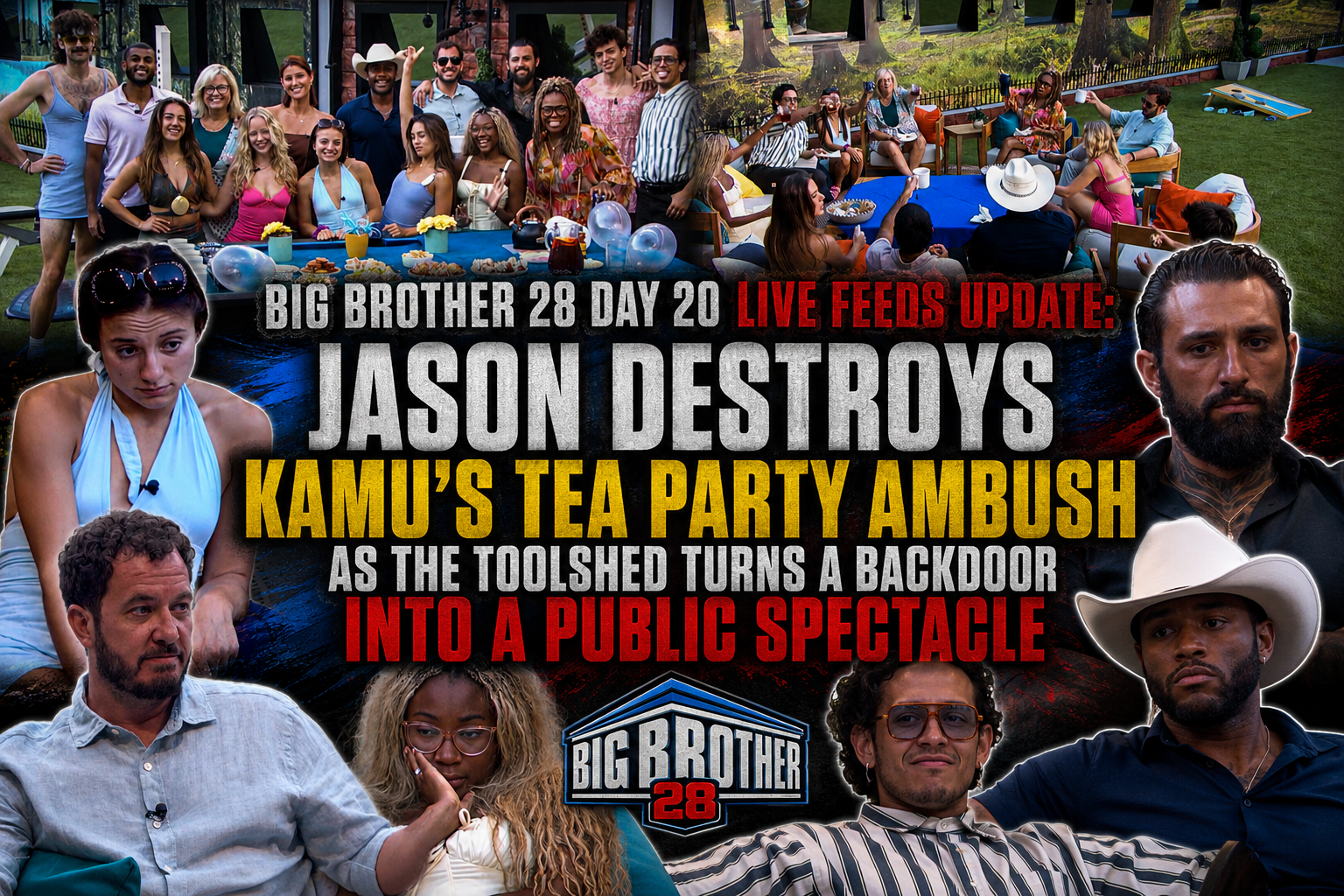
The Big Brother 28 Tea Party was supposed to be the moment Kamu destroyed Jason’s game in front of the entire house. Kamu had spent the day gathering information, comparing Jason’s conversations and preparing a public callout that he believed would expose Jason as a liar with no remaining path forward.
Kamu controlled the nominations. Lyric had won the Power of Veto. Jason was already the expected replacement nominee. Most of the house distrusted him, and several powerful players wanted him gone.
Kamu did not need a house meeting at the Big Brother 28 Tea Party.
He wanted one.
Instead of quietly completing the backdoor, Kamu interrupted a lighthearted Tea Party with a rehearsed attempt to discredit Jason in front of everyone. He expected Jason to become overwhelmed by the accusations and socially abandoned by the house.
Jason was socially abandoned. The painful silence after the confrontation made that unmistakable.
However, he was not overwhelmed.
Jason challenged Kamu’s account of their veto agreement, questioned why ordinary Big Brother campaigning was being treated like an unforgivable betrayal and redirected the conversation toward the alliances surrounding the reigning Head of Household. He named the Toolshed, raised the influence of Dee, Angela and Devens, highlighted Kamu’s increasingly visible relationships with Haley and Chuk and directly asked Devens whether he possessed a secret power.
Jason did not walk away from the Big Brother 28 Tea Party in a strong position. He remained isolated, distrusted and vulnerable to becoming the replacement nominee.
But a house meeting does not have to save its target to fail its organizer.
Kamu entered the gathering as an HOH who could make a straightforward move with broad support. He left looking like the most visible soldier protecting a power structure whose safest members allowed him to absorb the consequences.
The Tea Party belongs beside the most damaging public confrontations in Big Brother history—not because it immediately destroyed Kamu’s game, but because of how little he needed it and how much unnecessary information it exposed.
Everything Leading to the Big Brother 28 Tea Party
Kamu’s Week 3 Head of Household victory arrived immediately after Rome’s 12–1 eviction.
Jason had survived the previous week by winning the BB Blockbuster, but his position was already unstable. His public confrontation with Angela, close association with Rome and Lyric and aggressive campaigning against the house’s power players had made him an obvious target.
Kamu’s HOH kept the Toolshed in control and protected Dee, Angela and Devens for another week.
Kamu nominated Lyric, Mallory and LaTrice. Jason remained off the initial block because the plan was to backdoor him.
That strategy made sense. Jason had demonstrated enough competition ability to make allowing him to play for the veto unnecessarily risky.
Kamu also believed he had reached a private agreement with Jason.
According to Kamu’s account, Jason agreed that if Kamu kept him off the initial block and Jason was selected to compete for the veto, Jason would use it according to the HOH’s wishes.
The disagreement began when Kamu learned that Jason had discussed potentially using the veto on nominees who selected him to play.
Jason reportedly told Mallory that he could save her if she chose him through Houseguest Choice. Kamu heard additional versions of Jason’s campaigning and began believing Jason had offered incompatible promises to multiple people.
That gave Kamu a legitimate reason to question Jason’s reliability.
Jason was trying to maintain too many options. He wanted Kamu to believe he would respect the HOH’s wishes while giving nominees a reason to select and trust him. Those positions were always going to become difficult to reconcile once people compared notes.
Then Lyric won the veto.
At that point, Jason’s hypothetical promises no longer mattered to the immediate decision.
Jason did not win the competition. He could not save Mallory, LaTrice or Lyric. He could not violate the agreement with Kamu because he never received the power required to act on it.
Lyric could remove herself. Kamu could nominate Jason. The week was still under his control.
A disciplined HOH would have stopped there.
Kamu became more invested.
He wanted to prove that Jason had lied. He wanted to expose every conflicting conversation and leave Jason without enough credibility to survive the block.
The objective changed from removing a dangerous opponent to publicly humiliating him.
That is where Kamu lost control of his own HOH.
Who Came Up With the Plan to Call Out Jason?
The original idea belonged to Kamu.
He planned to approach the nominees and ask whether Jason had promised to use the veto on them. If their accounts supported his suspicions, he wanted to call a house meeting and confront Jason in front of everyone.
Mallory’s planned Big Brother 28 Tea Party gave him a ready-made audience.
The gathering had not been created to settle game disputes. It was supposed to be a lighthearted social event. Kamu decided to repurpose it into a public trial without warning Jason.
Kamu then began developing the presentation.
He planned to congratulate Lyric on winning the veto. He wanted to acknowledge that Jason had appeared calmer following the previous week’s confrontations. Then he would abruptly change direction with the line, “Or so I thought.”
He practiced the pause.
He planned the tea sip.
He imagined the dramatic reaction.
This was not an argument that unexpectedly became heated. Kamu spent hours preparing for the moment.
That matters because it removes the easiest excuse available to players who damage themselves during emotional confrontations. Kamu had time to consider whether the meeting was necessary. He had time to recognize that Jason was already vulnerable. He had time to understand that every accusation would reveal another source.
He proceeded because he had become attached to the spectacle.
Dee Encouraged the Mess Without Inventing It
Dee did not create the original plan.
Kamu brought the idea to her.
Her involvement became important because she recognized both how messy the confrontation would be and how useful that mess could become for her position.
When Kamu explained that he wanted to call Jason out during the Big Brother 28 Tea Party, Dee initially reacted to the obvious absurdity of hijacking a social event with a house meeting. She then began entertaining and encouraging the plan.
Dee helped Kamu discuss how the moment might unfold, but she was more cautious about how much of her own involvement would be exposed. She did not want every accusation directly connected to her name.
That distinction revealed the strategic imbalance between them.
Dee wanted Jason weakened.
She did not want to become the sole public face of weakening him.
If Kamu delivered the speech, Kamu would receive the immediate credit and the long-term blame. He would expose the information, absorb Jason’s response and become the person most directly associated with the public humiliation.
Dee, Angela and Devens could benefit without assuming equal risk.
Kamu should have recognized the warning in Dee’s caution. The people encouraging the confrontation did not want to stand as visibly behind the evidence as he did.
Instead of reconsidering the meeting, he continued searching for a presentation that would protect their names while exposing Jason.
Angela Benefited From Kamu Continuing Her Conflict
Angela had already engaged in a highly public dispute with Jason during Devens’ HOH.
Jason believed Angela was influencing Devens and helping control the week. Angela challenged Jason’s gameplay and accused him of using emotional conversations to manipulate the people around him.
Kamu’s Big Brother 28 Tea Party continued that war under a different HOH.
Angela no longer needed to be the person initiating the confrontation. Kamu was prepared to attack Jason publicly, defend information favorable to Dee, Angela and Devens and make himself the main person Jason would blame.
That arrangement protected Angela.
If Jason was evicted, one of her loudest critics disappeared.
If the meeting backfired, Kamu would carry most of the responsibility.
If Jason survived, his most immediate anger would be directed toward the person who planned the ambush.
Angela had firsthand experience with the danger of turning an HOH decision into a public performance. Her Big Brother 26 confrontation with Matt Hardeman helped make Matt a target but also made her look volatile and unpredictable.
Kamu was now repeating a similar mistake while Angela occupied the safer position.
Devens Supported the Confrontation but Had More to Protect
Devens also became part of the discussions surrounding the plan.
Publicly exposing Jason could help the group by damaging his credibility and potentially flushing out information about any advantage he might possess.
But Devens did not face the same risk as Kamu.
Kamu was the HOH preparing to confront Jason. Kamu would deliver the accusations. Kamu would lose the ability to compete in the next HOH.
Devens could support the move without becoming its central figure.
That difference became visible during the Tea Party.
As the gathering moved toward the planned confrontation, Devens appeared noticeably tense while waiting for Kamu to begin. His expression and body language suggested that the reality of the meeting was more uncomfortable than the earlier planning.
It is impossible to know exactly what Devens was thinking.
The risks were obvious.
Jason had already shown that he would argue publicly. He knew enough about the house to name alliances and question the influence surrounding Kamu’s HOH. A public meeting would give him the opportunity to bring Devens directly into the conversation.
That is exactly what happened.
The Big Brother 28 Tea Party Began With Jason Completely Unaware
The early portion of the Tea Party unfolded as a playful break from the game.
Houseguests dressed up, joked with one another and shared embarrassing stories. Drew and Barrett added to the comedy through their outfits and dramatic entrance.
Jason participated while Kamu waited to turn the event against him.
Several people knew a confrontation was coming. Jason apparently did not.
That made the entire setup feel less like an honest attempt to clear the air and more like a coordinated ambush.
Kamu checked his microphone and waited for an opening. The longer the harmless portion continued, the more calculated the eventual interruption became.
Kamu later described his objective as transparency.
The planning did not support that framing.
Someone seeking a direct clarification could speak to Jason privately.
Someone attempting to settle conflicting stories could gather only the people involved.
Someone primarily interested in making a nomination did not need to rehearse a dramatic tonal shift.
Kamu wanted the entire house watching.
Kamu’s Original Case Against Jason Had Merit
Kamu’s argument was not fabricated from nothing.
Jason had been campaigning aggressively. He had discussed using the veto in ways that appeared inconsistent with the understanding Kamu believed they shared.
Jason had also floated different targets to different players.
Kamu argued that Jason had named him, Haley and Chuk to some people while discussing Dee, Angela and Devens with others. Jason had also spoken with Drew and Barrett about their placement inside the Toolshed.
The larger point was credible: Jason was attempting to create safety by telling multiple people versions of the game that could not all become reality.
The problem was not that Kamu had no evidence.
The problem was that he expanded a manageable dispute into a sprawling public presentation.
The more conversations Kamu introduced, the more sources he indirectly exposed. Every accusation demonstrated that information was traveling back to him from different corners of the house.
Kamu wanted the house focused on Jason’s network.
He displayed his own.
Jason Refused to Play the Role Kamu Prepared for Him
Jason’s strongest move was refusing to accept Kamu as the unquestioned moderator.
Kamu delivered his accusations and expected to control the discussion that followed. Jason insisted on being allowed to answer without constant interruption.
That immediately changed the meeting from a presentation into a confrontation.
Jason disputed the wording and implications of the veto promises. He maintained that he would have respected Kamu’s decision had he actually won the veto. LaTrice also pushed back against the idea that Jason had made the same clear promise to every nominee.
That did not prove Jason had been completely honest.
It prevented Kamu’s version from becoming uncontested fact.
Jason then moved away from defending every individual conversation and attacked the premise of the meeting.
He was campaigning because he was in danger.
He was attempting to create relationships after losing close allies.
He was discussing possible targets because that is what players do inside the Big Brother house.
Jason’s defense worked because Kamu had attempted to present ordinary deception as a moral offense while surrounded by people who were also making deals, hiding alliances and discussing targets.
Jason may have been messier than the others.
He was not the only person lying.
Jason Turned the Investigation Back on Kamu
Jason began raising comments Kamu had allegedly made about other powerful players.
That changed the direction of the meeting.
Kamu wanted to stand above the house’s deception as the person exposing it. Jason forced everyone to remember that Kamu was also playing the game, discussing threats and presenting different information to different people.
The Big Brother 28 Tea Party stopped being about whether Jason had lied.
It became about why Jason’s lies required public punishment while everyone else’s lies remained protected.
That was the point at which Kamu lost the moral advantage he had attempted to create.
Jason did not need to establish complete innocence. He only needed to show that the meeting was political rather than principled.
It was.
Kamu was not exposing deception for the good of the house. He was exposing an opponent whose conversations threatened the people Kamu had chosen to protect.
Jason Exposed the Toolshed and the House Structure
Jason’s most important counterattack was broadening the conversation beyond his own deals.
He named the Toolshed.
He raised the influence of Dee, Angela and Devens.
He highlighted the perception that Kamu, Haley and Chuk operated together.
He discussed Drew and Barrett’s positions within the larger structure.
He connected his treatment to the way Rome had become isolated during Devens’ HOH.
Jason’s understanding did not need to be flawless to create damage. It only needed to connect suspicions other players already possessed.
One person might have noticed Kamu sharing information with Dee. Another might have questioned Angela’s influence around Devens. Someone else might have recognized Drew’s overlapping relationships.
A public house meeting allowed those fragments to enter the same conversation.
Kamu believed revealing Jason’s targets would demonstrate that Jason could not be trusted.
It also told everyone who Kamu considered important enough to defend.
Jason’s Question to Devens Changed the Meeting
Jason directly asked Devens whether he possessed a power.
That moment demonstrated why Devens had reason to feel uncomfortable before the confrontation began.
The Big Brother 28 Tea Party was not supposed to be about him.
Jason made it about him.
Devens did not need to admit anything for the question to matter. The fact that Jason directed suspicion toward him gave the rest of the house something new to watch.
Why did Jason believe Devens had a power?
Why was Devens so involved in conversations about advantages?
Why did Jason consider him central to the structure surrounding Kamu?
A public accusation can damage a hidden advantage without fully exposing it. Once people begin observing a player differently, managing that secret becomes harder.
Kamu created the venue that allowed Jason to direct the house’s attention toward one of the people Kamu was trying to protect.
That alone made the meeting strategically counterproductive.
Jason Connected the Big Brother 28 Tea Party to Rome’s Treatment
Jason argued that the confrontation resembled the way Rome had been treated during Devens’ HOH.
His larger point was that the dominant structure had developed a pattern:
Identify one person as the problem.
Present that person’s behavior as harmful to the entire house.
Publicly reinforce the majority’s narrative.
Socially isolate the target.
Treat the eviction as something everyone needs rather than something one group wants.
Jason suggested that Kamu was repeating the process.
That argument was more useful than attempting to prove he had never lied. Jason did not need the house to believe he had played perfectly.
He needed outsiders to question whether the majority would eventually use the same treatment against them.
Kamu wanted to destroy Jason’s narrative.
He gave him a clearer one.
The Silence After the Fight Was Brutal
Jason eventually asked whether anyone was willing to work with him.
Nobody openly answered.
He asked whether someone would help him pack.
Again, nobody volunteered.
Jason attempted to restart a normal conversation, but the group remained trapped in a long and deeply uncomfortable silence.
Eventually, people began clearing the area and leaving.
For Kamu, the silence could be interpreted as victory.
Jason appeared to have nobody.
That was exactly the result Kamu had discussed wanting.
But the silence also made the meeting look less like accountability and more like a public shunning.
There is a difference between targeting a player and attempting to erase their social presence.
Taylor appeared uncomfortable with that distinction. She did not need to believe Jason was innocent to recognize that the house’s treatment had become excessive.
Kamu transformed Jason from a messy player with too many deals into a messy player publicly cornered by a large majority.
The second version generates more sympathy.
Was It a Good Idea for Kamu to Follow the Icons’ Lead?
No—but the mistake was more complicated than Kamu blindly following orders.
Kamu originated the idea.
He developed the speech.
He wanted the dramatic moment.
Dee, Angela and Devens did not need to force him into anything. They only needed to recognize that his plan benefited them and avoid stopping him.
Dee could encourage the confrontation while limiting her visible connection to the evidence.
Angela could continue her conflict with Jason without leading another public attack.
Devens could support the exposure while Kamu assumed the responsibility.
Kamu believed their enthusiasm proved the meeting was good for his game.
It proved the meeting was good for theirs.
That is a crucial difference.
Strong players do not always need to manipulate an ally into making a mistake. Sometimes the ally arrives with a bad idea, and the strongest move is simply to let them believe it is brilliant.
Kamu Emerged as the Icons’ Shield
Before the Big Brother 28 Tea Party, Kamu had flexibility.
He was close to Haley and Chuk. He had relationships inside the Toolshed. Dee, Angela and Devens viewed him as useful. Other players appeared more threatening and more visible.
After the confrontation, his position became easier to define.
He had publicly attacked one of the veterans’ loudest opponents.
He had revealed that information from multiple groups reached him.
He had made his relationship with Haley and Chuk more obvious.
He had shown that perceived betrayal could push him into a dramatic public response.
He had created a personal enemy in Jason.
Most importantly, he could not compete for the next HOH.
Kamu accepted maximum visibility at the exact moment his official power was about to expire.
Dee, Angela and Devens could stand behind him while the next opposition HOH decided where to strike first.
Kamu did not move into the center of the power structure.
He moved in front of it.
Haley and Chuk Became Collateral Damage
Kamu presented Jason’s interest in targeting him, Haley and Chuk as evidence of Jason’s disloyalty.
That reinforced the perception that the three operated as a meaningful group.
Haley’s frustration over being constantly connected to Kamu and Chuk could not undo what the HOH had publicly confirmed.
When one member of a suspected trio treats threats against all three as the same offense, the house has every reason to evaluate them together.
Kamu cannot compete for the next HOH. If an outsider wins power and cannot reach him directly, Haley or Chuk becomes an obvious way to weaken him.
Dee, Angela and Devens have more room to distance themselves.
Kamu’s closest allies do not.
He believed the meeting was protecting his people.
It placed clearer outlines around them.
Jason Was Still Responsible for His Own Position
Jason’s strong response does not erase the gameplay that placed him in danger.
He talked too much.
He made aggressive pitches across competing groups.
He trusted people who immediately carried information back to Kamu.
He discussed targeting powerful players without building enough protection to survive the backlash.
He attempted to keep several contradictory possibilities alive at once.
Jason entered the Big Brother 28 Tea Party because his game was already unstable.
He left still facing the possibility of nomination and eviction.
However, Jason did not need to prove that he was a great player to outperform Kamu during the confrontation.
He challenged the veto narrative.
He exposed the political motives behind the ambush.
He named the structures around the HOH.
He placed Devens under suspicion.
He gave outsiders a reason to question whether the meeting was about honesty or power.
Jason could win the argument and still lose the week.
Kamu could complete the backdoor and still mishandle the HOH.
Both statements can be true.
How the Big Brother 28 Tea Party Compares to Big Brother’s Worst House Meetings
The Big Brother 28 Tea Party was not identical to every infamous Big Brother confrontation. Some were formal meetings called by the organizer. Others were public arguments or disclosures that developed under different circumstances.
What connects them is not format.
It is strategic failure.
Each involved someone believing that publicly exposing information would allow them to control how the house interpreted it. Instead, the confrontation damaged the organizer, strengthened the target or revealed a larger power structure.
BB14: Willie Hantz Tries to Rally the House Against the Coaches
Willie Hantz’s house meeting remains one of the closest comparisons to Kamu’s Tea Party.
During his HOH, Willie became convinced that returning coaches Britney Haynes, Dan Gheesling, Janelle Pierzina and Mike “Boogie” Malin were manipulating the new players.
Willie gathered the house and encouraged the newcomers to resist the coaches’ influence.
He believed he was revealing a truth that should unite everyone.
Instead, the meeting exposed his paranoia and made him look controlling. Players who might have shared concerns about the coaches became more concerned about Willie’s temperament and attempt to position himself as the house’s leader.
Willie’s game quickly deteriorated before his eventual expulsion following a physical confrontation with Joe Arvin.
How It Compares to Kamu
Both Willie and Kamu mistook temporary HOH power for permanent authority.
Willie believed winning HOH entitled him to reorganize the house against the coaches.
Kamu believed winning HOH entitled him to publicly determine which lies were acceptable and which player deserved collective condemnation.
Both made their priorities and alliances more visible.
Both emerged from power as larger targets.
The Difference
Willie attempted to inspire a rebellion against an entire system.
Kamu attempted to conduct the public destruction of one opponent.
Willie’s meeting failed because the house did not trust him enough to follow.
Kamu’s meeting failed because the apparent support around him convinced him that the people encouraging the attack shared his risk.
They did not.
BB16: Devin Shepherd’s First House Meeting
Devin Shepherd called a house meeting after deciding he had unfairly contributed to Donny Thompson becoming an initial target.
Devin admitted that he had pushed a misleading narrative about Donny and revealed information that implicated Caleb Reynolds in the nomination process.
He believed the confession would demonstrate honesty and accountability.
Instead, Brittany Martinez recognized that the original explanation for the nominations had been false. Devin’s Bomb Squad allies realized he had exposed internal information, and the meeting created more mistrust than it resolved.
How It Compares to Kamu
Devin believed public honesty would restore his credibility.
Kamu believed public exposure would establish his credibility.
Both revealed information that their allies would have preferred to keep private.
Both turned a manageable situation into a broader examination of who was controlling the week.
Both left the house questioning why the meeting had been necessary.
The Difference
Devin damaged himself by confessing.
Kamu damaged himself by prosecuting.
Devin’s meeting was driven by guilt and emotional instability. Kamu rehearsed his confrontation in advance, making his refusal to reconsider more difficult to excuse.
BB16: Devin’s Second Meeting and Zach’s Rebellion
Devin later gathered members of the Bomb Squad after learning that some were considering keeping Brittany over Paola Shea.
He wanted to force clarity and reaffirm loyalty.
Zach Rance openly admitted that he wanted Devin evicted.
The meeting exposed the alliance’s fractures and confirmed that Devin no longer controlled the people he believed he was leading.
How It Compares to Kamu
Both organizers expected the target of the discussion to become trapped by the room.
Zach openly challenged Devin.
Jason openly challenged Kamu.
Both confrontations exposed the larger alliance surrounding the organizer.
The person who called the meeting lost control because the other participant refused to provide the expected answer.
The Difference
Zach had stronger protection inside the majority and survived Devin’s attempt to remove him.
Jason remained far more isolated after the Big Brother 28 Tea Party.
Jason did not need to save himself for the meeting to damage Kamu. He only needed to prevent the confrontation from ending on Kamu’s terms.
BB20: Haleigh Broucher Admits She Was the Hacker
Haleigh Broucher called a house meeting and admitted that she had been the BB Hacker who nominated Tyler Crispen.
She hoped the confession would redirect blame from Bayleigh Dayton.
It did not save Bayleigh.
Instead, Haleigh confirmed valuable information for Level 6 while exposing herself as the person behind the move.
How It Compares to Kamu
Haleigh and Kamu both volunteered information without changing the immediate outcome.
Bayleigh remained the target after Haleigh’s confession.
Jason was already the intended replacement nominee before the Tea Party.
Both believed a dramatic act of openness would improve the moral logic of the week.
The opposition received more useful information while the person making the disclosure absorbed additional risk.
The Difference
Haleigh exposed herself in an attempt to protect an ally.
Kamu exposed himself to inflict additional damage on an opponent who was already cornered.
Haleigh’s decision was strategically poor but personally loyal.
Kamu’s was strategically unnecessary.
BB20: Bayleigh and Tyler’s Explosive Argument
Bayleigh Dayton and Tyler Crispen’s confrontation developed from disputed promises, shifting alliances and incompatible memories of earlier conversations.
Bayleigh believed Tyler had manipulated her and contributed to the circumstances leading to her eviction. Tyler denied giving her the assurances she believed she had received.
The emotional confrontation did not change Bayleigh’s fate.
How It Compares to Kamu and Jason
Both arguments revolved around what a prior agreement supposedly meant.
Kamu treated Jason’s veto promise as complete obedience to the HOH’s wishes.
Jason argued that he could have honored Kamu’s decision while still exploring possibilities with nominees before the competition.
A public argument could not establish objective truth because the original conversations were private and each participant had a reason to defend a different interpretation.
The Difference
Bayleigh and Tyler’s fight escalated spontaneously.
Kamu spent hours preparing the Tea Party ambush.
The existence of that preparation makes the BB28 confrontation a more preventable strategic error.
BB23: Frenchie Talks Himself Into Becoming the Next Target
Brandon “Frenchie” French’s opening HOH did not collapse because of one formal house meeting. His entire week became a series of promises, changing targets, oversized alliances and explanations that contradicted one another.
Frenchie attempted to manage how every houseguest understood his decisions.
The more he explained, the less anyone trusted him.
By the end of the week, Frenchie had transformed himself from the person holding power into the obvious target for the following eviction cycle.
How It Compares to Kamu
Frenchie and Kamu were not satisfied with making a move.
They needed the house to validate their reasoning.
Both attempted to force one accepted narrative onto a game built around uncertainty and deception.
Both became the central story of weeks that should have been focused on their targets.
The Difference
Frenchie was responsible for most of the contradictions he attempted to explain.
Kamu called the Tea Party to expose Jason’s contradictions.
The consequence was similar: the HOH revealed more about himself than the target.
BB24: Daniel Durston Publicly Attacks Taylor
Daniel Durston publicly confronted Taylor Hale while operating on incomplete and distorted information about her interactions with Paloma Aguilar.
The situation was more personal and serious than Kamu’s strategic dispute with Jason, and the two should not be treated as morally equivalent.
The strategic pattern remains relevant.
Daniel was surrounded by a house already comfortable treating Taylor as the common problem. He interpreted the majority’s silence and agreement as confirmation that his behavior was justified.
The confrontation ultimately became one of the clearest examples of how badly the house had misread and mistreated Taylor.
How It Compares to the Tea Party
Both confrontations involved someone supported by the majority publicly condemning an isolated player.
Both organizers believed the room’s silence validated their version of events.
Both risked generating sympathy for a person who had previously lacked social protection.
The Difference
Daniel’s confrontation involved highly personal circumstances and accusations that extended beyond normal strategy.
Kamu’s accusations centered on veto deals, targets and alliance information.
The lesson is not that the situations were equally severe. It is that majority approval inside the Big Brother house does not prove that a public attack is fair, necessary or strategically intelligent.
BB25: Jared Fields Loses Control Against Cory
The Have-Not Room confrontation between Jared Fields and Cory Wurtenberger became damaging because Cory refused to discuss only the narrow issue Jared wanted addressed.
Cory compared stories, identified contradictions and widened the argument toward the alliances protecting Jared.
The longer the confrontation continued, the harder it became for Jared to control the narrative.
How It Compares to Kamu and Jason
Kamu wanted to discuss Jason’s veto promises.
Jason discussed Kamu’s own statements.
Kamu wanted to expose Jason’s targets.
Jason exposed the Toolshed and the relationships surrounding Kamu.
Kamu wanted the house to judge Jason.
Jason questioned Devens.
In both confrontations, the person expected to defend himself broadened the discussion until the organizer’s power structure became the larger issue.
The Difference
Cory entered his confrontation with more preparation and stronger relationships.
Jason was ambushed in front of the entire house and still found a way to redirect the conversation.
That makes Kamu’s inability to contain the discussion even more revealing.
BB26: Angela’s “Crazy Eyes” Confrontation With Matt
Angela Murray’s public attack on Matt Hardeman is the closest recent comparison to Kamu’s Tea Party.
Angela was the reigning HOH and already possessed the power to nominate Matt. Instead of making the move quietly, she transformed her suspicions into a dramatic public performance.
Matt became the replacement nominee and was evicted.
The immediate objective succeeded.
The confrontation also established Angela as volatile, theatrical and capable of turning private concerns into public warfare.
How It Compares to Kamu
Both were reigning HOHs who already had the power to nominate the person they confronted.
Both wanted the house to validate their interpretation.
Both used performance and public humiliation to increase pressure on the target.
Both may succeed in removing that target while weakening their own reputations.
The Difference
Angela’s confrontation appeared impulsive.
Kamu rehearsed his speech and coordinated the timing.
Angela’s outburst offered very little time for reconsideration. Kamu repeatedly chose to continue after the immediate strategic need had disappeared.
BB26: Tucker Exposes Quinn
Tucker Des Lauriers used the Power of Veto on Angela and publicly revealed Quinn Martin’s hidden upgrade power. He expected Cedric Hodges to nominate Quinn.
Cedric refused.
Tucker damaged Quinn’s secrecy but failed to control what happened after the information became public. He also established himself as an unpredictable player willing to detonate alliance plans.
How It Compares to the Tea Party
Tucker and Kamu both assumed that publicly exposing information would produce a controlled outcome.
It did not.
Once the information entered the room, other people could reinterpret it, challenge it and use it for their own purposes.
The Difference
Tucker exposed an active secret power that could materially affect future weeks.
Kamu exposed hypothetical veto promises after Jason had already lost the veto competition.
Tucker’s decision was reckless but connected to an immediate strategic threat.
Kamu’s evidence had already lost most of its practical value.
What Made the Big Brother 28 Tea Party Uniquely Bad
The Tea Party was not the most personally offensive confrontation in Big Brother history.
It did not immediately destroy an alliance as thoroughly as Devin’s meetings.
It did not produce the same complete HOH collapse as Frenchie’s opening week.
Its long-term consequences for Kamu are still unfolding.
What makes it one of the worst is the lack of strategic necessity.
Willie believed he needed to expose the coaches.
Haleigh believed she needed to protect Bayleigh.
Tucker believed Quinn’s power needed to become public.
Cory needed to expose Jared’s contradictions to break the structure surrounding Cirie Fields.
Kamu already controlled the replacement nomination.
Jason was already isolated.
The majority already supported placing him on the block.
Lyric’s veto victory had already made Jason’s supposed promises irrelevant to the immediate decision.
Kamu accepted significant risk for almost no additional strategic reward.
He did not create a different outcome.
He created a louder and messier version of the outcome he already had.
Keesha’s Birthday Was Chaos—The Big Brother 28 Tea Party Was Self-Sabotage
The Tea Party will naturally be compared with Keesha Smith’s infamous birthday fight during Big Brother 10 because both gatherings began as social events before collapsing into unforgettable chaos.
The strategic difference is enormous.
Keesha’s birthday fight erupted from overlapping resentments among several people. No single player spent the day constructing it as a planned public ambush.
Kamu intended to hijack the Big Brother 28 Tea Party.
He prepared the accusations.
He knew the confrontation could become explosive.
He expected the explosion to improve his position.
Keesha’s birthday became legendary because nobody controlled it.
The Tea Party became disastrous because Kamu believed he could.
Jason Won the Confrontation but May Still Lose the Week
Jason should not receive credit for escaping a situation he created through strong gameplay.
His aggressive campaigning gave Kamu legitimate material.
He spoke too freely.
He trusted people who carried information directly back to the HOH.
He named powerful targets without having the structure required to protect himself.
He attempted to keep too many incompatible relationships alive.
The Big Brother 28 Tea Party did not erase any of that.
Jason remained isolated after the confrontation. Nobody publicly stepped forward to work with him. He was still the obvious replacement nominee.
But Jason performed better during the meeting than Kamu expected.
He prevented the ambush from producing an uncontested narrative.
He exposed the political purpose behind the accusations.
He named the alliances surrounding the HOH.
He placed Devens under suspicion.
He made the Big Brother 28 Tea Party look like something the majority needed rather than something the entire house needed.
Jason could lose the eviction and still have won the argument.
Big Brother is not decided by arguments alone, but those arguments can reshape how the surviving players understand the house.
Kamu’s HOH Created a Bigger Target Than It Removed
The Big Brother 28 Tea Party accomplished one immediate objective.
It made Jason appear completely isolated.
It also advertised nearly everything an opponent would need to know about Kamu.
He shares information with powerful players.
He views Haley and Chuk as extensions of his position.
He is willing to turn private discussions into public evidence.
He can become emotionally invested in punishing perceived disloyalty.
He is protecting Dee, Angela and Devens.
He cannot play in the next HOH competition.
The meeting gave Jason a personal reason to target him and outsiders a strategic reason to consider him the easiest entry point into the majority.
Dee, Angela and Devens can distance themselves from the spectacle.
Haley and Chuk cannot easily distance themselves from Kamu.
Kamu believed he was securing their safety by exposing Jason’s targets. He made their connection clearer to the entire house.
The Icons Did Not Force Kamu—They Allowed Him to Overplay
Calling Kamu a helpless puppet would let him avoid responsibility for his own decisions.
He conceived the meeting.
He rehearsed the speech.
He wanted the dramatic moment.
Dee, Angela and Devens recognized that his idea benefited them and allowed him to believe it benefited him equally.
That is more sophisticated than ordering an ally to make a move.
They gave Kamu enough encouragement to continue while maintaining greater distance from the consequences.
Kamu volunteered to become the visible aggressor.
The Icons accepted the protection.
Where the Big Brother 28 Tea Party Ranks Among Big Brother’s Worst Public Confrontations
The long-term damage cannot be measured completely until the next several rounds unfold.
Kamu could survive the backlash. Jason could leave. The Toolshed could remain intact. Another target could emerge and move in front of him.
None of those possibilities would make the Tea Party strategically necessary.
Among Big Brother’s failed public confrontations, it ranks below the complete game collapses of Devin, Willie and Frenchie because Kamu has not yet destroyed his position to the same degree.
It belongs near the top in preventable self-inflicted damage.
Kamu had the nomination.
He had the votes.
He had the house structure.
He had no need to prove Jason was dishonest to people who already wanted Jason gone.
He chose the most theatrical, revealing and personally antagonistic way to complete a move that required almost no public explanation.
The Big Brother 28 Tea Party may still end with Jason walking out of the house.
That would make the backdoor successful.
It would not make the ambush smart.
Kamu entered the gathering believing he was about to expose every reason nobody should trust Jason.
Jason left the gathering still endangered, but he had exposed something more important: Kamu was willing to stand in front of the Toolshed, absorb the retaliation and identify himself as the majority’s public enforcer.
Kamu held the meeting.
Kamu delivered the accusations.
Kamu became the target.
The Icons drank the tea.
Make sure to subscribe to our Late Night Crew Youtube Channel. Follow @yorkjavon, @kspowerwheels, @MS_MISCHA & @LateNightCrewYT on X.