
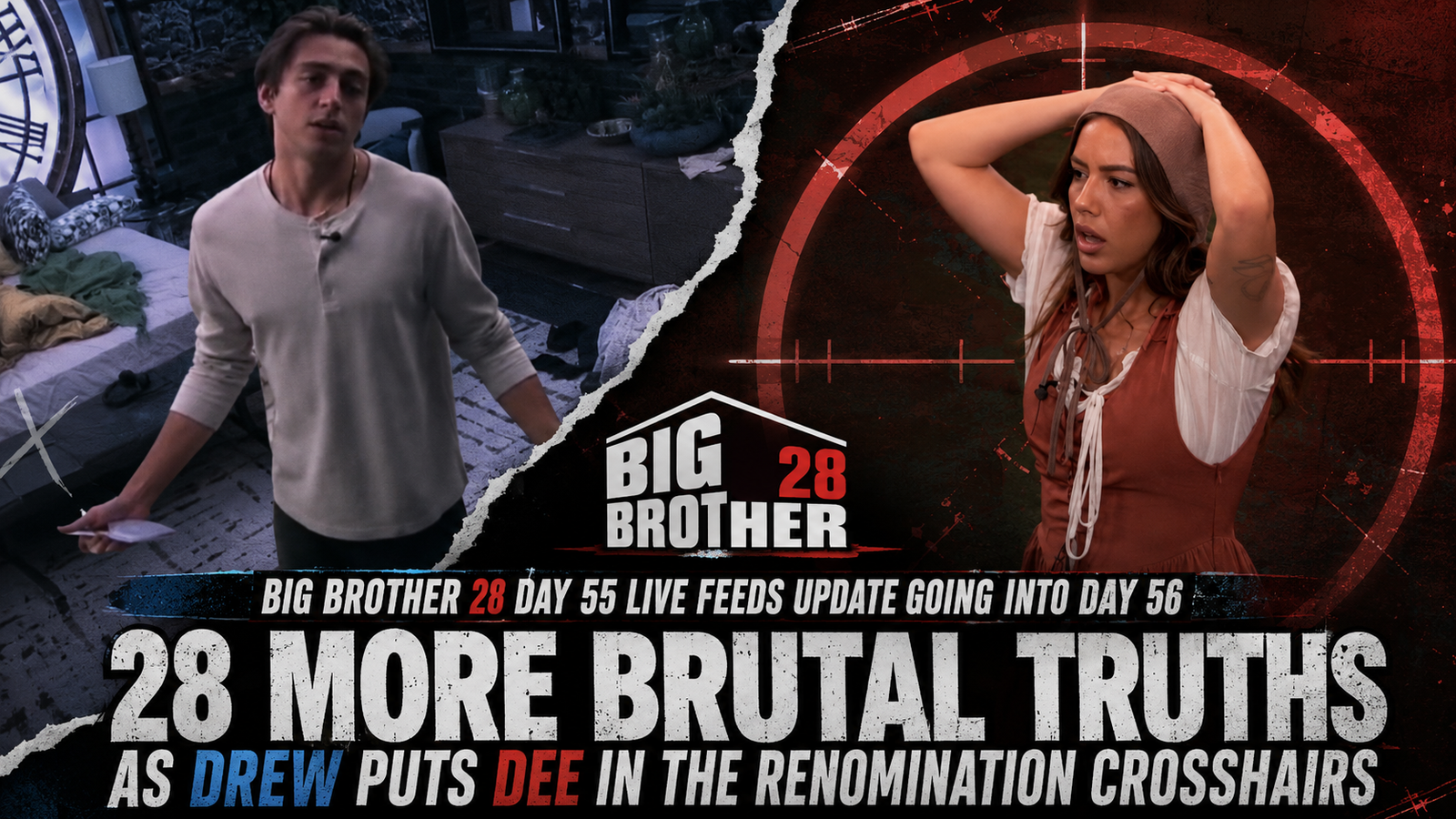
DAY 55 INTO EARLY DAY 56 · WEEK 8 · HOH: DREW
Big Brother 28 Day 55 live feeds did not settle Drew’s Week 8 Head of Household reign. They exposed how little control he has over the people he believes he is protecting.
When we left off in the previous Day 55 update, Yash had won the Power of Veto and was expected to remove himself from the block. Drew was leaning toward using Devens as the replacement nominee, Melody remained the alternative being pushed by Dee, and LaLa remained Drew’s intended eviction target.
That appeared to be the shape of the week. Then Drew spent the afternoon protecting Melody, briefly entertained Barrett as an alternative, accepted Devens’ offer to become a pawn, learned nothing about Barrett and Melody’s private intentions, and eventually told Melody that neither she nor Barrett would be nominated.
By approximately 3:09 a.m. PT on early Day 56, Drew had reopened the entire decision.
After emerging from a lengthy Diary Room session, he began asking why Dee should be allowed to escape the consequences of nominating him and playing selfishly during her HOH. He compared Dee’s competition record with Devens’ weaker performances, rehearsed what he could say at the veto ceremony and asked whether that ceremony could happen later in the day.
The timing is noticeable. It is not proof that production handed Drew an idea. What the feeds do prove is that Drew went into the early morning treating Devens as his likely pawn and came out treating Dee as a legitimate replacement-nominee option.
That is where the Week 8 game stands heading deeper into Day 56: Devens remains the established plan, Dee is now a real alternative, Melody and Barrett have received promises of safety, and Drew is discovering that postponing a decision does not make the consequences disappear.
Current Big Brother 28 Week 8 status
- Day covered: Day 55 into early Day 56
- Updated through: Approximately 3:18 a.m. PT on Monday
- Head of Household: Drew
- Original nominees: LaLa, Taylor and Yash
- Power of Veto winner: Yash
- Expected veto decision: Yash removes himself
- Replacement nominee: Unresolved
- Established replacement plan: Devens
- Active early-morning alternative: Dee
- Drew’s stated eviction target: LaLa
- Melody’s status: Drew has repeatedly promised not to nominate her
- Barrett’s status: Drew told Melody that Barrett would not be nominated
- Critical vote fracture: Barrett and Melody privately said they would evict Devens if given the opportunity
- BB Lackluster: Still pending
- Veto ceremony: Still pending
- Accuracy line: Neither Devens nor Dee is officially nominated until the ceremony happens
Here are 28 more brutal truths from the Big Brother 28 Day 55 live feeds
1. The continuation begins with Drew already searching for permission
The previous update ended with Drew leaning toward Devens but still circling the decision. The next stretch of the Big Brother 28 Day 55 live feeds showed that Drew was not searching for new information as much as he was searching for emotional permission to make a move he already knew could backfire.
He wanted a replacement nominee who would not become angry, would not expose him, would not damage his jury standing and would still help eliminate LaLa.
That person does not exist.
A replacement nominee is not a ceremonial extra. That person must compete in BB Lackluster and could become one of the final two nominees. Drew kept talking as though he could nominate somebody without forcing that person to confront the possibility of eviction.
His entire afternoon became an attempt to make the block feel harmless. The block is never harmless.
2. Devens volunteered, but Drew was the one who needed the favor
Shortly after the previous cutoff, Drew and Devens continued discussing the replacement nomination as though Devens would probably occupy it.
The explanation was simple: Devens had volunteered, could act as a team player, might confuse the other side and was expected to remain loyal afterward.
That arrangement benefited Drew more than it benefited Devens.
Drew could protect Melody, avoid exposing Barrett and preserve the appearance that his relationship with the Icons remained functional. Devens would assume the actual risk, compete for his life and trust voters Drew had not accurately counted.
Calling Devens a volunteer makes the arrangement sound noble. In practical terms, Drew needed somebody willing to absorb the danger created by promises Drew made to almost everybody else.
Devens gave him that somebody.
3. “Team player” became a polite way of saying expendable
Drew repeatedly described Devens as somebody willing to take one for the team.
That sounds flattering until the team’s structure is examined.
Drew was not volunteering himself. Melody was being protected because Drew feared losing her jury vote and whatever remained of their personal relationship. Barrett was being protected because Drew believed Barrett remained a dependable number. Angela had already received safety. Dee was initially being treated as too valuable or too dangerous to expose.
That left Devens.
The most loyal member of a shaky structure was being asked to sit on the block because everybody less loyal had become too politically expensive to nominate.
That is not how a strong alliance rewards reliability. It is how a deteriorating alliance transfers danger to the person most likely to forgive it.
4. LaLa remained the target, but Drew kept building escape routes for everybody around her
Drew continued identifying LaLa as the person he wanted evicted. The problem was not the target. The problem was everything he was willing to risk in order to reach her.
If Devens became the replacement nominee and lost BB Lackluster, the vote could turn against him.
If Dee became the replacement nominee and lost BB Lackluster, her competition record and social position could make her more tempting than LaLa.
If Melody went up, Drew believed he could lose her personally and in the jury.
If Barrett went up, Drew feared exposing how dependent he had become on Barrett’s loyalty.
Drew wanted LaLa gone while preserving every fragile relationship surrounding her. Big Brother rarely gives an HOH that luxury.
Once Yash won the veto, the week stopped being about Drew’s preferred target and started being about which ally he was willing to endanger.
5. Dee kept campaigning for Melody because she saw a threat Drew refused to address
Dee spent part of the afternoon continuing to push Melody as the replacement nominee.
Her argument was not completely unreasonable. Melody had grown closer to Yash, remained difficult to read and had already demonstrated that her emotional relationship with Drew did not guarantee strategic obedience.
Drew resisted.
He did not trust Melody completely. He simply believed nominating her would create more immediate damage than keeping her safe.
That distinction matters. Drew was not protecting Melody because their alliance had been repaired. He was protecting her because he understood that another betrayal could permanently destroy whatever influence he still had over her.
Dee was analyzing Melody as a game piece. Drew was calculating Melody as a relationship, a jury vote and an emotional consequence.
Those were never going to produce the same answer.
6. Drew protected Melody without regaining her loyalty
Drew eventually made his position clear: he did not want to nominate Melody.
He later told Devens that he could not put her up. He also told Melody that he had promised the others he would not nominate her.
That gave Melody safety. It did not give Drew control.
This is the central mistake underneath Drew’s HOH. He keeps treating protection as though it automatically purchases loyalty. It does not.
Melody can appreciate not being nominated and still vote differently from Drew. She can spend time in his HOH room, lie beside him, tease him, argue with him and remain strategically closer to Barrett than Drew understands.
Drew preserved their connection. He did not restore the alliance that existed before Mallory’s eviction.
Safety kept the door open. It did not erase what happened behind it.
7. The quiet afternoon gave Drew more time, not more clarity
The middle of the afternoon looked calm. Houseguests spent time around the pool, cleaned, talked casually and tried to enjoy the backyard.
Drew even went upstairs to wake Melody.
Nothing about that calm solved the replacement-nominee problem. It merely delayed the confrontation.
Drew’s decision-making style becomes weaker when he has too much time. He does not use the extra space to narrow his options. He uses it to imagine every possible reaction until each choice appears equally dangerous.
That is why the replacement conversation kept moving among Devens, Melody and Barrett before eventually reaching Dee.
A decisive HOH identifies the unavoidable damage and chooses where it should land. Drew kept trying to discover a nomination that would cause no damage at all.
The longer he searched, the less believable his promises became.
8. Melody refused to carry Drew’s decision for him
When Melody asked whether Drew knew what he was doing with the replacement nomination, the conversation remained awkward and indirect.
Drew wanted feedback without fully surrendering the information. Melody wanted safety without becoming responsible for selecting the person who would replace Yash.
That was smart on Melody’s part.
If she pushed too hard for Devens, Barrett or Dee, Drew could later blame her if the week collapsed. By leaving the final choice with him, she received information while keeping her fingerprints off the nomination.
Drew has spent much of the season acting as though Melody’s emotional openness means she is strategically transparent. It does not.
She may be loud about her feelings, but she understands when a decision belongs to the HOH and when accepting ownership would only create unnecessary blood.
9. Barrett briefly became an option because Drew had promised safety too freely
As Drew ruled out Melody, Barrett naturally moved closer to the danger.
Drew considered him because Barrett appeared capable of surviving and because using him could preserve Devens. He also recognized that nominating Barrett might expose too much and push Barrett completely away.
That was the problem.
Drew had spent weeks treating Barrett as both an ally and a shield without securing enough loyalty to use him as either. Barrett was useful because he appeared connected everywhere, but those same connections made him dangerous to touch.
Drew wanted Barrett’s vote, Barrett’s information and Barrett’s loyalty. He did not want the responsibility of testing whether any of those things were real.
By early evening, Barrett was drifting back toward safety.
Drew’s fear of discovering the truth about Barrett became stronger than his willingness to nominate him.
10. Barrett gave Melody the information Devens assumed would remain contained
During their private evening conversation, Barrett told Melody that Devens had volunteered to become the replacement nominee and was now nervous about it.
That information immediately changed the value of Devens’ offer.
A volunteer pawn is safest when the plan stays contained, the votes remain locked and the nominee understands the risk. Instead, Barrett shared the arrangement with somebody already angry at Drew’s broader alliance structure.
Barrett also told Melody that Drew would not nominate her because he had already lost too many potential jury votes.
Whether Drew intended that reasoning to travel did not matter. It traveled.
Melody now knew that her safety was not simply a sign of repaired trust. It was partly a concession to the damage Drew believed he had already done.
That is a much weaker foundation than loyalty.
11. Barrett said he would evict Devens, and Melody agreed
This was the most important private conversation before Drew’s early-morning shift.
Barrett told Melody that if Devens were nominated and remained vulnerable after BB Lackluster, he would vote to evict him. He told her to keep it quiet.
Melody said she would vote Devens out as well.
Drew believed putting Devens on the block preserved Barrett as a vote. Barrett was privately preparing to use that vote against Drew’s replacement nominee.
That is not a minor communication problem. It is a complete inversion of the plan.
Drew was about to nominate one ally because he trusted another ally to save him. The supposedly trusted ally had already described how he would do the opposite.
Barrett was positioning himself to remove a major threat while allowing Drew to take responsibility for creating the opportunity.
12. Devens’ volunteer plan became more dangerous the moment Melody joined Barrett
Barrett’s vote alone would have been concerning. Melody joining him gave the anti-Devens side a working foundation.
The pair did not have to control the entire house. They only needed Yash and whichever original nominee escaped BB Lackluster to recognize the same opportunity.
Devens had won power, built alliances and positioned himself as one of the most visible strategic players remaining. If he became vulnerable, the other side would have little reason to save him simply because Drew wanted LaLa gone.
That is the flaw in volunteer-pawn logic. The nominee and the HOH may agree that the move is temporary. The voters never signed that agreement.
Once Devens touches the block, his threat level becomes everybody’s business.
13. A Devens nomination could produce the exact 4–2 vote Drew says he wants to avoid
If Devens becomes the replacement nominee and loses BB Lackluster, the danger is not theoretical.
Barrett and Melody explicitly said they would evict him. Yash has little reason to preserve the strongest remaining Icon structure. Whichever of LaLa or Taylor wins safety would also have an obvious incentive to remove Devens over the other original nominee.
That creates a plausible four-vote bloc against him.
Angela and Dee would be expected to protect Devens, leaving a possible 4–2 result. Drew would not break a tie because there would be no tie to break.
Individual votes can still move, and BB Lackluster can erase the scenario by saving Devens. The projected count is not a locked vote.
It is still far more realistic than Drew’s assumption that Barrett will automatically protect his pawn.
14. Drew’s Barrett read remained one of the worst parts of his HOH
Drew continued telling Devens that Barrett would not fully go to the other side.
That belief allowed the Devens plan to feel manageable.
The feeds showed something very different. Barrett was maintaining relationships across the house, protecting Melody, sharing information with her and quietly preparing to evict Devens if Drew created the opening.
Barrett did not need to declare war on Drew. He only needed Drew to keep overestimating their relationship.
That is the beauty of Barrett’s position and the ugliness of Drew’s read. Drew mistakes Barrett’s calm manner for commitment. Barrett can remain friendly, avoid public confrontation and still make the vote that damages Drew most.
Drew sees Barrett as a dependable bridge. Barrett is using that bridge to move between whichever sides benefit him.
15. The halfway party interrupted the strategy but did not repair it
The feeds went down during the evening and returned after the houseguests received a halfway-style celebration.
There was food, cake, music, drinks, pictures and temporary relief from the game.
The atmosphere became louder and lighter. Houseguests played with the camera, posed for pictures and enjoyed having survived long enough to reach this stage.
Underneath the celebration, nothing had changed.
Devens was still preparing for the block. Barrett and Melody were still hiding their willingness to evict him. Drew was still trying to preserve relationships that could not all be preserved. Dee and Angela still expected their group to remain intact.
The party gave everyone photographs of unity while the strategy underneath those photographs continued splitting in opposite directions.
16. The celebration made Drew’s blind spot easier to see
Drew appeared comfortable moving among people who were privately preparing to defy him.
That is not because everybody suddenly became loyal. It is because social ease can conceal strategic separation.
Barrett could take pictures and joke with Devens while planning to vote him out.
Melody could spend time with Drew while withholding how far her strategic loyalty had moved.
Devens could participate in the celebration while believing the group would protect him.
Drew interpreted the absence of open conflict as evidence that his relationships remained functional. In reality, the house had simply learned how to smile while holding incompatible plans.
People do not have to dislike somebody before evicting them. They only need to believe removing that person improves their position.
17. Devens’ jury threat revealed that he understood the danger
After the party, Devens told Dee and Angela that he had agreed to go on the block. He also warned that anyone from their group who betrayed him would not receive jury votes from the Crossovers.
That was not the statement of a completely comfortable pawn.
It was leverage.
Devens understood that volunteering did not guarantee safety. He recognized that the block could become real danger, and he attempted to raise the price of betrayal before anybody cast a vote.
The threat might intimidate somebody who believes Devens can influence a jury bloc. It might also make voters more determined to remove him before he gains additional control.
Jury threats rarely create loyalty. They expose how little loyalty the speaker believes already exists.
18. Dee immediately recognized the hypocrisy in Devens’ threat
When Angela relayed Devens’ warning, Dee laughed at the contradiction.
Devens had criticized similar jury-based pressure when Dee considered using it. Once his own game could be at risk, he was willing to make essentially the same argument.
Dee was right to notice it.
Players often condemn tactics while those tactics are being used against them and rediscover their value when they need protection. Devens was no exception.
The larger issue is that Dee’s reaction suggested she did not view the group as emotionally unified. She could understand why Devens made the threat while still recognizing how self-serving it was.
That tension became even more important once Drew began considering Dee as the replacement nominee a few hours later.
19. Drew finally told Devens that Melody was off the table
During their late-night conversation, Drew told Devens that he could not nominate Melody.
Devens said he understood the jury consequences and the danger of Melody winning BB Lackluster, coming off the block and remaining in the house angry at Drew.
The exchange clarified Drew’s priorities.
He was willing to expose Devens because he believed Devens would forgive him. He was unwilling to expose Melody because he believed Melody would not.
That means Devens’ loyalty made him more disposable, while Melody’s damaged loyalty made her more protected.
It is backward but common Big Brother logic. The player who complains, threatens consequences or withholds trust often receives more careful treatment than the person who keeps proving reliable.
Drew rewarded uncertainty and taxed loyalty.
20. Devens agreed to act annoyed because the plan already required theater
Devens told Drew that he could act irritated after being nominated.
The performance was supposed to disguise how coordinated the decision had been.
That plan underestimated the rest of the house.
Barrett already knew Devens had volunteered. Melody learned it from Barrett. Dee and Angela knew Devens was preparing for the possibility. There was no meaningful secret left to protect.
Acting angry might have created a television moment, but it would not have erased the information already circulating.
The proposed performance also revealed how comfortable Drew and Devens had become with appearance-based strategy. They were planning how the nomination should look before securing the votes that would make it safe.
A pawn does not survive because the nomination looked convincing. A pawn survives because the numbers are real.
21. Drew hoped BB Lackluster would solve the vote he failed to secure
Drew told Devens to win BB Lackluster and expressed hope that he would not have to deal with a tie.
That was another admission disguised as encouragement.
If Drew believed his votes were solid, the safety competition would not feel essential. His dependence on Devens winning exposed his uncertainty.
Using somebody as a pawn and then telling that person to save himself is not a stable plan. It is transferring responsibility for the HOH’s decision onto the nominee.
Drew wanted credit for protecting Melody, keeping Barrett close and targeting LaLa. He wanted Devens to absorb the nomination and then remove the danger through competition.
That would allow Drew to preserve every relationship without proving any of them.
The game rarely provides that clean an exit.
22. Drew gave Melody two promises that narrowed his decision even further
Later, Drew told Melody that Barrett would not be the replacement nominee.
He also reminded her that he had not nominated her and said he was becoming a better ally.
The moment was revealing because Drew framed basic protection as evidence that their relationship was improving.
Melody accepted the safety, spent time with him and eventually rested beside him in the HOH bed. None of that required her to return the strategic loyalty Drew wanted.
By promising safety to both Melody and Barrett, Drew effectively reduced the decision to Devens, Dee or a dramatic reversal.
At the time, Devens looked like the obvious answer.
A few hours later, Drew’s frustration with Dee opened another door. The promises made to Melody and Barrett helped push him toward it.
23. Melody’s accidental comment exposed the distance Drew still refuses to measure
During the late-night interaction, Melody let it slip that she did not care if Barrett was working on something against Drew.
The comment was awkward enough to produce an argument, but Melody still climbed into bed with him afterward.
That sequence perfectly summarized their relationship.
The personal closeness is real. So is the strategic separation.
Drew appears to treat the first as evidence that the second can eventually be repaired. Melody can care about him, enjoy being around him and still permit Barrett to organize against him.
Those positions are not mutually exclusive.
The problem is not that Drew values the relationship. The problem is that he repeatedly converts emotional intimacy into strategic credit the relationship has not earned.
Melody’s slip gave him a warning. Whether he understood the warning remains questionable.
24. At approximately 3:09 a.m. PT, Dee became a real replacement-nominee option
The most important early Day 56 development happened after Drew returned from a lengthy Diary Room session.
He began openly considering Dee instead of Devens.
Drew questioned why Dee should be allowed to escape after nominating him and playing what he described as a selfish game during her HOH. He recognized that putting Dee on the block could produce a vote against her and potentially remove a proven winner.
This was no longer the vague idea of an impossible alternative.
Drew began discussing how he could explain the nomination, how Dee’s competition record compared with Devens’ and how the resulting vote might break.
Dee moved from protected ally to active possibility in one early-morning conversation.
That is a genuine shift. It is not yet a final decision.
25. Drew’s case against Dee is part strategy and part delayed resentment
There is a legitimate strategic argument for nominating Dee.
She has won competitions, holds substantial influence and already demonstrated that she will prioritize her own game over Drew’s comfort. If she survives, she remains a larger obstacle than Devens in several future competition and jury scenarios.
Drew’s language, however, was not purely strategic.
He complained that Dee had been selfish, that she had put him on the block and that everybody was allowing her to get away with it. He was also angry that she had not come to speak with him.
That is resentment catching up with strategy.
Drew spent most of the week acting as though last week’s betrayal could be compartmentalized. At three in the morning, he started admitting that he had not actually moved past it.
26. Nominating Dee would not be a pawn move once Drew admits she could leave
Drew acknowledged that Barrett could cast a vote against Dee and that the house could remove a winner.
That statement destroys any attempt to describe Dee as a completely safe pawn.
If Drew nominates her knowing a stray or coordinated vote could eliminate her, he is accepting the possibility that she becomes the target.
Dee’s competition record makes that danger larger. Players do not often receive a clean opportunity to remove somebody who has repeatedly proven capable of gaining power.
Drew might still tell Dee that LaLa is his target. The house is not obligated to honor that preference.
Once Dee sits on the block after BB Lackluster, the vote belongs to the six eligible voters. Drew only participates if they split evenly.
Putting Dee up would be a real attack, whether Drew uses that language or not.
27. Asking for a later veto ceremony proves Drew knows the decision is unfinished
At approximately 3:17 a.m. PT, Drew asked whether the ceremony could happen later in the day.
That request matters because it shows he was not merely venting.
He wanted more time.
He began rehearsing a nomination explanation based on Dee’s competition wins and Devens’ weaker competition record. He also discussed what he might tell Yash if the vote went badly and Yash gained power afterward.
Drew was not simply comparing names. He was already preparing speeches and cover stories for the possible aftermath.
That does not mean Dee will be nominated. Drew has reversed himself repeatedly, and another conversation could send him back to Devens.
It does mean the original plan is no longer secure enough to report as settled.
The ceremony delay gives every interested player another opportunity to influence him.
28. The only accurate conclusion is that Drew is choosing between two dangerous betrayals
Devens remains the established replacement-nominee plan. He volunteered, discussed the performance with Drew and spent the night expecting that he could be used.
Dee is now the active early-morning alternative. Drew articulated strategic and personal reasons to nominate her, practiced how he could explain it and requested additional time before the ceremony.
Neither outcome is official.
Putting up Devens risks handing Barrett, Melody, Yash and the surviving original nominee the opportunity to evict him.
Putting up Dee risks detonating Drew’s remaining connection to the Icons and placing a proven winner in front of voters who may not give her back.
Drew protected Melody and Barrett, the two people least committed to following his preferred vote, and narrowed his final choice to two people who had been more willing to work with him.
That is the real story of this HOH.
Final Thoughts on the Big Brother 28 Day 55 live feeds
The Big Brother 28 Day 55 live feeds began with Drew trying to preserve an alliance structure that was already splitting underneath him. They ended in early Day 56 with Drew finally considering whether one of the people inside that structure deserved protection at all.
For most of the night, Devens appeared destined to become the replacement nominee. He volunteered, accepted the risk, discussed how he would react publicly and threatened jury consequences if anybody betrayed him.
The problem was never whether Devens would cooperate. The problem was whether the votes would.
Barrett and Melody privately prepared to evict him. Yash would have little reason to save him. LaLa or Taylor could join that group after winning safety. Drew’s assumption that Barrett would remain loyal created a path where the supposed pawn could leave by a clean 4–2 vote.
The late move toward Dee changes the danger but does not remove it.
Dee has legitimate reasons to believe Drew owes her protection, even after she nominated him. She helped create the conditions that kept him in the house, remained part of his larger structure and expected that Devens’ volunteer offer would prevent her from touching the block.
Drew now appears to be asking a different question: why should Dee’s previous power protect her from the consequences of how she used it?
That is the right question several days late.
If Drew nominates Dee, he cannot pretend the move is harmless. Her competition history, visibility and influence would make her an immediate eviction possibility. Barrett would not need to organize an elaborate betrayal. He might only need to cast the vote Drew has already admitted could come.
Meanwhile, Drew has promised safety to Melody and Barrett while receiving no corresponding promise that either will honor his preferred eviction.
That is the contradiction defining his HOH. The people he is protecting are preparing to play around him. The people he is considering nominating are the ones he expects to remain loyal afterward.
Yash’s veto created the opening. Drew’s promises created the trap.
The veto ceremony will determine whether Devens becomes the pawn he volunteered to be, whether Dee becomes the winner Drew finally decides should not “get away with it,” or whether another reversal sends the week somewhere else entirely.
Until that ceremony happens, the replacement nominee remains unconfirmed.
What is confirmed is that Drew’s HOH has stopped being a straightforward attempt to remove LaLa. It has become a test of whether Drew can recognize the difference between the people who care about him, the people who work with him and the people who will actually vote the way he needs.
Those are three different groups.
Stay with Late Night Crew for the veto-meeting result, the final BB Lackluster scenarios and the next Big Brother 28 live feed update.
Make sure to subscribe to our Late Night Crew Youtube Channel. Follow @yorkjavon, @kspowerwheels, @MS_MISCHA & @LateNightCrewYT on X.
Leave a Reply