
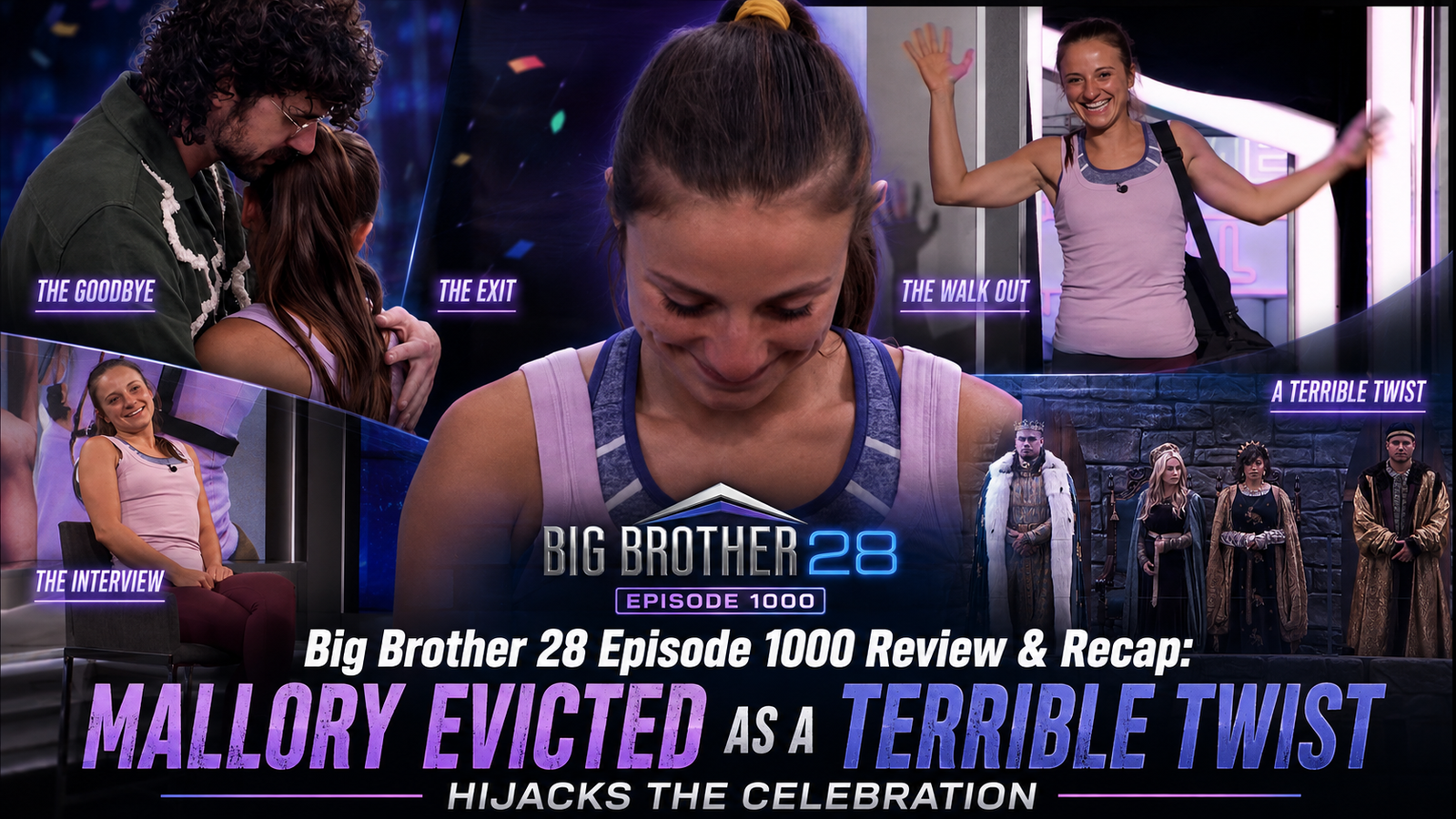
Big Brother 28 Episode 1000 spent a large part of its anniversary celebration reminding us how good this show can be. Then it ended by announcing that several of the things that make the current game work were about to disappear.
Mallory was evicted 6–2. Drew won the BB Block Buster, escaped the vote Barrett had been trying to organize against him, and then voted out Mallory himself. Angela voted her out, too. Melody and Barrett were the only people who voted to keep her.
Then came the trip to the year 1000: no Head of Household, no veto competition, no Block Buster, and someone’s game ending before the next live eviction. The feeds would stay off until after Sunday’s show.
That is how Big Brother chose to finish celebrating a thousand episodes.
The opening screamed series finale. The ending gave the people who follow the game between broadcasts a reason to turn the television off until Sunday.
Somewhere between all the applause and the next production announcement, there was an actual eviction with actual consequences. That should have been the part the show trusted most.
The Opening Had Series Finale Energy
The retrospective covered fights, twists, blindsides, competitions, disastrous decisions, showmances and winners. Former houseguests were in the audience. There were fan awards, familiar faces and Guinness World Records recognition.
Reaching this milestone deserved acknowledgment. Nobody needed Big Brother to pretend twenty-six years of television had not happened.
But the opening had the energy of a farewell special: look at everything we did, remember everyone you loved, and please applaud the institution.
I wanted an anniversary episode that made me excited about the season still being played.
Instead, the celebration leaned hard into the franchise congratulating itself. The go along, get along gang atmosphere became exhausting because the current season already has enough people treating proximity to an established name like an accomplishment.
For a celebration this large, I also wanted the earliest seasons to feel more central. Janelle’s presence mattered, but a greatest-hits montage is not the same experience as hearing more from the people who built those first few years.
The issue is what the broadcast chose to emphasize. An audience full of alumni cannot substitute for a compelling episode happening inside the house.
The Cookout Won Favorite Alliance. That Does Not End the Argument.
The category was Favorite Alliance, and the Cookout won the fan vote. That wording matters. A popularity award does not establish an objective ranking of the best alliances ever assembled.
My objection to the Cookout has always included the decision to make race a condition of membership in its core alliance. I consider that exclusion discriminatory. The goal of securing a Black winner explains why the alliance formed; it does not require me to approve of that organizing principle.
Its members’ achievement still has to be described accurately. All six reached the final six, and the alliance secured a Black winner of the regular U.S. series. Keeping that many people committed while maintaining relationships outside the group took coordination and discipline.
But effectiveness, entertainment value and the best decision for every individual member are separate questions.
A group can accomplish its shared mission while leaving some members with a worse path to the money. It can dominate a season and still make that season less interesting to watch. Viewers are allowed to acknowledge the accomplishment without enjoying the experience.
That is the discussion these celebrations usually flatten. Everything becomes a trophy, a highlight package and another round of applause.
I would have voted differently. The Cookout winning Favorite Alliance does not make disagreement with that choice an inability to understand what happened in BB23.
Dan Won Favorite Winner. Dr. Will Still Has My Vote.
Dan winning Favorite Winner is understandable. His BB10 victory ended with a unanimous 7–0 jury vote, and his ability to recover from danger is a major reason people still talk about him.
But Dr. Will remains my choice.
Will won BB2 without winning Head of Household and without a Power of Veto available. He was nominated four times. The record does not need to become “almost every week” to make the argument impressive.
Once he was on the block, there was no veto competition waiting to give him another way out. He had to make keeping him seem preferable to keeping the person beside him. His influence came through relationships, manipulation and how other players assessed their own interests.
That is an extraordinary foundation for a winning game.
The absence of a veto does not automatically settle the comparison, because everyone in BB2 played under that format. Dan navigated a different game with different tools, and his unanimous victory deserves its place in the argument.
Still, a fan poll does not close the debate.
There is another distinction worth keeping straight: Dan’s Funeral happened in BB14, which he did not win. It absolutely belongs in a discussion of his career. It is not part of his BB10 winning season. Fans choosing their favorite winner can consider both appearances; anyone ranking the strongest winning game needs to separate them.
My vote stays with Will. Dan’s trophy does not erase the case.
Janelle Had a Case. Danielle Had the Stronger One.
Janelle received both Best to Never Win and Favorite Comp Beast.
The competition award is easy to understand. Her consecutive third-place finishes in BB6 and BB7 made her one of the defining players of that era. Her popularity came from surviving pressure, winning when she needed to and giving the audience a personality it wanted to follow.
There is a legitimate case for her.
For Best to Never Win, I still would have chosen Danielle.
Danielle reached the BB3 final two through a strategically valuable, largely concealed partnership with Jason. Her social positioning and information management were central to that run. Evicted jurors could watch the broadcasts, including her Diary Room commentary, before voting; the following season introduced a sequestered jury.
That history gives her candidacy a different weight. She helped define a style of Big Brother built on relationships that did not look like an alliance from the outside, while telling the audience what she was actually doing.
That does not erase Lisa’s victory or mean Danielle handled every part of the game perfectly. It does mean that this category deserved more than an assumption that the most beloved competition performer was also the strongest player without a win.
And yes, seeing Danielle passed over stings. Whatever anyone thinks of her later appearances or her relationship with the franchise, her BB3 game should not need another round of smiling, showing up and playing nice to remain central to this conversation.
She does not owe the franchise more loyalty to make that résumé matter.
The fans chose Janelle. I disagree with the result. A vote for Danielle would have recognized a different kind of excellence, and it is the kind I value more in this category.
The Best Memories Explained Why the Current Game Deserved More Time
Dan’s Funeral won Favorite Moment. Rachel’s “Floaters, grab a life vest” won Most Iconic Quote. The retrospective and record presentation gave the anniversary its historical context.
Those memories also exposed the problem with the evening’s priorities.
People remember a desperate player talking his way out of danger. They remember personalities colliding, loyalties cracking and contestants making decisions that immediately change the house.
BB28 had its own version of that tension waiting: Barrett was questioning whether protecting Drew meant continuing to protect the Icons, while Mallory was discovering how little her place in Mosh Pit guaranteed her.
That story did not need a trophy or a medieval setting.
It needed room.
Mallory’s Nomination Finally Forced Barrett to Choose
Once the episode returned to the current house, the reaction to Mallory’s replacement nomination supplied the conflict the anniversary packaging could not manufacture.
Mallory was furious with Dee. Melody was prepared to keep Mallory over Drew. Barrett was frustrated with Dee’s handling of the week and increasingly uncomfortable with what his relationship with the Icons was costing him.
Devens understood the danger. Changing the target required care because the Icons risked losing Drew and Barrett along with Mallory’s trust.
That was the actual strategic problem: how much damage could the Icons do to their wider alliance before its other members stopped accepting it?
Barrett eventually told Mallory she was the target. Then he brought Mallory and Melody together, raised the problem of Drew’s positioning and pushed the possibility of sending Drew out against the Icons’ wishes.
That would not have removed an Icon directly. It could have removed a player helping keep their structure intact, while proving they did not control every eviction.
Barrett was finally confronting something this house has spent too long avoiding. Being included in an alliance does not mean the alliance’s decisions are designed to benefit you.
His frustration mattered because he started translating it into a voting plan. Unfortunately, that plan still depended on Drew remaining eligible for eviction.
Drew Won BB Lackluster and Killed the Blindside
The BB Grand Cliptacular put Drew, Mallory and Taylor into a challenge involving clues and clips displayed across different screens. They had to identify the correct screen and submit the answer.
It fit the anniversary theme. It also required attention and speed rather than simply rewarding the strongest body in the room.
Drew won. Give him credit for saving himself under pressure.
And there went the blindside butterbeans.
Barrett could organize votes against Drew, Melody could agree to cut him, and the Icons could finally be facing a result they did not want. None of it could remove somebody who was no longer on the block.
The final choice became Mallory or Taylor.
Calling it BB Lackluster captures how deflating that result was to watch, but disliking the outcome is not evidence the competition was rigged. Drew won an established safety competition. The frustration is what his win prevented: a test of whether Barrett’s rebellion had enough support to survive an actual vote.
The house returned to the eviction with a different decision in front of it. Anyone judging the votes has to judge that decision, rather than the Drew eviction that could no longer happen.
Angela’s Vote Told Mallory Where She Ranked
Angela voted to evict Mallory.
For someone who had treated Angela as a close connection, that was the clearest answer Mallory was going to get about where she stood.
Friendship does not obligate someone to keep you in Big Brother. Betrayal is part of the game. But viewers do not have to pretend the betrayal becomes emotionally meaningless because the person casting the vote has a strategic explanation.
Angela chose the outcome Dee and Devens wanted over keeping Mallory.
That is the point the rest of the house keeps learning after it becomes expensive: the relationships around the Icons can be real, and the Icons can still put each other first.
Mallory’s connection with Angela did not outweigh that priority. The vote made the hierarchy visible in a way another reassuring conversation never could.
Drew Saved Himself, Then Helped the Icons Cut Mallory
Drew’s vote was the one that made me roll my eyes hardest.
He survived the block, then entered the Diary Room and voted to evict Mallory. After everything Dee had done to the people around him, he still helped deliver the result her side wanted.
It looked weak. More specifically, it looked like another opportunity to establish independence that Drew decided was not worth taking.
There is a defense available: Mallory was leaving, and Drew may have considered a minority vote an unnecessary risk. That is a possible strategic explanation, not a confirmed account of his thinking.
But avoiding friction with the majority also has a price. Mallory was another relationship outside the Icons’ central trio. Losing her reduced the alternatives around Drew, and his vote gave Melody and Barrett another reason to question whether he would choose their interests when the choices became uncomfortable.
The arithmetic matters, too. Drew did not single-handedly evict Mallory. If only his vote had changed, she still would have left, 5–3.
His vote mattered as a statement of priorities. Blaming him for personally deciding a six-vote eviction would overstate his influence almost as badly as his game has overstated his independence.
Melody and Barrett Were the Two Votes That Matched Their Promises
Mallory received eviction votes from Angela, Drew, Yash, Haley, Devens and LaLa. Melody and Barrett voted to evict Taylor.
That made the result 6–2.
Whatever else there is to criticize about Melody and Barrett’s earlier decisions, they did not abandon Mallory when the vote arrived. Barrett’s resistance to the target switch survived the competition result, even though his larger plan to remove Drew did not.
The remaining votes also deserve more analysis than calling everyone obedient.
Yash and LaLa were choosing between Mallory and Taylor, a player with whom they had their own strategic connections. Keeping Taylor could serve their interests while also producing the outcome the Icons wanted. Voting together on one eviction does not prove everybody has the same alliance or the same reason.
That makes Drew’s position more frustrating, not less. He had a substantial connection to Mallory and still joined the six votes sending her out.
The people who stayed loyal to her were the two sitting on the losing side of the count.
Mallory’s Exit Made Her HOH Mistake Impossible to Ignore
The tears after Drew’s win gave the eviction its emotional weight. Julie told the houseguests they were appearing in the milestone episode, Mallory and Taylor made their final appeals, and Mallory left after fifty-two days in the house.
She received a standing ovation. In her exit conversation, she acknowledged that she had not tried as hard in the HOH competition.
That admission belongs beside every complaint about Dee’s choices.
Mallory did not deserve a guarantee that another player would protect her simply because she felt comfortable letting that player have power. And easing off did not guarantee Dee would win, either. It meant Mallory had not done everything she could to control her own position.
There is no way to know that trying harder would have made her HOH. The mistake was accepting less effort as sufficient while relying on a structure that was already showing cracks.
Her anger at Dee made sense. Her disappointment with Angela and Drew made sense. Those reactions do not erase her responsibility for trusting the wrong arrangement.
The applause was a warm send-off. It could not give her the competition or the week back.
Big Brother 28 Episode 1000 Ended by Taking Away the Usual Game
Julie announced that the houseguests would travel to medieval times, the year 1000, for the next phase.
No Head of Household.
No veto competition.
No Block Buster.
Someone’s game would end before the next live eviction.
That is a major change to the structure the remaining players have spent weeks navigating. It also leaves the most consequential question unanswered in the announcement: exactly how does somebody lose their place in the game?
A theme is decoration. An elimination mechanism determines whether someone still has a chance at the prize. Announcing the former does not adequately explain the latter.
I have no interest in calling this brilliant just because the show can say it has never done this exact combination before. On the information announced, it is one of the worst directions the season could have taken at this moment.
And before anyone points to BB2, yes, Big Brother existed before the veto. Will’s season had an established HOH-and-eviction structure. This criticism concerns a midseason suspension of the current format, with another elimination promised before the replacement process has been clearly explained to viewers.
Novelty does not make that a satisfying anniversary gift.
The Twist Gives the #PIFE Criticism Plenty of Fuel
The timing is what makes this so irritating.
The house had finally produced an organized attempt to resist the Icons’ preferred outcome. Drew’s competition win stopped that particular plan. A normal next round would have given the remaining players another chance to win HOH and act on the relationships this eviction damaged.
Instead, the familiar route to power disappeared for the announced medieval phase.
After the Diamond Veto and the BB Bribe had already affected the Icons’ position, another dramatic change naturally invites the #PIFE reaction. The show has given skeptical viewers plenty of reason to question how often twists interrupt the consequences players would otherwise face.
But the criticism needs to stay accurate. Nothing announced proves that an Icon is immune, that production chose a particular person to save, or that this format will necessarily help the trio. Removing veto and HOH opportunities also removes opportunities they could have used themselves.
We do not yet know who benefits most.
What we do know is that the show interrupted the established game just as the next contest for power had a clear, interesting story behind it. That decision deserves criticism without pretending an unannounced outcome has already happened.
If an Icon ends up losing under the twist, that would not automatically make the design good. The standard should be whether the rules produce a coherent, credible competition, regardless of whose favorite survives.
Three Days Without Feeds Is a Miserable Anniversary Gift
The feeds would remain unavailable until after Sunday’s show.
Roughly three days without feeds, immediately after a contested eviction and during a major format change. That is a wild way to thank the audience for staying with Big Brother through a thousand episodes.
The feeds are how viewers follow decisions before they are condensed into an episode. They let us see relationships change, competing versions of a conversation and the difference between what somebody tells the Diary Room and what they actually do.
This was precisely when that access mattered.
How would Melody respond to Drew voting out Mallory? Would Barrett keep pushing against the Icons? Would people who agreed on evicting Mallory remain aligned once the next decision arrived?
Those were immediate questions created by the players. The show answered them with a waiting period.
A blackout does not prove production is hiding wrongdoing. It does mean viewers lose the contemporaneous access that makes this format different from an ordinary edited competition show.
The go along, get along gang got its celebration. The feed audience got told to come back Sunday.
What the Episode Got Right
Barrett’s resistance was the strongest part of the current-game story because it developed from identifiable damage to his relationships. Dee’s target shift had consequences, and Devens recognized that managing those consequences mattered.
Melody’s willingness to prioritize Mallory made her position clear. The 6–2 eviction showed that those loyalties survived the final decision instead of disappearing into a unanimous vote.
Drew’s competition win mattered. Mallory’s reaction mattered. Her exit admission about the HOH mattered because it connected her disappointment to a decision she had made herself.
The standing ovation gave her a generous reception after an ugly week.
And a milestone retrospective had a legitimate place in the broadcast. Seeing the history was not inherently the problem. The problem was how much more confidently the episode celebrated past gameplay than it trusted the current game to carry the ending.
There was enough material here for a strong Big Brother episode.
Where the House Actually Stands
Mallory is out, and ten houseguests remain: Angela, Barrett, Dee, Devens, Drew, Haley, LaLa, Melody, Taylor and Yash.
Dee’s second HOH ended with Mallory leaving. LaLa’s veto had already saved LaLa, and Drew’s Block Buster win left Taylor beside Mallory for the final vote.
The Icons are intact. Melody has lost her closest partner. Barrett has shown that he will oppose their preferred target. Drew is still in the house, but his vote supplies another concrete reason for people outside the trio to question his priorities.
Taylor survived. Yash and LaLa helped keep her. That does not settle their relationships with everyone else going forward.
The announced medieval phase does not have a conventional HOH, veto competition or Block Buster. An additional elimination is coming before the next live eviction, but its full mechanism and eventual result were not established here.
Yash’s bribe restriction was tied to his next HOH. It should not be stretched into a claim that the Icons have blanket protection under every possible replacement format. The announcement did not resolve that interaction.
The next scheduled point for feed access is after Sunday’s broadcast. Until then, the uncertainty belongs in the coverage instead of being filled with invented results.
Final Thoughts
Big Brother 28 Episode 1000 had a useful story sitting underneath all the celebration: people were finally being forced to decide whether their anger at the Icons meant anything when it became time to vote.
Barrett tried to organize a move. Melody chose Mallory. Drew won his safety and then chose the majority. Angela showed exactly where Mallory ranked. Mallory left having acknowledged that she had not fought as hard as she could for power.
Those are the decisions worth examining. They explain the eviction, and they would have made the next ordinary HOH competition worth watching.
Instead, the anniversary ended with an unexplained elimination process replacing the usual structure and the feeds disappearing for the weekend.
The awards were fan preferences, and I disagreed with several of them. The nostalgic tone felt far too much like a farewell. But the biggest disappointment was how quickly the show moved from celebrating the history of its game to putting the current version on hold.
If Big Brother wanted this milestone to remind us why we keep watching, the answer was already inside the house.
Let the players deal with the consequences of their choices. Let the next struggle for power develop. Let the audience watch it.
Episode Grade: D−
Barrett’s attempted rebellion, the split eviction vote and Mallory’s exit gave the episode substance. Drew also earned his safety, however frustrating the result was for anyone hoping for a blindside.
But the extended self-celebration, the poorly explained format change and the weekend feed blackout overwhelmed those strengths. This grade is for the episode and the twist announcement we received, not an elimination that has not happened yet.
Big Brother’s thousandth episode deserved an ending that showed confidence in the game people spent twenty-six years following.
Make sure to subscribe to our Late Night Crew Youtube Channel. Follow @yorkjavon, @kspowerwheels, @MS_MISCHA & @LateNightCrewYT on X.
Leave a Reply